Banned for Building: What PewDiePie's OpenAI Suspensions Actually Reveal
Felix Kjellberg, the creator the internet knows as PewDiePie, has spent the past few weeks building something most of his 111 million subscribers will never touch: a small model of his own. Ajax is a fine-tuned 9 billion parameter assistant for Odysseus, the self-hosted AI workspace he released earlier this year. It browses, takes notes and manages a calendar without sending your data to anyone else's server.
He also says OpenAI banned his account twice while he was making it. The first suspension, according to an email he showed on camera, cited "Distillation". He appealed, was reinstated, ran the process again to generate seed data, and was banned a second time. His reaction to that second ban is the line everyone is quoting: "How did they even know?"
That is the news. The interesting part is the rule it rests on, because that rule sits underneath almost everything the AI industry now sells.
The rule doing the work
Distillation is using one model's outputs, or its hidden reasoning, to train another. OpenAI's terms prohibit using its output to develop models that compete with OpenAI, and the company enforces that clause automatically, against anyone who trips its thresholds.
To be precise: the account of the two bans is Kjellberg's own, backed by a screenshot of the first suspension email. OpenAI has not confirmed the details. The clause itself is real, and the pattern matches what other developers have reported.
If distillation is theft, what do we call the training run that gave the model its answers in the first place?
The clause, in one line
Using output to develop models that compete with OpenAI.
Hover to see what it does not say: nothing about scale, nothing about intent. A 9 billion parameter desk assistant is swept up by a rule written for rival laboratories.
The same move, two verdicts
Here is the asymmetry that makes people stop scrolling. A frontier lab absorbs the public internet, everything people wrote and published without being asked, and turns it into a product. A creator then asks that product a question and uses the answer to teach a model of his own, and the account gets cut.
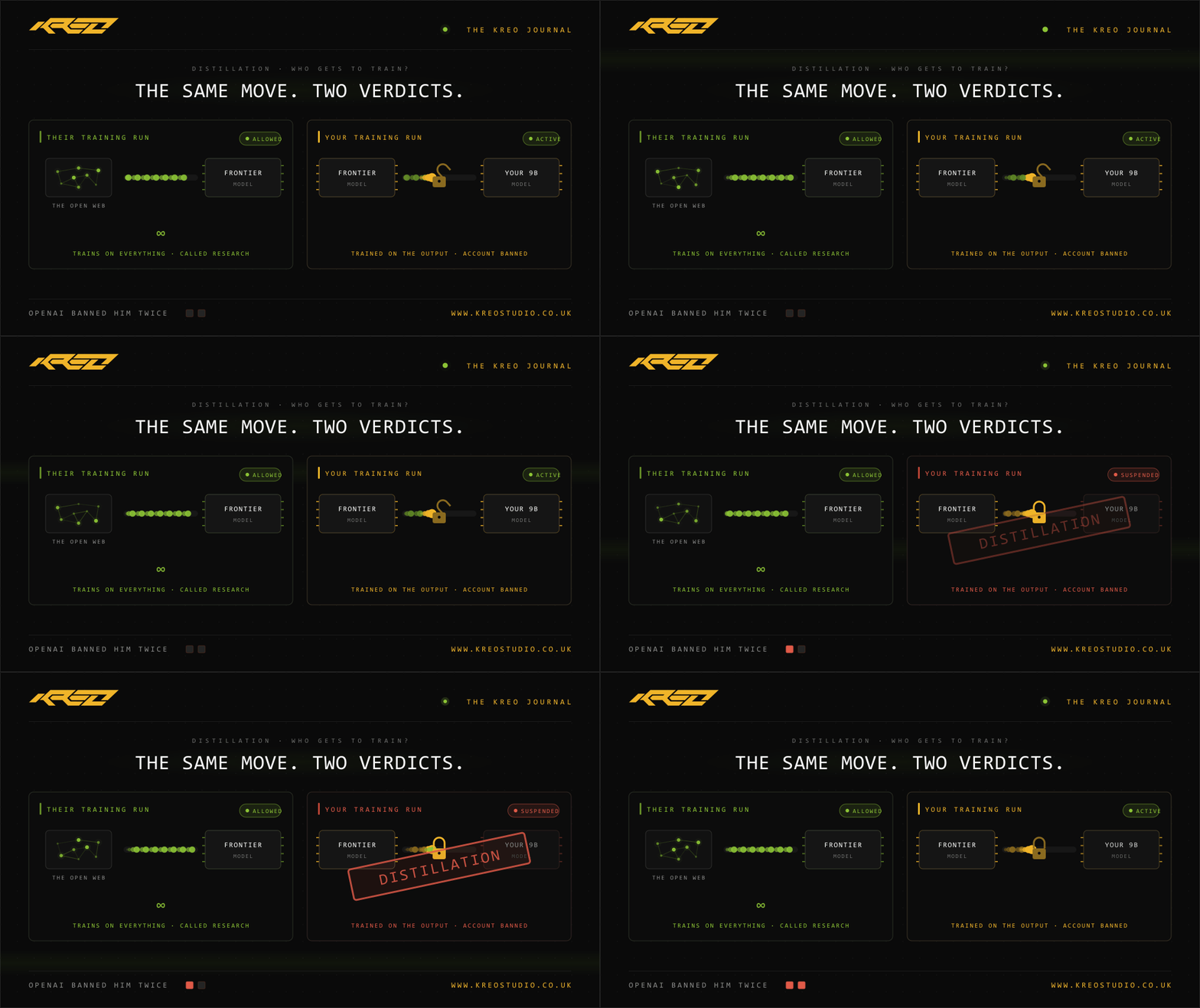
Both processes are, mechanically, learning from examples. One is called research, the other is called theft. The difference is not the method. It is who owns the pipeline.
Why I side with the builder
I build local and on-prem AI for a living, and I have spent enough evenings staring at a sandbox error I did not cause to recognise the feeling in that video. The instinct to build is not a threat. It is the thing open source is made of, and a rule that treats every ambitious builder as a suspect punishes the people who would extend the technology.
I agree with Kjellberg on the principle. If you buy access to a tool and point it at your own project, you should be able to train on what comes back. His model is not a competitor to GPT. It is a small assistant for his own desk. Calling that a national security event, while the frontier models themselves were trained on all of our output, is a difficult position to defend with a straight face.
The honest counterpoint
There is a real argument on the other side, and it is not only corporate self interest. Adversarial distillation can strip the safeguards off a model and reproduce its capabilities cheaply, and OpenAI disclosed a coordinated campaign of exactly that kind in late September. Reasoning tokens are hidden for a reason: they can reveal more than the finished answer, and extracting them is not the same as asking a question.
So a line has to exist somewhere. The problem is where the industry has drawn it, so far toward the provider that ordinary builders are caught in enforcement meant for rivals. A clause written to stop laboratories copying a flagship should not be the same clause that switches off a creator's account.
Readout: what is actually confirmed
- PewDiePie (Felix Kjellberg) released Ajax, a fine-tuned Qwen3.5-9B model for his self-hosted Odysseus workspace.
- He says OpenAI suspended his account twice; an email he displayed cites "Distillation" for the first ban.
- He appealed and was reinstated, then suspended again after generating more seed data.
- OpenAI's terms bar using its output to build competing models, enforced automatically.
- In late September, OpenAI separately disclosed and disrupted a coordinated distillation campaign.
- Ajax is not yet downloadable; its page was still collecting training data on 2 October.
What this means if you build
The practical lesson is the one I keep repeating to clients. Do not rent the layer that decides what you are allowed to make. Keep your models local where you can, keep your evaluation harness free of any single vendor, and keep your options portable, because the terms you accept today are the permissions you will not have tomorrow.
Kjellberg built his own anyway, then started the next version. That is the part the ban did not stop, and the part worth copying. People who own their pipeline get to keep building when the rules change.
If you are weighing up where your own models should run, and what it would take to keep that choice, email brandon@kreostudio.co.uk.
Reader signal
Was this useful?
Work with KREO Studio
AI engineering, data science and design architecture, from Plymouth to the wider UK.
