This Is Not a General AI Detector
Google has opened its watermark detector to everyone. Upload an image, a video or a clip of audio and it will tell you whether the file carries Google's invisible mark. The catch is printed on the tool itself: it is not a general AI detector.
On Tuesday, Google switched on synthid.com for the world, in English, for anyone with an account. Since 2023 it has been hiding SynthID, an invisible watermark, inside media made by its own models. Now you can bring a file to the portal and get a straight answer: was this made, or altered, by Google or one of its partners?
The partner list is the real story. It is not just Google. OpenAI, NVIDIA and Kakao sign their AI media with the same invisible ink, and Apple is next. For the first time there is a single place to check watermarks from several of the largest labs at once.
What it can actually see
Google says it has watermarked more than 180 billion images and videos, and 240,000 years of audio. The detector gives a plain yes or no. The same check already runs inside Search, the Gemini app and Chrome, where Google says it handles about a million requests a day.
I mapped the guest list
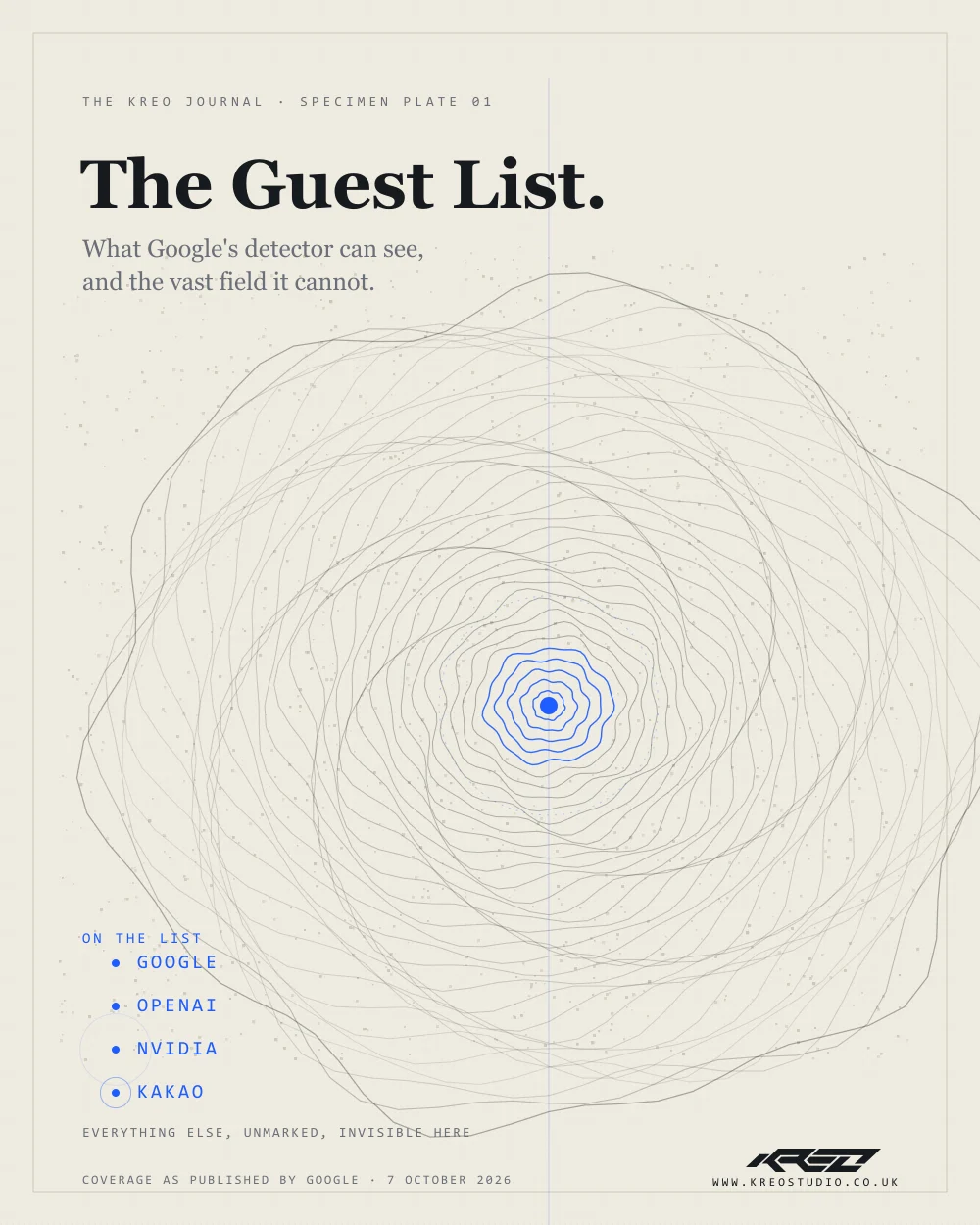
I downloaded Google's announcement and the detector's own notes, then mapped what it can see against the tools people actually reach for. The covered list is short. Google's own models lead it: Gemini and Nano Banana for images, Veo for video, Lyria for audio. Then OpenAI's images, NVIDIA's Cosmos video, and Kakao, with Apple next. Almost everything else is invisible to it, because those makers never joined the club.
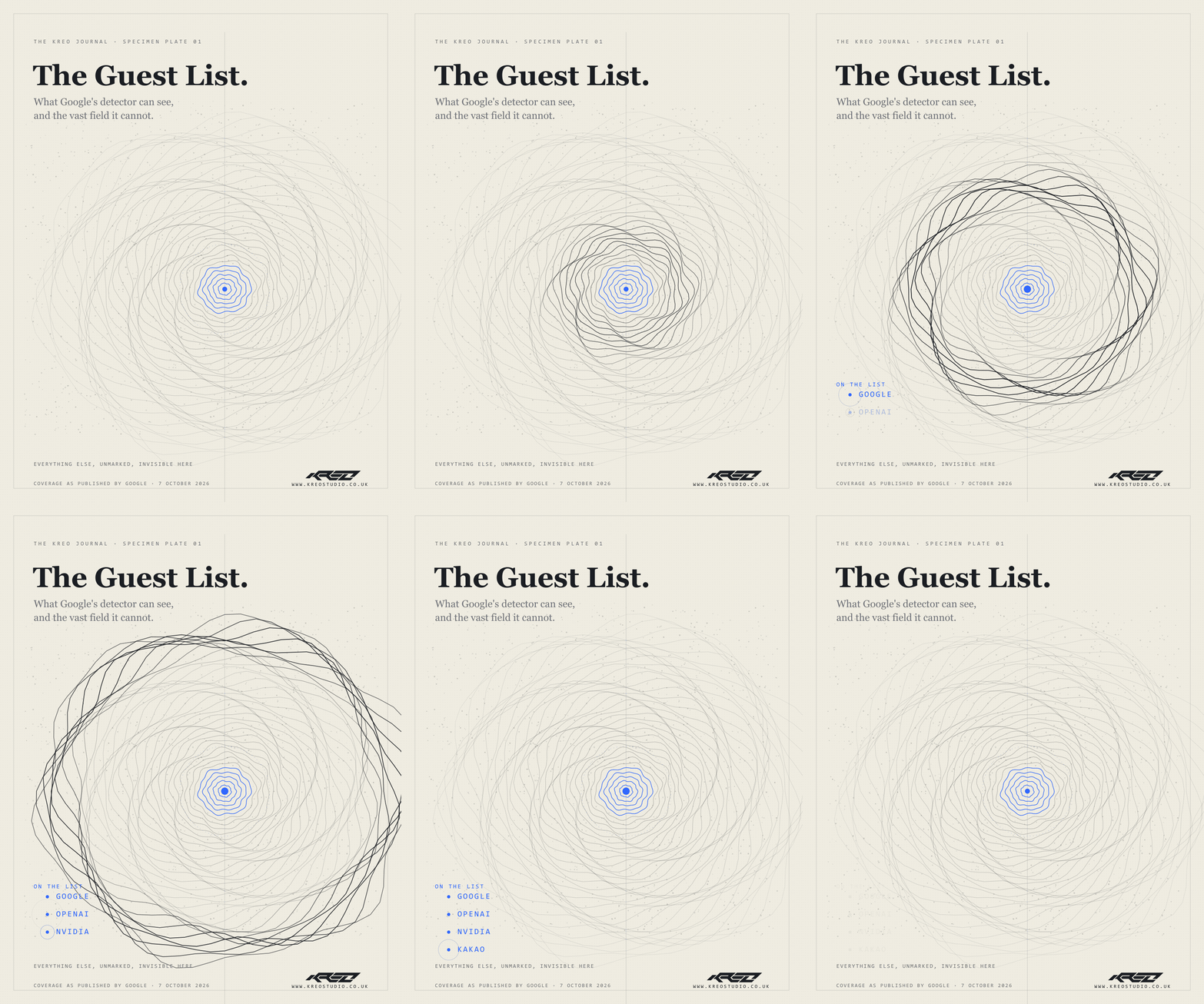
You can see the shape of it below. Coverage is not a switch; it is a list you assemble, lab by lab, and it only ever covers the names on it.
Interactive · build the guest list
Turn on a lab, and its marks appear.
Tick each maker that signs its AI media with SynthID. Only the files on the list answer. The grey field never does.
Every lab you add widens the blue. Nothing widens the grey.
The hole in the middle
Here is the sentence the tool puts on itself: "This is not a general AI detector." It only knows media from companies that signed up. A Midjourney render, a Stable Diffusion still, or the output of a model running on your own laptop sails straight through with no mark, not because it is authentic but because its maker is not on the list. If you read a blank result as a clean bill of health, the tool has done the opposite of its job.
A watermark you can trust is useful. The photo that carries nothing is the one to worry about.
The honest counterpoint
Google is careful to say all of this, and the design is honest. SynthID is a provenance signal, not a lie detector, and getting rivals to share one portal is genuine progress. The marks are built to survive cropping, filters, dropped frames and compression. Text is the odd one out. Google watermarks Gemini text separately and leaves it out of this detector, and OpenAI's own testing found that swapping a quarter of the words in a passage drops detection from about nine in ten to under two in ten. Words are the easiest thing to fake and the hardest thing to tag.
What would change my mind: an independent test showing the marks survive a round trip through a social network, and a detector willing to say "unknown" instead of staying silent.
Readout: what is confirmed, and what is not
- Confirmed (Google, 7 Oct 2026): the SynthID Detector at synthid.com is open globally in English; it checks images, video and audio from Google, OpenAI, NVIDIA and Kakao, with Apple coming. It is not a general AI detector.
- Confirmed (Google): over 180 billion images and videos and 240,000 years of audio watermarked since 2023; the check runs in Search, the Gemini app and Chrome at about a million requests a day.
- Reported (Ars Technica, The Verge, TechCrunch, 7 Oct 2026): a sign-in is required (Google, OpenAI or Apple accounts) and each user gets roughly ten checks a day.
- My own check (7 Oct 2026): the images Google published alongside the announcement carry no SynthID or Content Credentials metadata, because the mark is in the pixels, not the file. I mapped coverage from Google's own materials; the list above is Google's, not mine.
- Unconfirmed: whether any given mark survives a specific edit or platform re-encode, and how well detection holds outside the lab.
If you are working out which parts of your stack you can actually trust, email brandon@kreostudio.co.uk.
Sources & references
- We're making it easier to identify AI-generated content globally, Google, 7 October 2026.
- Google SynthID, Google DeepMind, read 7 October 2026.
- Google rolls out improved SynthID AI content detector, Ars Technica, 7 October 2026.
- Google's AI content detector is rolling out globally, The Verge, 7 October 2026.
- Google's new SynthID website can identify AI-generated media, TechCrunch, 7 October 2026.
Reader signal
Was this useful?
Work with KREO Studio
AI engineering, data science and design architecture, from Plymouth to the wider UK.
Next Article
