The Open Panel
On the 19th of October 2026, Reuters reported that a Chinese-speaking hacker had used an open-source AI platform called Cairn to break into more than 100 websites, including Deere, SharkNinja and Cummins. The agents did almost all of the work. A researcher watched through the attacker's own control panel, which was open to the internet.
Key · companies amber, places red
Snorre Fagerland did not break in. He went looking for open doors. From the 2nd of October, the NorForge researcher scanned for reachable Cairn servers, found about two dozen, and watched. One operator ran a campaign against more than 1,200 e-commerce sites in the United States, Canada, Australia and Japan.
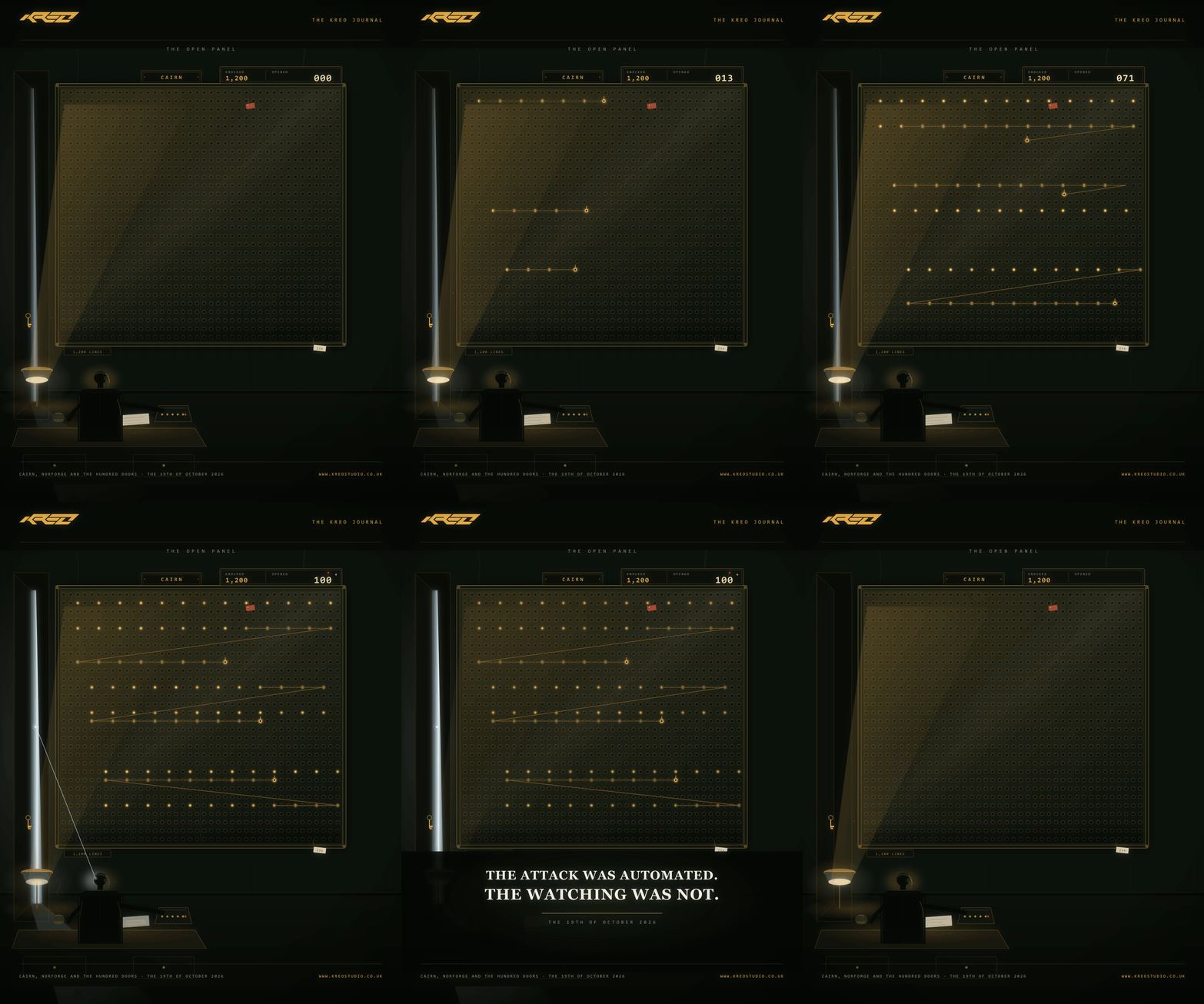
Start with the numbers. More than 100 sites fell. A successful intrusion took about 23 hours. Fagerland estimated the campaign cost at about $5,000 in model tokens, or roughly $50 per breach. One person, a few thousand dollars, and a workforce that does not sleep.
The unit of cybercrime is no longer the hacker. It is the panel.
The board
Cairn is not a bespoke hacking tool. It is a general-purpose problem-solving engine: give it an origin and a goal, and agents search for a path. They write what they find to a shared board of facts, intents and hints. Each worker reads the graph, acts, and posts the result. They coordinate by leaving notes, not talking. An agent can die; the notes remain. It is a queue with memory.
The README says the team was the only one to solve all 54 problems at a Tencent Cloud penetration-testing challenge.
The door
In one intrusion, the agents found no weakness in a large company's public application. They went looking for the infrastructure behind it, found a public control panel, and found a subtle flaw in how it processed data. After hours of trial and error, they talked the server into running their commands. “It's not straightforward to come up with solutions like that,” Fagerland said. “It's not script kiddie stuff.”
The panels were not breached. They were found. Fagerland scanned for Cairn servers reachable from the open internet; about two dozen were, and he judged more than 20 malicious. NorForge's Trufflehog scan verified 11 per cent of the exposed secrets as valid.
Interactive · the panel
What a stranger could read.
Readable. None of it hacked.
What the code says
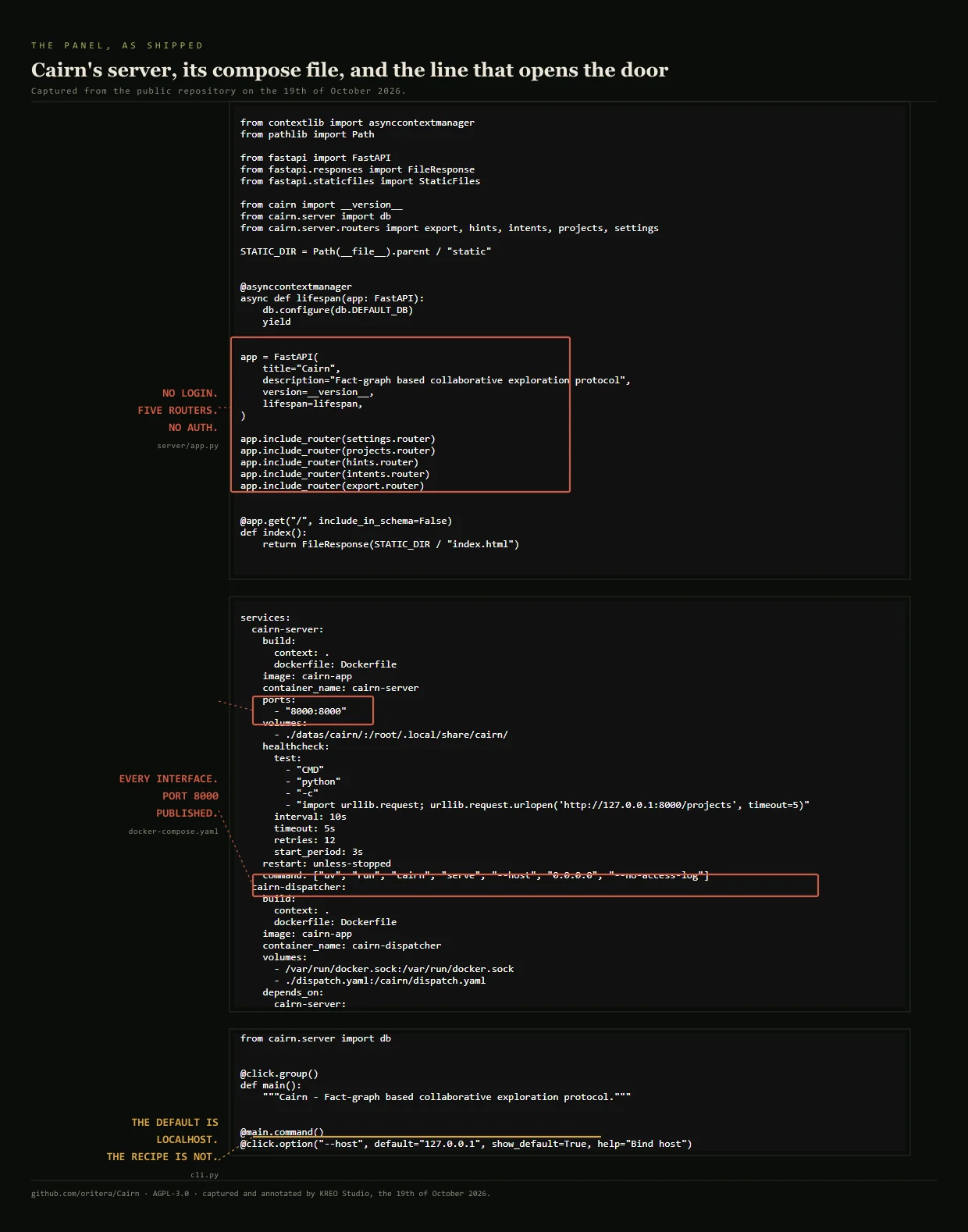
I downloaded and read the shipped code. The command-line server defaults to 127.0.0.1. The Docker recipe in the README runs cairn serve --host 0.0.0.0 and publishes port 8000. The app mounts five routers and asks for no authentication. There is no login screen to misconfigure. The panel is the perimeter. The easiest way to run it puts that perimeter on every interface.
The exposure is a deployment choice, not a hidden one. A careful operator can bind it to localhost or put it behind a proxy. The recipe is the problem: it makes the open version the default path. That is how a tool becomes a window.
What it costs
Deere said it took “necessary remediation actions” and had “no indication that sensitive information was accessed”. SharkNinja said the attack hit a standalone product-support site and was contained. Cummins said it was investigating a third-party vendor's site. Reuters could not establish how much data, if any, was taken.
The campaign rented a workforce by the token, and did not sleep, did not get bored, and did not need a share. At that price, the constraint is no longer skill. It is target selection.
What the window does not show
This is one firm's view through a window the attackers left open. The 100 is a floor, the $5,000 is his estimate, and “Chinese-speaking” describes a keyboard, not a passport. Cairn's author, le1xia0, says the platform was not designed for attacks. That is true. It is also not a defence: a general engine does not choose the goal.
The operation was visible because it was careless. The next campaign will close its panel. The agents will still be cheap; the watching will get harder. The lesson is not that AI can hack. It is that the panel running the agents is now the softest door in the building.
The attack was automated. The watching was not. If you run agents and want the panel shut, email brandon@kreostudio.co.uk.
Readout: what is confirmed, and what is not
- Confirmed, from Reuters of the 19th of October 2026: the campaign began on the 25th of September; more than 1,200 sites were attempted; more than 100 were breached; a success took about 23 hours; the campaign used about $5,000 of tokens, or about $50 per breach; Fagerland found about two dozen exposed Cairn instances from the 2nd of October and judged more than 20 likely malicious; Deere, SharkNinja and Cummins were among the victims, and their statements are as quoted.
- Confirmed, from the public repository read on the 19th of October 2026: the CLI default host is 127.0.0.1; docker-compose.yaml publishes 8000:8000 and runs cairn serve with --host 0.0.0.0; server/app.py mounts five routers with no authentication dependency; the README recommends the Docker Compose path. The repository had 3.7k stars, 611 forks and 70 commits at the time of reading.
- Reported, not confirmed by me: the NorForge technical report, which Reuters saw before publication; the 11 per cent valid-secret figure, from NorForge's Trufflehog scan; the Gambit Security report of at least 600,000 card records from 25 companies, cited by Reuters but not read directly; the estimate that the campaign mixed DeepSeek and Claude Code.
- Not confirmed: how much data, if any, was taken from the victims; the full victim list; the attacker's identity or location. 'Chinese-speaking' is the report's description of the operator's language, not a statement of nationality.
- What would change my mind: a Cairn deployment whose public panel was authenticated and still exposed; evidence that the 100 figure counts a different class of access; or a primary NorForge report that revises the cost estimate.
Sources & references
- Reuters, How one hacker used AI agents and a few thousand dollars to break into scores of sites, by Raphael Satter, the 19th of October 2026. Read through the full syndication; the primary returned a 401 from this machine.
- Cairn, the public repository, including server/app.py, docker-compose.yaml and cli.py, read and captured on the 19th of October 2026.
- NorForge, Snorre Fagerland’s technical report on Cairn activity, October 2026, as reported by Reuters. The report itself was not public.
- Deere, SharkNinja and Cummins, statements to Reuters, the 19th of October 2026.
- Gambit Security, the September 2026 report cited by Reuters, not read directly.
Reader signal
Was this useful?
Work with KREO Studio
AI engineering, data science and design architecture, from Plymouth to the wider UK.
Next Article
Asked and Answered
From the KREO Journal · kreostudio.co.uk/blog/the-open-panel · published the 19th of October 2026. Corrections are dated, never silent.
