Open, Then Closed: What Kimi K4 Reveals About Who Owns AI
Moonshot's next model, Kimi K4, is not yet official. What is official is that China is deciding whether to stop giving its best AI away.
On 17 July, Xi Jinping stood up in Shanghai and praised openness. "Encourage open source, openness, collaboration and sharing," he told the World AI Conference.
Four days later, his government was reported to be preparing to close it.
China's Ministry of Commerce had been meeting Alibaba, ByteDance and Zhipu to discuss new export controls, according to the Financial Times. The plan: stop the rest of the world freely downloading China's best AI models. The proposals are still being weighed. The direction of travel is not.
The giveaway that worked
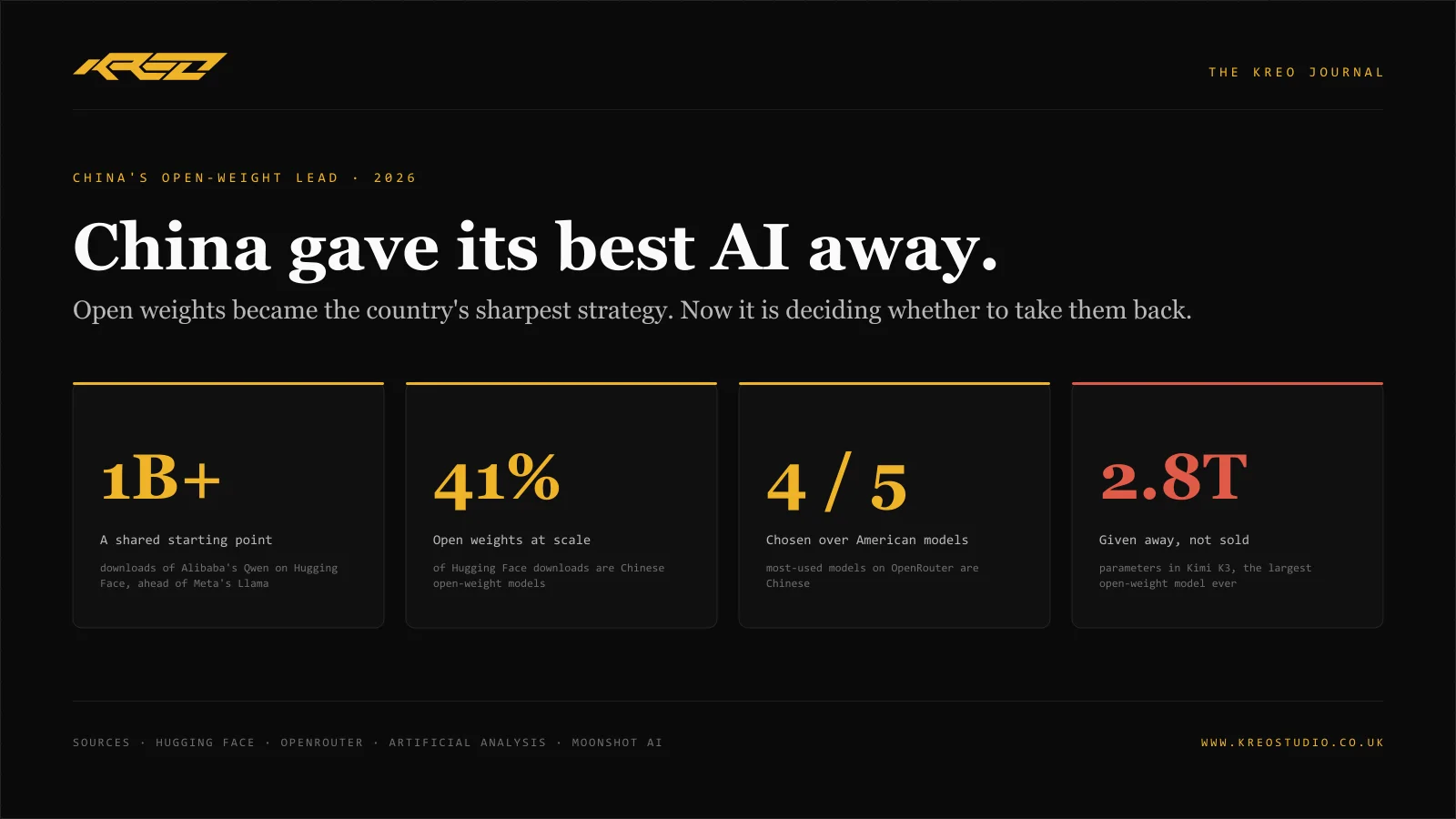
Kimi K3 arrived on 16 July: 2.8 trillion parameters, the largest open-weight system in the world, and Moonshot AI gave it away. Anyone could download it, run it, and build on it for free. Independent testers ranked it third in the world, behind only Anthropic's Fable 5 and OpenAI's GPT-5.6 Sol.
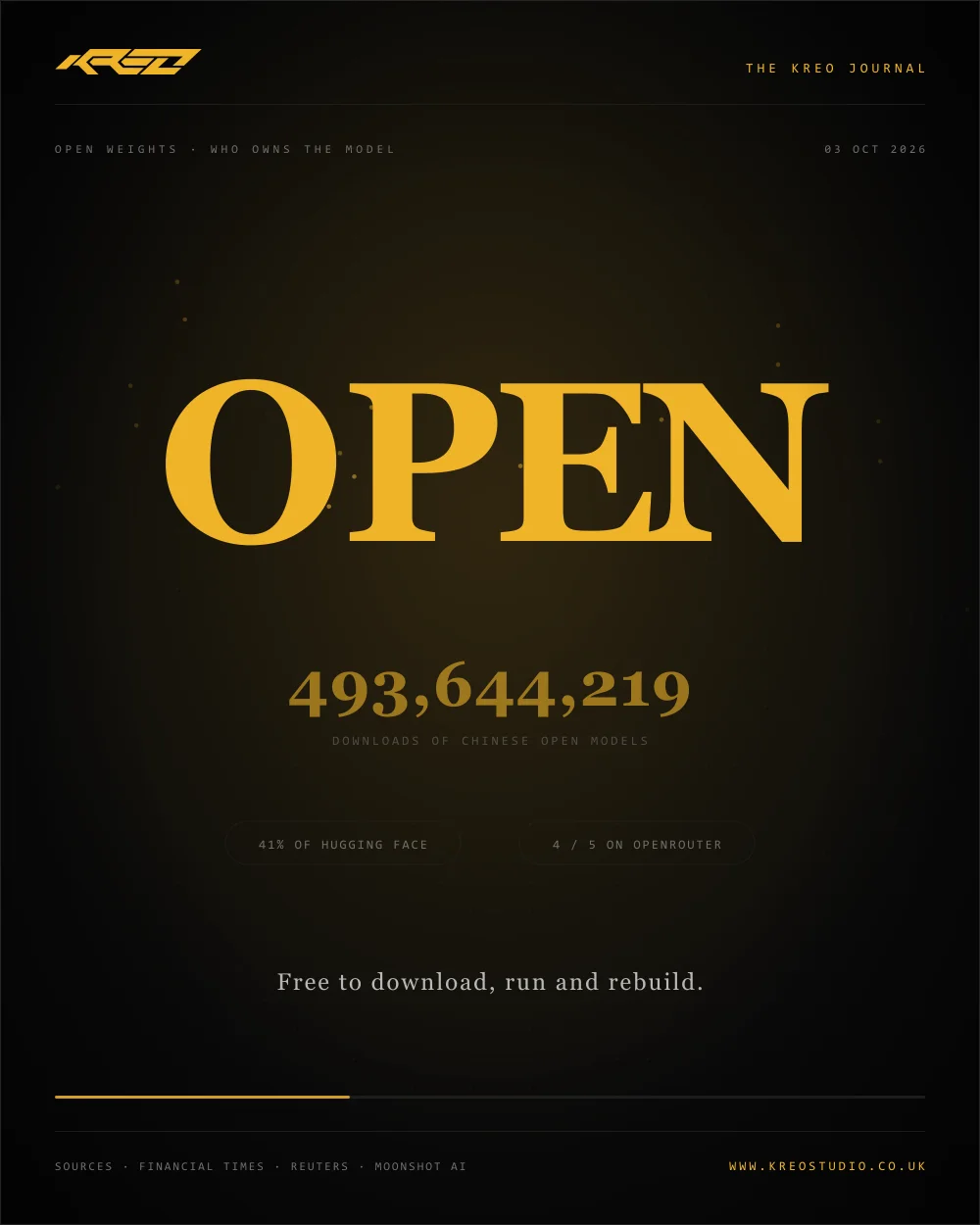
For China, that generosity paid. Alibaba's Qwen passed a billion downloads on Hugging Face, overtaking Meta's Llama as the most-downloaded open model anywhere. Chinese open models now make up around 41 percent of downloads there, according to Hugging Face's spring 2026 ecosystem report, and four of the five most-used models on OpenRouter are Chinese. Western developers became customers of China's free models, because they were good, and because they were cheap.
Openness was not charity. It was strategy, and it worked.
The door begins to close
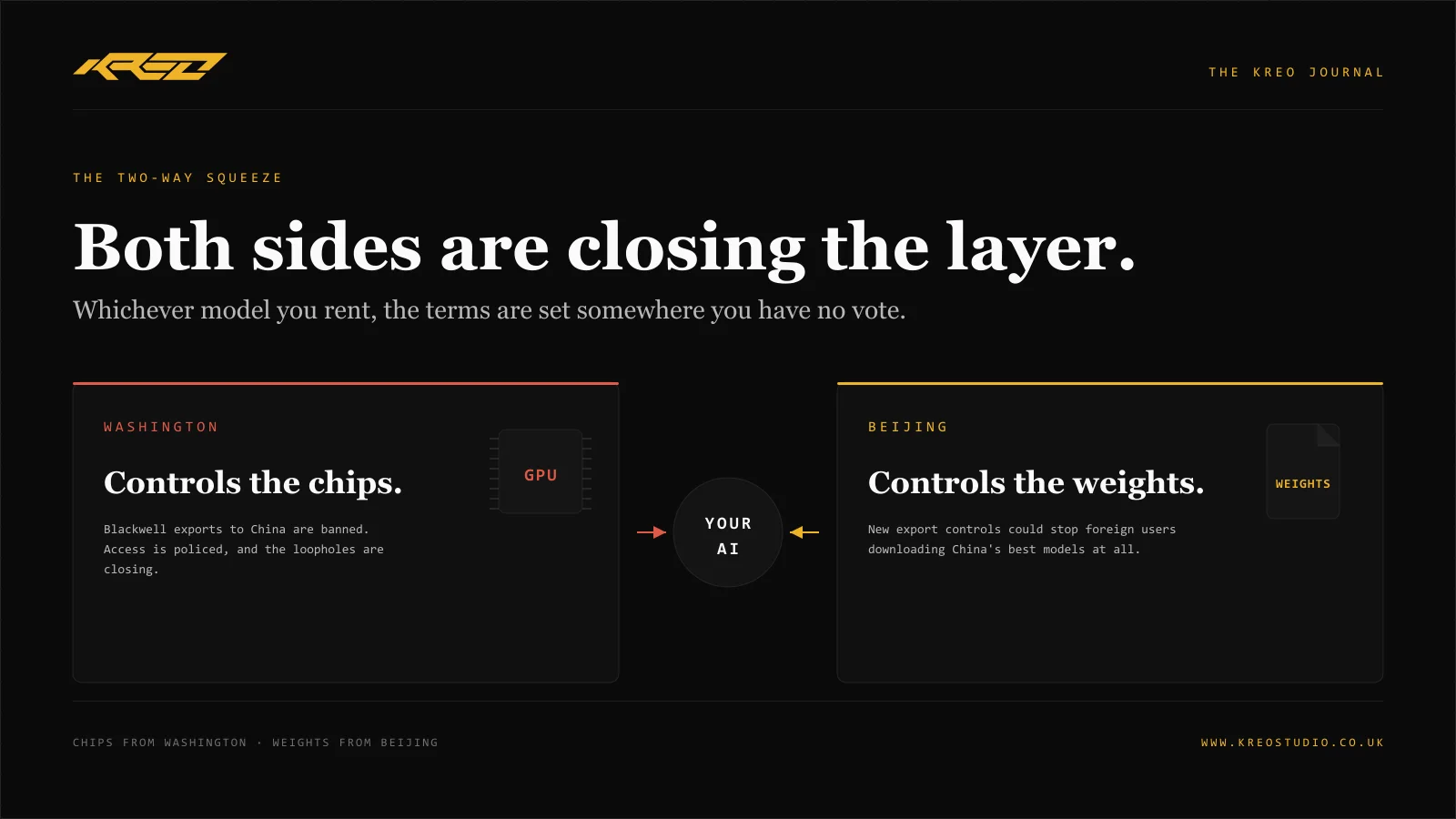
Now Beijing is reconsidering. The measures under discussion would restrict whether foreign users may download model weights at all, limit the export of training data, and block foreign takeovers of Chinese AI start-ups. Officials floated treating any leak of AI technology as a national security offence. If those rules land, the free download disappears. What remains is API access, where every question you ask runs through a server in China, under Chinese law.
The signalling started in early July, when Reuters reported authorities had held meetings about restricting overseas access to the country's most advanced models, including unreleased ones. The proposals could enter the next update of China's technology export catalogue. Nothing is final yet.
The model that won the world by being free may soon be the one you can no longer hold.

And the chips run the other way
Here is the contradiction at the heart of K4. Moonshot reportedly trained K3 on some twenty thousand Nvidia chips routed through Alibaba's cloud, industry reporting the company has not confirmed. US officials say it also reached banned Blackwell GB300 servers in Thailand to do it. A White House adviser accused Moonshot of distilling Anthropic's Fable into K3, though researchers note the timing makes that unlikely: only fifteen days passed between Fable going public and K3 shipping. The Treasury still threatened sanctions.
Then, on 28 July, The Information reported that Moonshot is seeking more Blackwell capacity for a successor "significantly larger than K3." There is no model card, no confirmed name, no date. K4 exists, so far, as a purchase order. But it points at a hard ceiling: a frontier lab that cannot buy the chips it needs, inside a country now deciding whether to stop giving its work away.
The honest counterpoint
Both governments have a case. China can reasonably treat its strongest models as a strategic asset, and worry about foreign buyers acquiring its champions. The United States has spent two years keeping advanced chips and models from rivals, and points to documented campaigns to extract capabilities at scale. Beijing's own position is blunt: it called the US accusations groundless, and its Foreign Ministry says it opposes politicising technology. Neither side is acting without reason.
The problem is what those reasons produce for everyone else. When the frontier becomes a national asset on both sides, the individual builder is left renting permission from a supplier that answers to a government.
What it means if you rent your AI
If you build on someone else's model, the lesson of the last month is getting louder. The chip layer is run from Washington. The weight layer may soon be run from Beijing. Whichever model you rent, the terms are set somewhere you have no vote.
I made a version of this argument when OpenAI banned PewDiePie for building, and again when Anthropic switched off paying users with a phrase it would not define. The details differ. The shape is the same: the layer you do not own can be withdrawn at any time, by someone you cannot reach.
The only AI you truly control is the one running on your own hardware, from weights you actually hold. Everything else is permission, and permission is being renegotiated on both sides of the Pacific.
Readout: what is confirmed, and what is not
- Confirmed: Kimi K3 is a 2.8-trillion-parameter open-weight model (Moonshot AI, 16 July 2026); Artificial Analysis ranked it third, behind Anthropic's Fable 5 and OpenAI's GPT-5.6 Sol.
- Confirmed: Alibaba's Qwen passed a billion Hugging Face downloads; per Hugging Face's spring 2026 report, Chinese open models are about 41% of downloads there and four of five most-used models on OpenRouter.
- Confirmed: Xi Jinping's open-source remarks at WAIC, 17 July 2026.
- Reported (FT, Reuters): China's Ministry of Commerce is weighing controls on AI model weights, training data and foreign acquisitions. Not finalised.
- Reported (The Information, 28 July): Moonshot is seeking more Nvidia Blackwell capacity for a larger successor. No official K4 model card, name, scale or date exists.
- Alleged (White House OSTP, 22 July): that Moonshot distilled Anthropic's Fable and accessed GB300 servers via Thailand. No public evidence has been released, and researchers dispute the timing.
If you are working out where your own models should run, and what it would take to keep that choice, email brandon@kreostudio.co.uk.
Sources & references
- China weighs tighter export controls on AI models and chips, Financial Times, 21 July 2026.
- Beijing is looking at curbing overseas access to China's top AI models, Reuters, 7 July 2026.
- China considers tighter export controls on AI models and chips, Reuters, 21 July 2026.
- Moonshot Seeks More Nvidia Blackwell Chips for Next Model, The Information, 28 July 2026.
- China's Moonshot AI stole from Anthropic, Trump tech adviser says, BBC News, 23 July 2026.
- Chinese AI model takes US tech industry by surprise, Associated Press, 17 July 2026.
- Moonshot AI open-sources key infrastructure behind Kimi K3, Global Times, 28 July 2026.
- Chinese company releases world's largest open-source AI model, Xinhua via People's Daily, 17 July 2026.
- The Chinese AI Blockade Is Coming, Forbes, 7 July 2026.
- Kimi K3: Open Frontier Intelligence, Moonshot AI technical blog, 14 July 2026.
Reader signal
Was this useful?
Work with KREO Studio
AI engineering, data science and design architecture, from Plymouth to the wider UK.
