Leaders, and Nations
On the 19th of October 2026, the government’s own science advisers warned that Britain risks becoming a “high-value AI customer”. Four days later, a Plymouth MP told me he did not recognise my description of his colleagues’ views. He was right to ask. Underneath the argument sits an older question: can a country that hosts the leaders still call itself one?
Key · companies amber, places red
On Friday morning a message arrived from a member of parliament. It was polite, which made it worse.
“I don’t recognise that characterisation of Kanishka nor Liam’s views to be honest,” Fred Thomas wrote.
The member for Plymouth Moor View is a Labour MP and a marine reservist. He had been on a panel about the defence industrial base, arguing that the budget is captive to programmes that will deliver nothing soon. It was a serious post, and most of it was right.
Then he read what I had written about two of his colleagues and stopped.
I had written that Liam Byrne and Kanishka Narayan, a committee chair and the AI minister, were “championing Anthropic and OpenAI while ignoring the need for a sovereign AI model”. That they would “alienate the very people expecting them to build for the UK’s future”.
What he heard was a claim about motives. He was entitled to hear it. I have no window into either man’s mind. I was not writing about their motives, and I should have said so.
I do not withdraw the argument, because the argument was never really about them. It was about a word we have all been using too loosely, and what happens to a country that mistakes hosting for leading.
The word is leader.

In the AI conversation, “the leaders” are not countries. They are a handful of companies. Liz Kendall, speaking as technology secretary, put 70 per cent of the world’s AI computing power in five firms. Kanishka Narayan, giving evidence to a select committee on the 8th of July 2026, was blunter about the physical facts. The United States has 75 per cent of the world’s data centre capacity. “Britain barely features on the table,” he said. “We have not built very much compute at all.”
He does not deny it. At Imperial College on the 12th of October 2026 he said: “Much of the technology that will shape our economy, our public services, and our national security is being developed outside this country.” He cited Inmos, the chip company Britain backed in 1978 and lost. “An early lead in technology,” he said, “is not the same as retaining the power to shape its future.”
The minister has made the argument. The difficulty is what follows it.
Because when the same minister defends Britain’s position, the evidence he reaches for is revealing. In the Commons on the 10th of March 2026 he was asked whether a large language model needed to be British. He replied that Britain has “huge strengths, not just because a number of the Gemini teams and researchers continue to sit in King’s Cross at DeepMind”.
Gemini is Google’s model. DeepMind is Google’s lab. The researchers are in London. The asset is in California.
That is the arrangement in a single sentence. Britain is routinely called a world leader in AI testing, assurance, governance and adoption. It is rarely called a world leader in AI, full stop. The compliment has been reassigned, and we have kept accepting it.
Anthropic’s written evidence to the Commons on the 9th of October 2026 made the same move. “The UK continues to be a world-leader in this regard,” the company said. The regard was governments understanding AI capabilities. The compliment is real. It is also the consolation prize.
A lease is the most honest document in this story. It says who owns the building, and who owns what will be built inside it.
Follow the money down to the ground and you find a lease.
In April 2026, Anthropic signed for 158,500 square feet at One Triton Square, near Euston, in the Knowledge Quarter. The building opens next year. The space can hold about 800 people; the company’s current London office holds about 200. OpenAI has taken about 95,000 square feet nearby, room for 550, up from 200. Databricks has taken a further 137,000. In the first half of 2026, AI companies leased more than 700,000 square feet of London offices, more than double the whole of 2025.
This is good news: rates, jobs, lunch queues, a cluster that compounds. The best companies are here because the universities, the language and the city are here.
But a lease is a document about ownership. The building belongs to British Land and Royal London Asset Management. The tenant does not. The 800 people will be British and international. The model they build will be Anthropic’s.
One Triton Square will have a brass plate. It will not say Great Britain.
The lease was the first move. The second is the work itself.
On the 23rd of October 2026, the Financial Times reported that Anthropic and Hg, the London private-equity firm, had agreed to create an independent European consultancy. It will launch by the end of the year with hubs in London and Berlin. Its consultants and engineers will sit inside European businesses, designing AI products and supporting existing teams. It will target software companies and other white-collar firms. It will compete with Accenture, Deloitte, EY, KPMG and PwC.
Anthropic is putting balance-sheet capital in; Hg is investing through funds it manages, including HgCapital Trust. Hg already has 150 AI specialists across its portfolio, according to the FT. The venture follows Anthropic’s $1.5bn US services company, announced in May with Blackstone and Hellman & Friedman, and OpenAI’s own joint venture with TPG, Advent, Bain Capital and Brookfield.
This is the third lease. The first was the office. The second was the model. The third is the person who explains the model to the client. Official figures put professional and technical services at about 8 per cent of the British economy, and a large share of what the country sells abroad. If the model owner also owns the delivery layer, the British consultancy does not become a partner. It becomes a channel.
The country has done this before. The precedent is the reason the word matters.
In 2014 Google bought DeepMind, the London lab, for a sum reported at £400m. In 2024 its founders won the Nobel prize in chemistry for work done largely in London. This year 74 of its researchers left; Anthropic’s London adverts offer £260,000 to £630,000 for a research engineer. Arm went to SoftBank in 2016. Graphcore followed in 2024. We are very good at building companies that other people buy. We have turned it into a business model and called it a cluster.
The strongest argument for sovereignty is not economic. It is the night the lights went out.
On the 12th of June 2026, at 5.21pm eastern time, the US government issued an export control directive. It suspended access to Anthropic’s two most capable models, Fable 5 and Mythos 5, for any foreign national, inside or outside the United States. Anthropic switched both models off for everyone, including its own foreign employees. Mythos 5 was restored for a set of US organisations at the end of June. In September the UK’s AI Security Institute was not given Mythos 5.1 for pre-release testing; the Financial Times reported it as the first time a major model had been withheld from the institute.
In Parliament on the 13th of October 2026, the Cabinet Office permanent secretary was asked whether UK testing still depended on voluntary cooperation from companies and foreign governments. “Yes,” Cat Little said. Asked whether the government could guarantee access, she said: “We cannot guarantee it.”
The Science and Technology Committee had already put it more sharply in July. Britain, the MPs warned, risked having its access “cut off at the whim of its partners”.
This is the empirical answer to the argument about leaders. A company can be told to switch off. A nation that owns nothing can be switched off with it. Sovereignty is not a wall. It is the ability to survive being told no.
Martha Dacombe put it best in June, writing about that directive: “Frontier capability was never ours; we were mere rentiers.”
Now the receipts, because this is where the argument stops being philosophical.
On the 19th of October 2026, the government’s own Council for Science and Technology published a letter it had sent to the AI minister in July. Its co-chairs are Dame Angela McLean, the government’s chief scientific adviser, and Lord Browne of Madingley. Their warning: “Without deliberate and urgent action, the UK risks becoming a high-value AI customer, rather than a country able to shape the technology and its usage.”
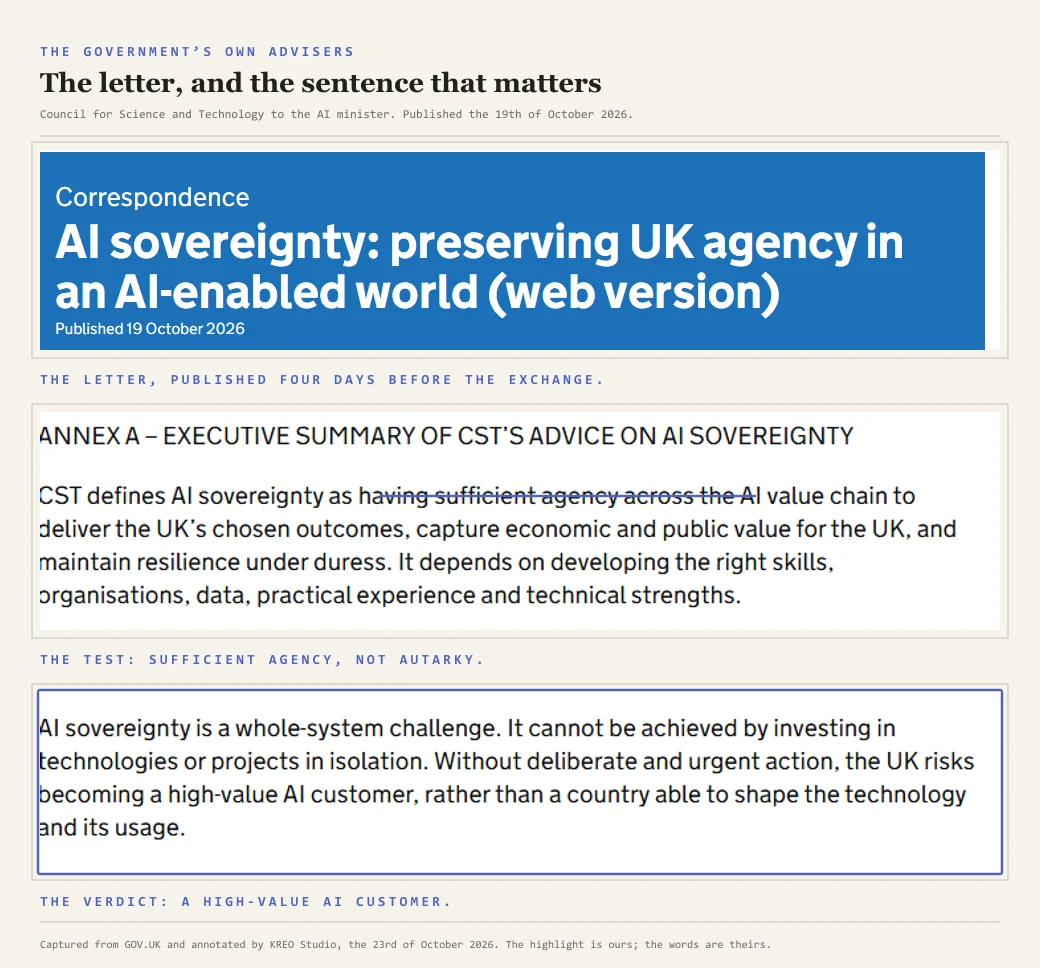
The council did not call for autarky. It called for agency: a plan, a single accountable owner, investment in skills, data and compute, and continued access to foreign models alongside selected domestic capability. It defined sovereignty as “having sufficient agency across the AI value chain”. That is the serious version of the argument, and it is now official advice to the minister at the centre of this row.
The money is not matching the advice.
The government’s Sovereign AI fund is £500m. In September 2026, a group of British technology companies coordinated by Cosine, a London lab with about 30 employees and $15m of backing, wrote to the prime minister and the AI minister asking for more than £20bn over five years. BT, Telefónica Tech, Leonardo, HPE, Kainos and Sopra Steria signed. The letter, reported by Computing, asked for roughly £18bn more than has been pledged, a sovereign capability plan within 90 days, and a ten-year cross-party strategy.
Cosine’s own contribution is Lumen Sovereign, which the government has described as Britain’s first fully sovereign frontier model, trained on the Isambard-AI supercomputer and due in 2027. It is a serious attempt. It is also a company of 30 people competing with firms that lease 158,000 square feet and pay researchers £630,000.
For scale: America’s biggest technology companies are projected by The Register to spend about $700bn on capital projects this year. That is about $13.5bn a week by its arithmetic. The entire British sovereign AI fund is worth roughly eight hours of it. The $700bn is a projection; the £500m is a commitment. The arithmetic is mine.
And the state’s own buying power is pointed the other way. A sweep of 2,008 UK public-sector AI procurements by BidSkim was reported by Computer Weekly on the 8th of October 2026. It found 1,470 contracts with a published award value of £1.83bn between January 2022 and August 2026. BidSkim found that British-controlled suppliers won two-thirds of the contracts and took 35 per cent of the money. American-owned firms won about one in ten contracts and took more than half the money, £932m. Palantir alone took £553m across 17 contracts.
Interactive · the split
Two-thirds of the work. A third of the money.
UK-controlled
978 of 1,470 66.5%
US-owned
about 1 in 10 10%
Two-thirds of the contracts went to British-controlled suppliers.
UK-controlled
£640m of £1.83bn 35%
US-owned
£932m 51%
More than half the money went to American-owned firms.
Source: BidSkim analysis of 2,008 UK public-sector AI procurements, reported by Computer Weekly, the 8th of October 2026. Published award values, January 2022 to August 2026.
Two-thirds of the work. A third of the value. That is what “AI maker, not AI taker” looks like in a spreadsheet.
Under the post, Nigel Jacklin put it as a catechism. “Q: So what is Parliament actually doing to make sure the next frontier company is built and scaled here, rather than absorbed abroad? A: Giving contracts to American companies?”
This is where Fred Thomas’s panel and my post turn out to be the same argument.
He was talking about the defence industrial base. The Ministry of Defence is the biggest public-sector buyer of AI in the country: £595m of the £1.83bn, across 137 contracts. Its largest single AI deal is a £240.6m enterprise agreement with Palantir, awarded directly in December 2025 without a competition involving British firms. In the Lords in February, Lord Fox asked the question that ought to trouble every member of the defence committee. Was this not the outsourcing of a sovereign capability? The data might stay; the knowledge of what to do with it would not.
The minister, Lord Coaker, said the data and decision-making remained sovereign. Perhaps they do. But a defence industrial base that runs on a foreign company’s model, under a foreign government’s export-control regime, is not a defence industrial base. It is a service level agreement with a foreign power.
Fred Thomas wants to protect funding now for new capability. He is right. The question is whose capability he will be buying. If the answer is a subscription, then the money has not bought sovereignty. It has bought a nicer interface for dependence.
The case against all this deserves a proper hearing, because it is not stupid.
The Tony Blair Institute argues that chasing national frontier models is a distraction: “Any nationally built frontier model would likely lag the global leaders within months.” The country does not build GPUs; even America depends on Taiwan. Autarky is a fantasy. But the institute recommends not dependence but “managed interdependence”, with countries deciding what to control, what to steer and what to depend on. That is the Council for Science and Technology’s framework with a different accent. The disagreement is not whether Britain should own everything. It is whether Britain has decided what it must own.
The chorus crosses traditions. Rafael Behr warned in the Guardian that Britain must not end up “at the mercy of US tech giants”. Parmy Olson asked in Bloomberg why an “AI maker” keeps buying American. Jennifer Holly wrote in ConservativeHome that Britain is “a lauded ‘surveyor’ of AI” that “owns none of it”. Cindy Yu argued in the Times for a sovereign model built partly on open Chinese weights. Mike Bracken supplied the line for the Cabinet Office wall: “Institutions rarely lose sovereignty in a crisis. They lose it one reasonable decision at a time.”
Behr to Holly. The Guardian to ConservativeHome. This is not a fringe complaint. It is the mainstream, arriving late.
What would a nation do that a host does not?
It would build people, not merely attract them. It would fund the pipeline from schools to universities to the lab, and make the lab worth staying in: compute, data, procurement, visas. It would use the state’s buying power as venture capital with a purpose. It would pick the parts of the stack where Britain can be indispensable, not merely present. It would write a ten-year plan and stick to it.
It would tell the truth about the costs. Industrial electricity is twice the European average and four times the American. Planning cannot deliver a data centre at the speed of the technology. Copyright makes commercial training legally fraught; as Dacombe notes, on one reading no general-purpose model can lawfully be trained here. And the government’s own evidence pack shows 74 per cent of UK venture capital in 2025 came from abroad: the ownership question is settled long before the exit.
None of that is fixed by a slogan about sovereignty. All of it is made harder by pretending the problem is prejudice against British engineers. The engineers are not the gap. The capital, the compute and the customer are.
I have thought about Fred Thomas’s reply all morning, and I think he did me a favour. He made me be precise.
The precise version is this. I cannot tell you what is in Liam Byrne’s or Kanishka Narayan’s mind, and I should not have suggested I could. But I can read what they do. I can read the leases, the contracts, the committee evidence, the speeches, and the silence when a model is switched off. The pattern does not depend on motive. It depends on ownership.
There is a difference between leaders and nations. Leaders build companies. Nations build the people who can build companies, the institutions that keep them, and the arrangements of power that decide whether they stay.
We call them the leaders because they are. The trouble is that we have started calling ourselves leaders too, on the strength of their postcode.
A nation is not a name above a door. It is the thing that decides who may enter, what is built inside, and whether the lights stay on when someone else’s government says no.
The leaders are welcome. The question is whether we are still a country that can raise one.
Readout: what is confirmed, reported and calculated
- Confirmed, from the Council for Science and Technology letter of the 30th of July 2026, published on the 19th of October 2026: “Without deliberate and urgent action, the UK risks becoming a high-value AI customer, rather than a country able to shape the technology and its usage.” The council defines AI sovereignty as “having sufficient agency across the AI value chain to deliver the UK’s chosen outcomes, capture economic and public value for the UK, and maintain resilience under duress.”
- Confirmed, from the Business and Trade Committee evidence of the 8th of July 2026: Kanishka Narayan said the United States has 75 per cent of data centre capacity globally; “Britain barely features on the table”; “We have not built very much compute at all.”
- Confirmed, from Hansard of the 10th of March 2026: Narayan said Britain has “huge strengths, not just because a number of the Gemini teams and researchers continue to sit in King’s Cross at DeepMind”.
- Confirmed, from the Business, Innovation, Science and Trade Committee evidence of the 13th of October 2026: Cat Little said UK testing still depends on voluntary cooperation, and that the government “cannot guarantee” access to models.
- Confirmed, from Anthropic’s statement of the 12th of June 2026: a US export control directive suspended access to Fable 5 and Mythos 5 for any foreign national, and Anthropic disabled both models for all customers.
- Confirmed, from Anthropic’s written evidence of the 9th of October 2026: “The UK continues to be a world-leader in this regard”, in a passage about governments understanding AI capabilities.
- Reported, from the Financial Times of the 23rd of October 2026, as relayed by Traders Union and Newsquawk: Anthropic and Hg have agreed to create an independent European consultancy, launching by the end of the year with hubs in London and Berlin, placing consultants and engineers inside European businesses and competing with Accenture, Deloitte, EY, KPMG and PwC. The FT article itself was behind its paywall and was not directly read. Anthropic’s US services company with Blackstone and Hellman & Friedman was announced on the 4th of May 2026 with $1.5bn of planned investment.
- Reported, from the Financial Times of the 9th of September 2026: Anthropic did not give Mythos 5.1 to the UK AI Security Institute for pre-release testing, the first time a major model had been withheld. The FT article is behind a paywall; I read the report as relayed by IT Pro and The Next Web, which attribute it to the FT.
- Reported, from BidSkim’s analysis as reported by Computer Weekly on the 8th of October 2026: 1,470 valued contracts worth £1.83bn, January 2022 to August 2026; UK-controlled suppliers 978 contracts but £640m, 35 per cent of value; US-owned firms about 10 per cent of contracts but £932m, more than half the value; Palantir £553m across 17 contracts; defence £595m across 137 contracts.
- Reported, from CBRE, Bisnow, City AM and the Estates Gazette: Anthropic’s 158,500 square feet at One Triton Square, capacity about 800 against a current London office of about 200; OpenAI’s roughly 95,000 square feet and capacity of 550; Databricks at 137,311 square feet; more than 700,000 square feet of London office take-up by AI companies in the first half of 2026, more than double all of 2025.
- Reported, from the Observer of the 11th of August 2026, citing Zeki: 74 departures from Google DeepMind in 2026; an arrivals-to-departures ratio of 1.7, down from 2.6 in 2025 and 4.7 in 2024; Anthropic at 8.3.
- Reported, from Anthropic’s own London job adverts: a salary range of £260,000 to £630,000 for a research engineer in pretraining.
- Reported, from Computing on the 29th of September 2026 and the Times on the 28th of September 2026: the £20bn letter coordinated by Cosine, signed by BT, Telefónica Tech, Leonardo, HPE, Kainos and Sopra Steria, asking for about £18bn more than has been pledged.
- Calculated by me: £500m is roughly eight hours of $700bn a year of American capital spending. The $700bn is a projection, the £500m is a commitment, and the conversion is my arithmetic. The 35 per cent and 51 per cent bars in the interactive are rounded from £640m and £932m against £1.83bn.
- Analysis, mine: the reading of the lease as an ownership document, the “service level agreement with a foreign power” formulation, and the distinction between hosting and leading are arguments, not quotations. The facts they rest on are listed above.
- Not confirmed: whether Anthropic’s decision to withhold Mythos 5.1 was a company choice or a response to US policy. The FT reports Whitehall fears of a protectionist shift; no document I read establishes the cause. Award values in the procurement data are ceilings, not money paid.
- What would change my mind: a British-owned frontier model in service at scale before 2028; a procurement shift in which UK-controlled suppliers take the majority of public-sector AI value; or a binding UK guarantee of access to frontier models that survives a US export-control directive.
Sources & references
- Council for Science and Technology, AI sovereignty: preserving UK agency in an AI-enabled world, the 30th of July 2026, published the 19th of October 2026.
- Reuters, UK risks becoming “AI customer” rather than creator, advisers warn, by Sam Tabahriti, the 19th of October 2026.
- Business and Trade Committee, oral evidence: artificial intelligence, business and the future of the workforce, the 8th of July 2026.
- Business, Innovation, Science and Trade Committee, oral evidence: AI adoption, safety and governance, the 13th of October 2026.
- Hansard, Technology Sovereignty, the 10th of March 2026.
- Kanishka Narayan, Building a Safer, More Secure Britain in the age of AI, the 12th of October 2026.
- Anthropic, written evidence to the Business, Innovation, Science and Trade Committee, the 9th of October 2026.
- Anthropic, statement on the US government directive to suspend access to Fable 5 and Mythos 5, the 12th of June 2026.
- Anthropic, Redeploying Claude Fable 5, June 2026.
- Financial Times, Anthropic withheld latest AI model from UK testing agency, the 9th of September 2026.
- IT Pro, Anthropic withholds access to Mythos 5.1 from UK safety testing body, the 9th of September 2026.
- Computer Weekly, Defence tops public sector AI spend as Palantir takes £553m, by Antony Adshead, the 8th of October 2026.
- Hansard, Ministry of Defence: Palantir Contracts, the 10th of February 2026.
- Hansard, Ministry of Defence: Palantir Contracts, the 11th of February 2026.
- Science, Innovation and Technology Committee, Government must set out strategy to achieve sovereign AI capabilities, the 7th of July 2026.
- CBRE, Central London office take-up rises in Q2 as AI occupiers drive demand, 2026.
- Bisnow, AI Firms Go On 375K SF London Office Leasing Tear, the 17th of April 2026.
- City AM, San Francisco tech firm expands London footprint with new City office, the 30th of September 2026.
- Observer, Gemini, how do we reverse the DeepMind brain drain?, the 11th of August 2026.
- Anthropic, Research Engineer, Pretraining, London, job listing read on the 23rd of October 2026.
- Computing, UK tech leaders call for £20bn sovereign AI push, the 29th of September 2026.
- The Times, Britain must commit £20bn to AI sovereignty, tech leaders urge, the 28th of September 2026.
- The Next Web, Britain’s Cosine rallies BT, HSBC, and BAE to build a sovereign AI model, the 8th of June 2026.
- Tony Blair Institute, Open-source AI critical for middle powers’ global standing, the 9th of February 2026.
- Tony Blair Institute, AI isolationism “would be a mistake”, the 19th of January 2026.
- Rafael Behr, In the coming AI future, Britain must not end up at the mercy of US tech giants, the Guardian, the 29th of April 2026.
- Parmy Olson, Britain Wants AI Sovereignty. So Why Does It Buy American Tech?, Bloomberg Opinion, the 18th of May 2026.
- Jennifer Holly, Britain needs domestic AI power now, or risks becoming a US vassal, ConservativeHome, the 29th of June 2026.
- Martha Dacombe, Britain’s AI sovereignty is an illusion, Arguably, the 18th of June 2026.
- Mike Bracken, GOV.UK founder warns AI gold rush could leave Britain locked in, The Register, the 21st of September 2026.
- Cindy Yu, Britain should build its own sovereign AI, The Times, the 19th of October 2026.
- Liz Kendall, speech to London Tech Week, the 9th of June 2026.
- GOV.UK, UK startups and VC landscape evidence pack, the 28th of July 2026.
- Traders Union, Anthropic, Hg to launch European AI consultancy as firms expand enterprise services, the 23rd of October 2026, citing the Financial Times.
- Newsquawk, Anthropic and Hg have agreed to form an independent consultancy, the 23rd of October 2026, citing the Financial Times.
- Anthropic, Building a new enterprise AI services company with Blackstone, Hellman & Friedman, and Goldman Sachs, the 4th of May 2026.
- Hg, Hg extends collaboration with Anthropic to bring agentic AI capabilities across the portfolio, the 21st of September 2026.
- House of Commons Library, Industries in the UK, the 3rd of October 2024: professional, scientific and technical activities were 8.3 per cent of UK gross value added in 2023.
Reader signal
Was this useful?
Work with KREO Studio
AI engineering, data science and design architecture, from Plymouth to the wider UK.
Next Article
The Front Page Is a Promise
From the KREO Journal · kreostudio.co.uk/blog/leaders-and-nations · published the 23rd of October 2026. Corrections are dated, never silent.
