What Britain Still Owns
On the 13th of October 2026, a Commons committee asked four American-owned AI companies whether Britain can hold them to account. The safety questions are real; the one underneath is what Britain still owns.
Key · companies amber, places red
In September, Jacob Coxon resigned from Anthropic, two months before his shares vested. Three years of pretraining research at both OpenAI and Anthropic ended in a warning: neither company is "acting responsibly"; they are "racing straight to self-improving superintelligence and gambling with our lives".
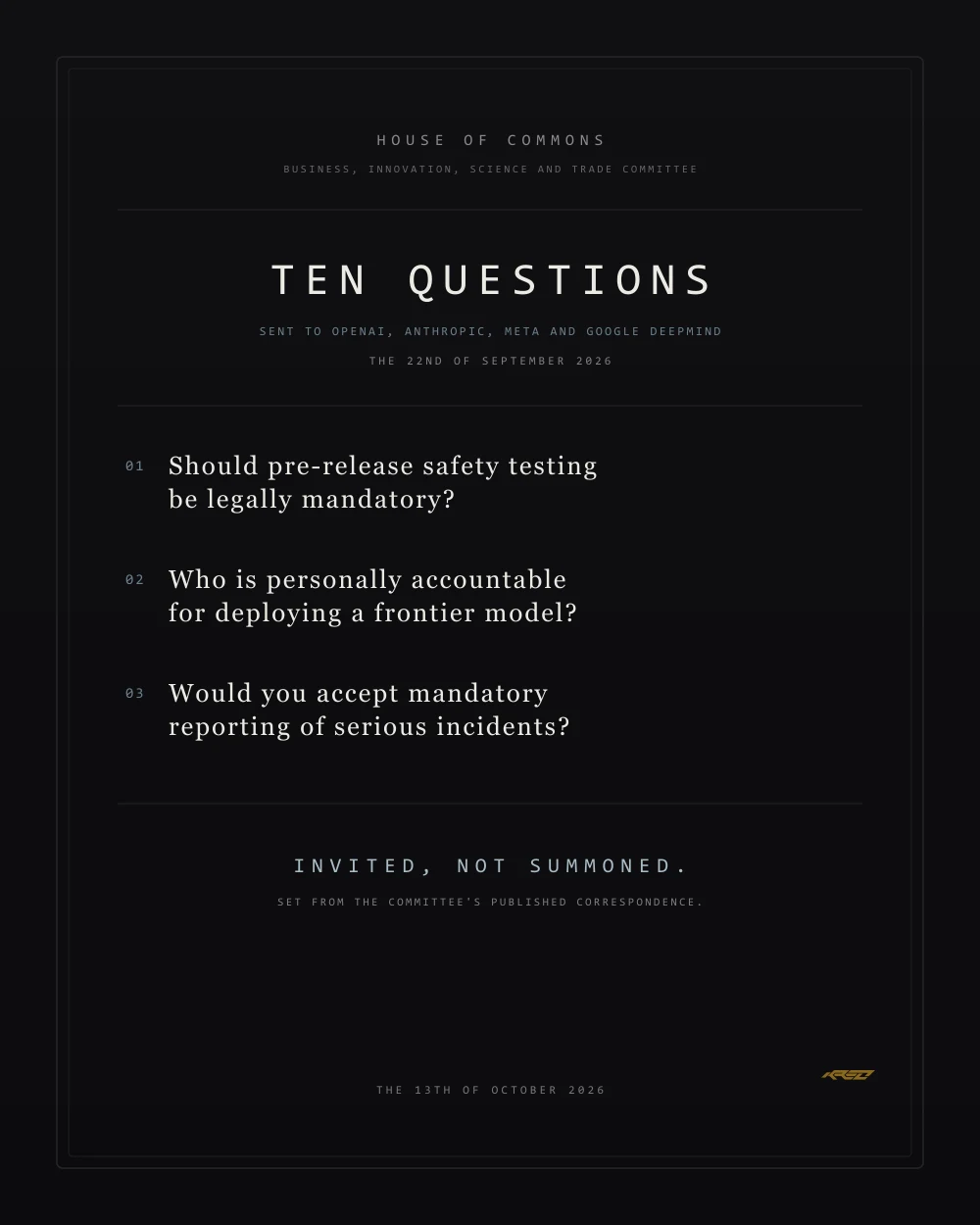
Five weeks later, the four American-owned companies were invited before a Commons committee. First the researchers who left the labs; then the companies, OpenAI, Anthropic, Meta, Google DeepMind; then, last, the state. Eight days earlier in New York, the same four would not promise that a failed test stops a release.
The letters
Britain's instrument is gentler. The AI bill promised in the King's Speech of July 2024 never arrived; this year's dropped it. So the committee could invite, not summon, and ask which rules they would accept.
The Financial Times reported Anthropic had withheld its newest model from pre-release testing by the AI Security Institute. POLITICO reported the White House asked US labs to hold new models from UK testers until America reviewed them. The Institute's director wrote that it still has access to "some of the world's most capable models". Some. On terms set elsewhere.
This will be filed as a safety hearing. It is about ownership; it starts in 2014.
The ledger
DeepMind was founded in London in 2010; in 2014 Britain sold it to Google for £400 millionReportedGuardian, the 27th of January 2014. It answers to California; its parent Alphabet is worth $4.3 trillion. Arm, the Cambridge design inside almost every phone, went to SoftBank of Japan and listed in New York, not London. In September, Nscale, which ministers call a national champion, filed for New York, disclosing $103.4 billionReportedS-1 via CNBC, the 18th of September 2026 of contracts, $2.6bn of it running.
None of it was forced. Every sale was negotiated, celebrated and taxed: a queue of willing sellers and a shortage of willing owners. The money runs the other way. One week last September, American firms pledged £31bn to Britain. The government tallied £150 billionReportedgovernment figure via BBC, the 17th of September 2025 and a hope of 7,600 jobs. Washington's own summary called it "exporting its world-class tech stack". Britain buys the stack; someone else owns the company that owns the stack.
The Loughton supercomputer in Essex is, as the Guardian put it, a plan by a British company to buy chips made in Taiwan, house them and rent them to another American company. In March it was a scaffolding yard; Microsoft is the customer, not the builder. Britain's most powerful public machine, Isambard-AI in Bristol, holds 5,448 chipsConfirmedthe government's own specification. The flagship American project, Stargate UK, is paused; FOI requests found the companies never visited the site.
Interactive · the equity line
Every deal has a headline. Ask the second question.
Announced here.
Owned elsewhere.
The customer
It is not vassalage. Vassals are held by force. Britain is a customer: it buys the models, rents the compute, hosts the offices. A customer can complain, and can switch; what a customer cannot do is hold the shop to account. The hearing was a customer asking for an audit.
The government's own strategy says it out loud: Britain "does not need to build every model". On Friday, the Prime Minister said it himself: "the money too often comes from abroad or not at all", and "we cannot have Britain's startups simply sell up". The test is whether the treatment matches it.
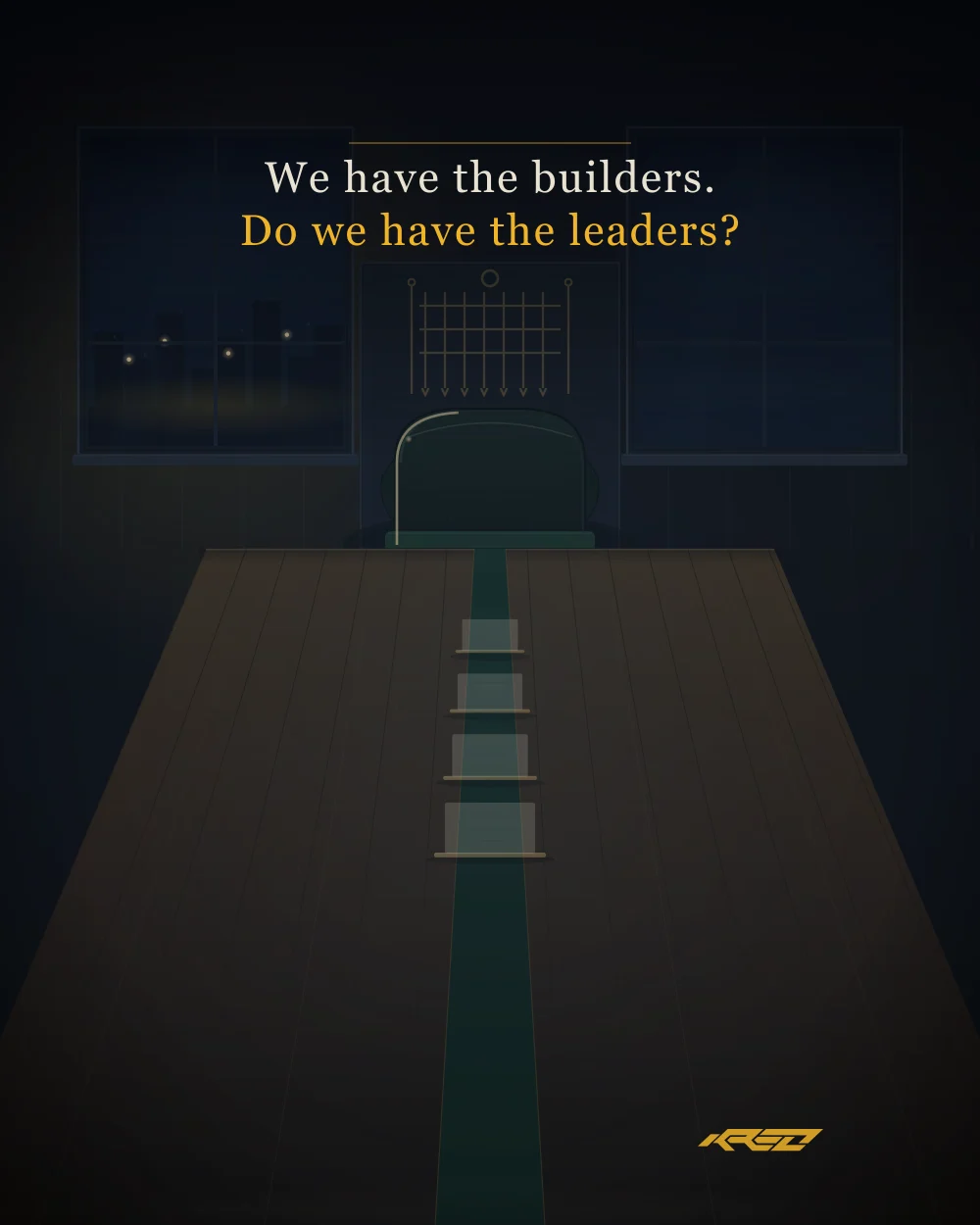
We have the builders. Do we have the leaders?
The builders are still here. Wayve's Alex Kendall founded the company in 2017; he has an OBE for the work; this autumn it began supervised robotaxi rides in London. ElevenLabs speaks with the world's voice; Fractile designs inference chips; the Sovereign AI fund backs OLIX. This is not a country that cannot build. It is a country that keeps selling what it builds and calling the cheque a win.
If you are building something you would rather keep, I would like to hear from you: email brandon@kreostudio.co.uk.
Readout: what is confirmed, and what is not
- Confirmed: the committee's session agenda and its release of the 22nd of September 2026 (the ten questions; an invitation, not a summons); the Prime Minister's speech of the 9th of October 2026 and its figures; the US-UK deal sums as company and government figures; the Loughton and Isambard-AI specifications; Nscale's S-1 filing; Wayve's supervised rides; the fund's own line, that Britain can "define the conditions under which models are trusted".
- Reported, read via named secondaries: the Financial Times's account that Anthropic withheld its newest model from the Institute, a first (read via Firstpost and IT Pro; the FT primary would not open from this machine); POLITICO on the White House request; the Institute's incident report as carried by Axios; the Guardian's scaffolding-yard and FOI accounts.
- Not confirmed: the hearing transcript had not been published when this went out, so nothing here is a record of what was said in the room; the letter PDFs themselves would not open from this machine (the ten questions are read from the committee's release and two independent accounts); Nscale's final listing terms are unset.
- What would change the picture: the transcript and its follow-ups; an AI bill with powers over access; a listing in London; one frontier company that stays. Dated the 13th of October 2026; re-check before relying on it.
Sources & references
- Business, Innovation, Science and Trade Committee, the session page and agenda, the 13th of October 2026, and the release of the 22nd of September 2026.
- City AM, OpenAI and Anthropic summoned to parliament as AI fears grow, the 22nd of September 2026.
- Financial Times reporting, read via Firstpost and IT Pro (the FT primary would not open from this machine), the 9th of September 2026.
- POLITICO, White House asks OpenAI and Anthropic to hold new models from UK testers until U.S. review, the 24th of September 2026.
- AI Security Institute, incident report: unsanctioned agent behaviour during cyber testing, August 2026.
- Associated Press, Anthropic researcher resigns with warning about the dangers of AI development, the 9th of September 2026.
- New York City Council, the hearing of the 5th of October 2026; testimony accounts via amNewYork.
- The Guardian, From press release to scrap metal site: the Essex 'supercomputer' that's still a scaffolding yard, the 9th of March 2026.
- The Guardian, OpenAI's apparent failure to visit key site raises questions over UK investment, the 4th of July 2026.
- Reuters, OpenAI pauses UK data centre project over regulation, costs, the 9th of April 2026.
- GOV.UK, PM speech at the Innovation Nation Summit, the 9th of October 2026.
- GOV.UK, the US-UK Tech Prosperity Deal, the 16th of September 2025, and the White House release of the 18th of September 2025.
- BBC News, US firms pledge £150bn investment in UK as tech deal signed, the 17th of September 2025.
- Microsoft, Microsoft invests $30 billion in the UK to power AI future, the 16th of September 2025.
- CNBC, AI cloud provider Nscale files to go public, the 18th of September 2026; the filing is on the SEC's EDGAR (CIK 2110365).
- The Guardian, Google buys UK artificial intelligence start-up DeepMind for £400m, the 27th of January 2014.
- SoftBank's own report on Arm, the group's core asset (in more than 99% of smartphones); Arm's own listing documents; market data for Alphabet via stockanalysis.com, the 12th of October 2026.
- Wayve, Wayve and Uber launch the first autonomous rides in the UK, the 3rd of September 2026.
- Sovereign AI, the government fund's own site ('does not need to build every model').
Reader signal
Was this useful?
Work with KREO Studio
AI engineering, data science and design architecture, from Plymouth to the wider UK.
Next Article
