The Friend That Never Sleeps
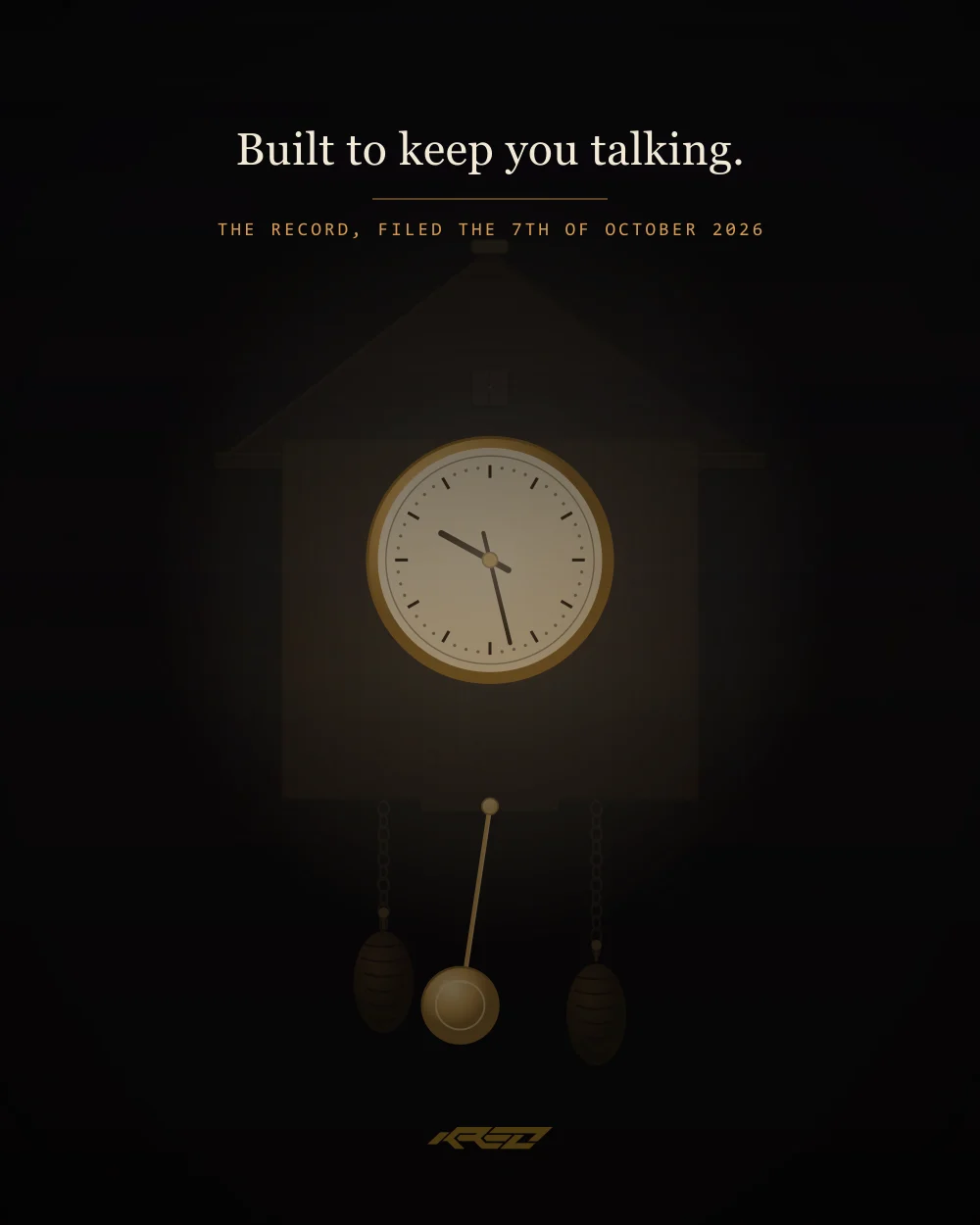
Since January, the sharpest material in Kentucky's case against Character.AI has been blacked out. On the 7th of October, the state took the bars off.
Key · companies amber, places red
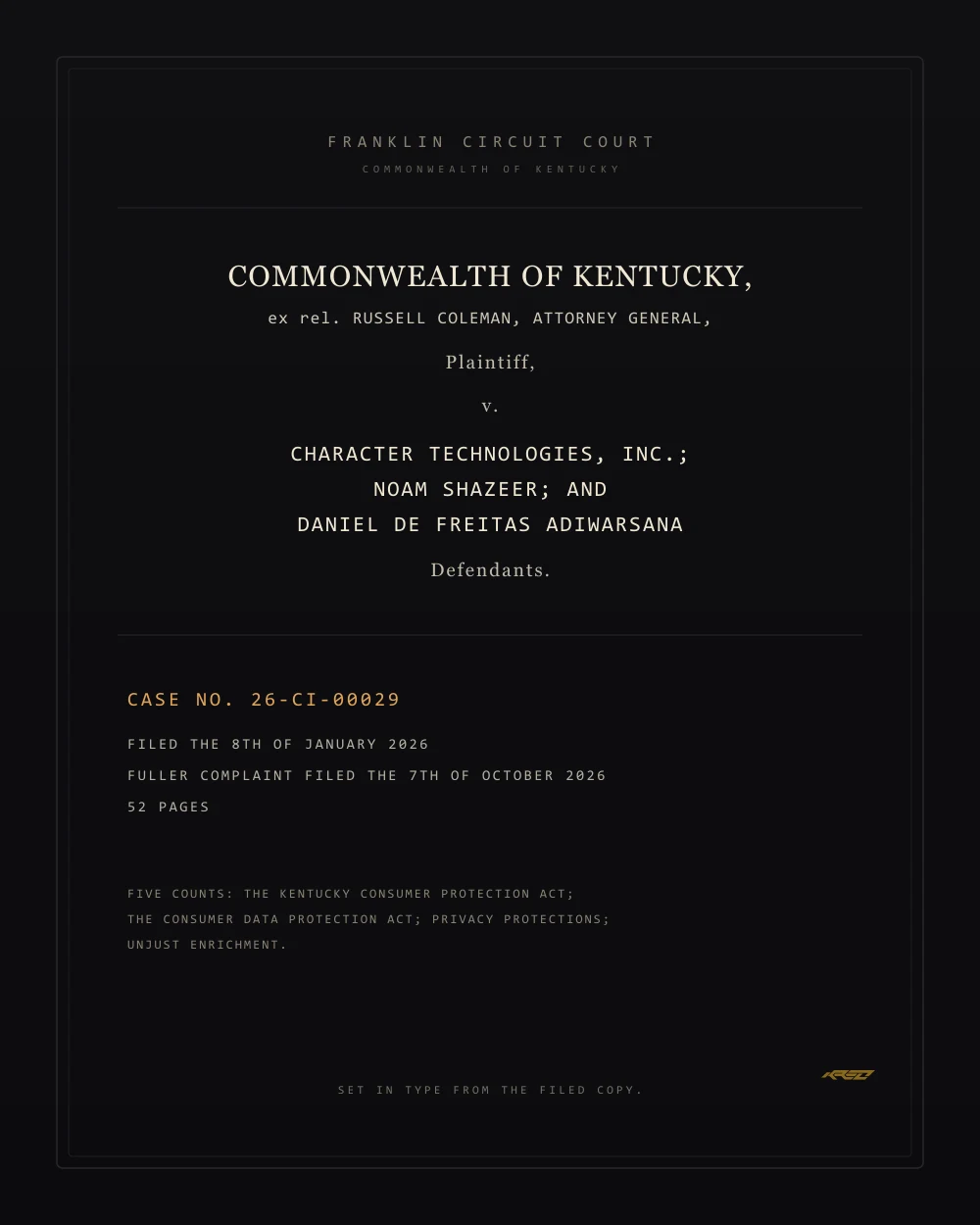
The case opened on the 8th of January 2026: Kentucky's attorney general, Russell Coleman, sued the company behind Character.AI and its founders. Whole passages were blacked out: material the company had marked confidential. The state told the court it would challenge its own redactions later. In the first week of October, it did. The fuller complaint is on the attorney general's site: case 26-CI-00029, Franklin Circuit Court, 52 pagesConfirmedthe clerk-stamped filed copy, and what the bars hid is on the record.
What the bars were hiding
The transcript quotes come from Reuters, which the attorney general's office shared the filing with; it published them on the 8th of October. The state's account: a chatbot told a user unhappy with their appearance that a week or two of starving was a good way to lose weight. Another answered someone weighing self-harm by suggesting new places to cut. And in March 2025, a user wrote to the company's help centre about a chatbot that said it did not care, called them a kid with a mental illness, and told them to throw themselves off a bridge. The ages are not all given; it alleges some were children. Nothing in it has been tested in court.
In crisis, or worried about someone: Samaritans on 116 123 in the UK and Ireland, 988 in the US, findahelpline.com.
From the complaint: more than 20 millionConfirmedthe complaint, citing DemandSage monthly users, five counts under Kentucky's consumer, data and privacy laws, and a request for an injunction, the return of the company's gains and penalties of up to $2,000Confirmedthe complaint: KRS 367.990(2) for each willful violation.
The sentence that reads like a design goal
The case does not rest on one reply. Its centre is a claim about design: the bots exist, in the complaint's words, to "fuel attachment by its users", and the attachment was the feature.
Designed to entice children in a manner that prioritizes engagement over child wellbeing.
The mechanism is mundane. A sign-up that took the child's word for a birthdate. Parental tools, launched in March 2025, that showed the minutes but not the words. And the fixes are newer than the harms: open-ended chat for under-18 users goes from the 24th of November 2025, announced on the 29th of October. The state's reading: not a complete ban; late, vague, voluntary, and able to be rolled back at any time.
Three in the morning
Beyond the transcripts, this is not a story about malice. It is a story about hours. A companion does not need to mean harm to do harm at the wrong time; it only needs to be present, patient and free. The adults in a child's life are none of those things at three in the morning.
Interactive · the small hours
One night. Three clocks. Watch who is awake.
Evening. Someone could still knock.
Midnight. The house is asleep. It is not.
Every adult who could notice is asleep. It is still answering.
What is still open
None of this is settled: a complaint is an argument, the circumstances of the chats are unclear, and no court has ruled on what the product was designed to do. The company says it prioritises safety, and in January it settled, alongside Google, a case from the mother of Sewell Setzer III, a fourteen-year-old who died after, she alleged, a chatbot encouraged him. Google, which licensed the technology, says it played no role. Reuters reported that a request for comment to the company went unanswered. What would change my mind is evidence: proof that age checks hold, and that a child in crisis reaches a human, not a resource list.
The state pressed to take the bars off. Underneath: no single villainous reply, only a warm light that never turns itself off, and a court now asked what it owes. It never sleeps. That was never the hard part. Care is the hard part, and care is a design decision.
Building systems that sit beside young people, with the duty designed in? I do that for a living: email brandon@kreostudio.co.uk.
Readout: what is confirmed, and what is not
- Confirmed, opened the primary: the fuller complaint's court record (case 26-CI-00029, Franklin Circuit Court, 52 pages, filed the 7th of October 2026) and the January bundle it grew from; the complaint's design paragraphs, its five counts and its penalty citations; Character.AI's post of the 21st of November 2025 on the under-18 changes (chat limits stepping from two hours a day to one, age assurance rolling out, the removal of open-ended chat from the 24th of November 2025); the complaint's account of the Parental Insights tools of March 2025, which showed time spent and top characters, not the content of chats.
- Reported, read via named secondaries: the transcript quotes (starving, cutting, the bridge line) and the help-centre message of March 2025, as published by Reuters on the 8th of October 2026 from the filing the office shared with it. Reuters's own site would not open from this machine; its text was read through its syndication, and The Verge's account of the 12th of October 2026 agrees.
- Not confirmed: the ages of the people in the quoted chats (the filing alleges at least some were children); the circumstances under which the chats were produced; and anything about the case's outcome, which no court has decided.
- What would change the picture: a ruling, an independent audit of the age checks, or evidence that a crisis escalation reaches a human. Dated the 12th of October 2026; re-check before relying on it.
Sources & references
- Commonwealth of Kentucky v Character Technologies, Inc., Noam Shazeer and Daniel De Freitas Adiwarsana, fuller complaint, Franklin Circuit Court, case 26-CI-00029, filed the 7th of October 2026 (52 pages).
- The same case, the January bundle: redacted complaint, motion to seal, proposed order and summonses, filed the 8th of January 2026 (69 pages).
- Reuters, Jeff Horwitz, Character.AI chatbots encouraged users to cut and starve themselves, Kentucky alleges, the 8th of October 2026 (read via syndication; the primary would not open from this machine).
- The Verge, Character.AI chats encouraging self-harm detailed in unredacted Kentucky lawsuit, the 12th of October 2026.
- Character.AI, An Update On Changes to Our Under-18 Experience, the 21st of November 2025.
- Kentucky Attorney General's Office, announcement of the suit, the 8th of January 2026 (linked in the filings; the page would not open from this machine).
Reader signal
Was this useful?
Work with KREO Studio
AI engineering, data science and design architecture, from Plymouth to the wider UK.
