The Unopened Register
Britain counts everything except who pays if the AI boom ends. So I built the register from public records: three pages that can be written, and a fourth that cannot.
Key · organisations and agencies amber
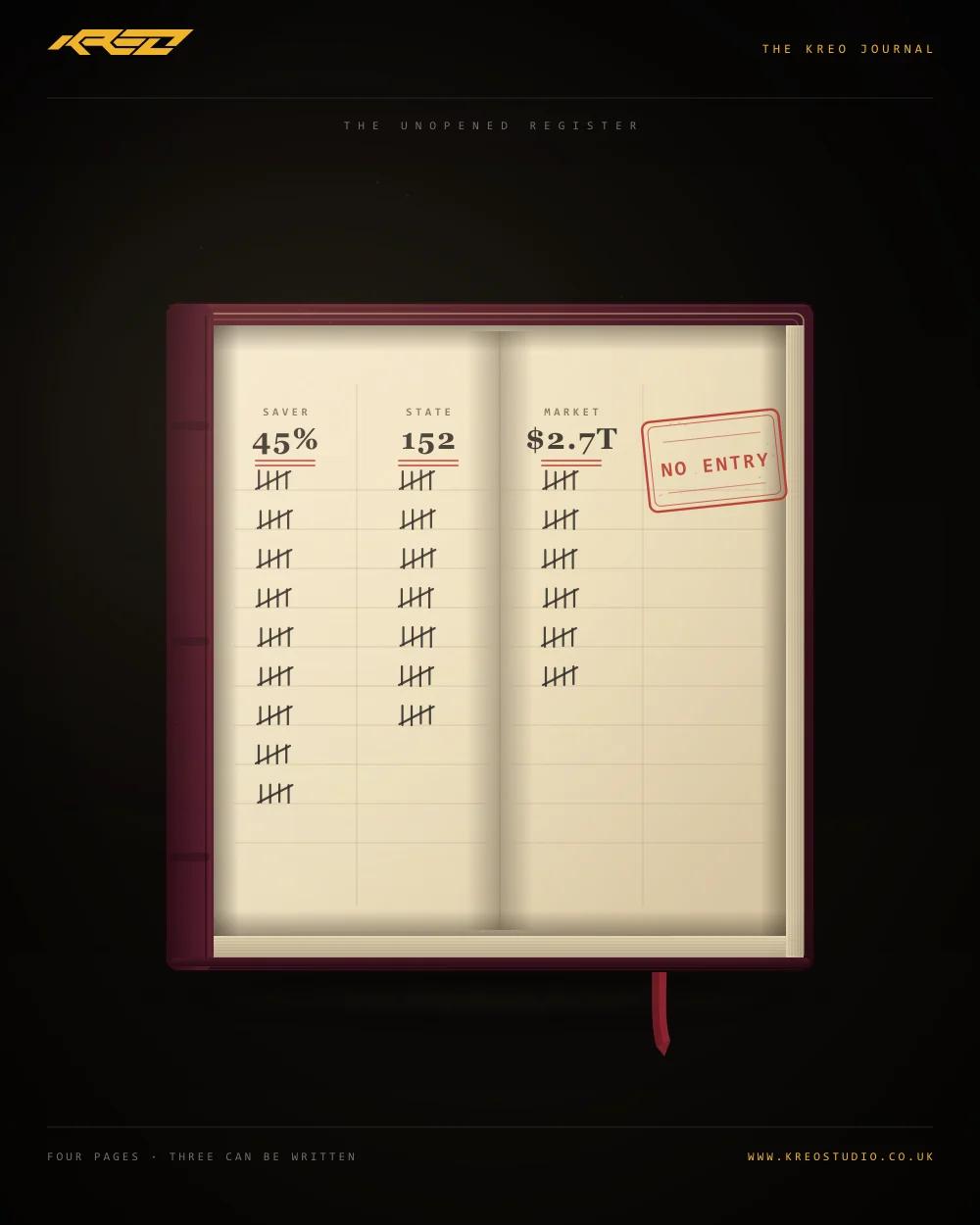
There is a bet inside your pension you never placed. Most savers in Britain hold it. I could not find the total, to the pound, anywhere.
On the 8th of October 2026 the Financial Times reported OpenAI’s annualised revenue nearer $50 billion than the $70 billion others estimated. Chip stocks fell, per MarketWatch: Broadcom 4.6%, Micron 4.8%, Nvidia 2.9%. Two days later Lord Holmes of Richmond asked on LinkedIn: who holds the power? and who holds the risk?
Both questions are answerable. That is the strange part. The answers are already public, in fragments; the register’s fourth page is why this piece exists.
I · The saver’s page
The index that prices everybody’s future: Goldman Sachs, as reported by Seeking Alpha, puts AI-linked companies at close to 45% of the value of America’s 500 biggest listed companies, up from 25% at ChatGPT’s launch. The Bank of England calls US valuations close to the most stretched since the dot-com bubble, and in July 2026 ran a scenario: US equities fall 45%, UK GDP lands 2.2 percentage points lower. That is not a forecast; it is the arithmetic of exposure, and it lands on savers. New Capital Consensus found the Magnificent Seven are 22.4% of the MSCI World, and a default UK pension sends more money to Apple than to every listed UK company combined. No saver chooses this. It arrives by default.
II · The state’s page
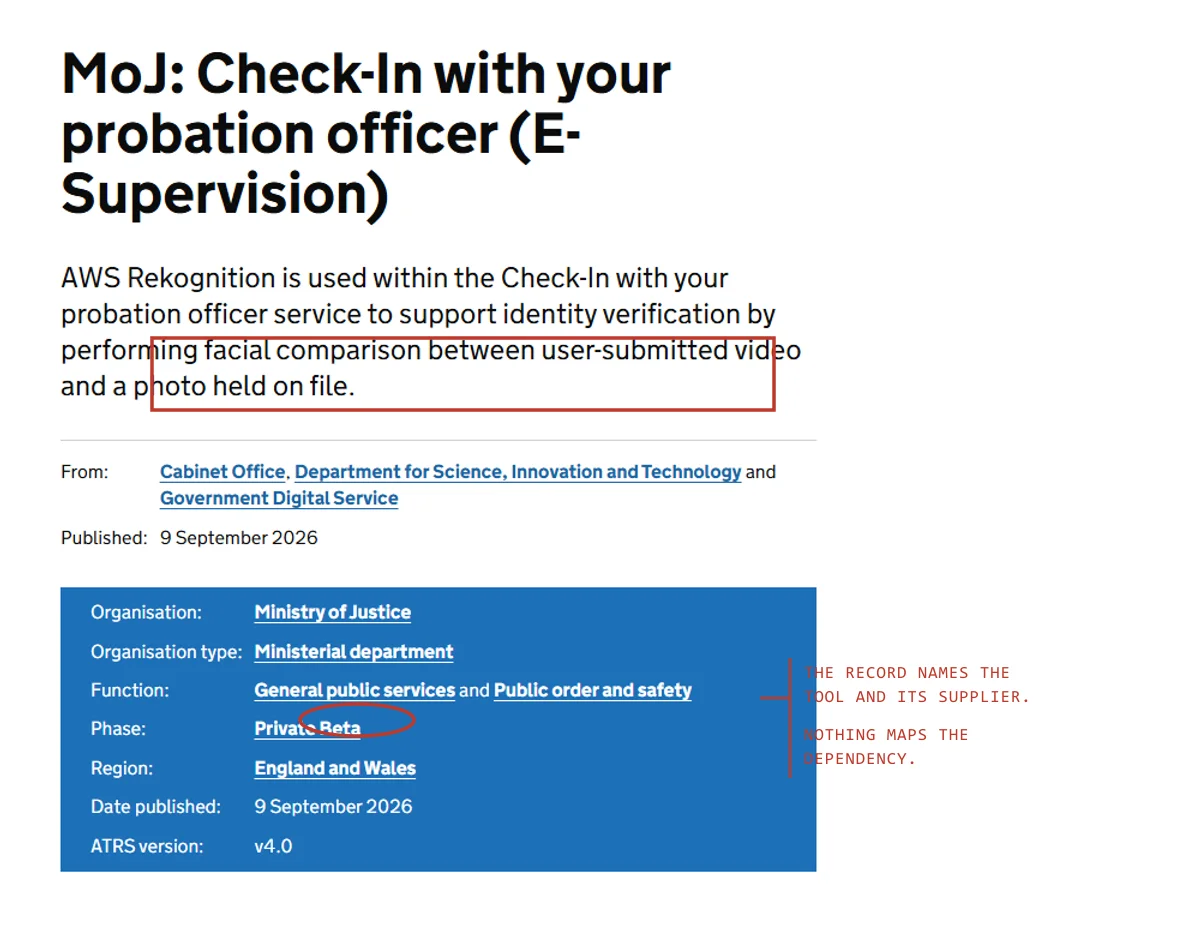
The state is already a customer. I opened the transparency hub on the 11th of October 2026; it held 152 records: facial comparison in probation check-ins, live tribunal transcription, a model predicting engagement with tax-debt recovery. The records are thorough: supplier, procurement, human review. But a record is not a map, and Holmes’s second question, what happens mid-contract if a supplier fails, has no register behind it. The Ada Lovelace Institute told Parliament there is no systematic map of where AI sits across government; the National Audit Office found in 2024 that 70% of bodies were piloting AI and the strategy had no owner.
III · The market’s page
Now the money. Gartner forecasts $2.59 trillion of AI spending in 2026, a 47% rise on 2025, revised to $2.7 trillion in September. The building is borrowed: the Bank expects roughly half of the data-centre build to be financed externally, mostly by debt; on the 30th of September it warned AI valuations remain vulnerable to a sharper correction than July’s.
Interactive · the register
Open the pages. The fourth is blank.
The register is closed. Open a page.
The saver
- Close to 45% of the value of the 500 biggest US companies is AI-linked (Goldman Sachs).
- The Magnificent Seven: 22.4% of the MSCI World (New Capital Consensus).
- One scenario: UK GDP 2.2 points lower (Bank of England).
The state
- 152 transparency records: probation facial comparison, tribunal transcription, tax-debt recovery scoring.
- Recorded: tool, supplier, procurement. Missing: the dependency.
The market
- $2.59 trillion of forecast AI spend for 2026, revised to $2.7 trillion (Gartner).
- Roughly half the data-centre build to 2028: debt-financed (Bank of England).
The missing page
No page. Nothing totals the exposure, or names who holds it.
Entries from primary documents; links in Sources.
IV · The missing page
Here is the fourth page, and the finding. No public register records which British pensions sit on which valuations, which public services depend on which suppliers, or who pays if a correction arrives. Ada Lovelace’s remedy for middle powers: structural mapping of technology dependencies. The work is cheap: publish a dependency map; make pension schemes state their concentration; write failure and exit clauses into public AI contracts, then test them. Resilience, as Holmes put it, has to be designed in, not bolted on after the event.
A register is not a forecast. It is the first thing an insurer writes before the weather changes. Almost half the value of America’s biggest listed companies rides on one theme, and the page that would say who is holding it is still blank.
Want your own exposure register? Email brandon@kreostudio.co.uk.
Readout: what is confirmed, and what is not
- Confirmed, opened the primary: the Bank of England’s July 2026 Financial Stability Report (the scenario of a 45% US equity fall over six quarters, credit spreads 350 basis points wider, UK GDP 2.2 percentage points lower) and its December 2025 report (“close to the most stretched” since the dot-com bubble; roughly half of the build financed externally, mostly by debt); Gartner’s release of the 19th of May 2026 ($2.59 trillion) and its revision of the 16th of September 2026 ($2.7 trillion); the transparency hub (152 records, opened the 11th of October 2026, including the MoJ E-Supervision probation record); the National Audit Office (70% of surveyed bodies piloting or planning AI, the 15th of March 2024); the Holmes quotes, from his post.
- Reported, via a named secondary: Goldman Sachs’ AI-linked share of the S&P 500 (close to 45% of the index’s value, up from roughly 25% at ChatGPT’s launch), via Seeking Alpha, the 22nd of April 2026; the note itself was not read. The 8th of October market moves and the FT’s OpenAI revenue report are carried by MarketWatch (the FT piece is paywalled and was not read directly; Trading Economics reports the same figures). The 30th of September valuation warning is carried by The Straits Times. New Capital Consensus’s index numbers (Apple 5.5%, the UK 3.8%, the Magnificent Seven 22.4% of the MSCI World) are the think tank’s own published figures; the underlying report PDF was not opened.
- Not confirmed: any public map of supplier dependencies across public services. The hub records the tool and its named supplier; it does not map the dependency. The register above is the closest assembly available.
- What would change the picture: a published UK exposure register, or a year of compounding adoption with no correction. The figures are dated the 11th of October 2026; re-total quarterly.
Sources & references
- Lord Holmes of Richmond, post on LinkedIn, the 10th of October 2026.
- Bank of England, Financial Stability Report, July 2026 (the 2.2 percentage point scenario).
- Bank of England, Financial Stability Report, December 2025.
- Gartner, AI spending forecast, the 19th of May 2026; revision, the 16th of September 2026.
- Algorithmic Transparency hub, 152 records, opened the 11th of October 2026; MoJ E-Supervision (facial comparison).
- Ada Lovelace Institute, Beyond the Bubble, and written evidence to Parliament.
- National Audit Office, Use of artificial intelligence in government, the 15th of March 2024.
- New Capital Consensus, Diversifying Investment Flows, the 30th of July 2026.
- MarketWatch, the 8th of October 2026; Trading Economics, the same day.
- Seeking Alpha, Goldman Sachs: AI stocks near 45% of S&P 500 weight, the 22nd of April 2026.
Reader signal
Was this useful?
Work with KREO Studio
AI engineering, data science and design architecture, from Plymouth to the wider UK.
