The Window and the Hinges
Twenty million people a month work inside Microsoft's business software in Britain. On the 16th of October 2026 the competition regulator proposed designating the company for special scrutiny, and its first question is whether customers can choose an AI other than Copilot. The interesting part: the window learned to open.
Key · companies amber, agencies red
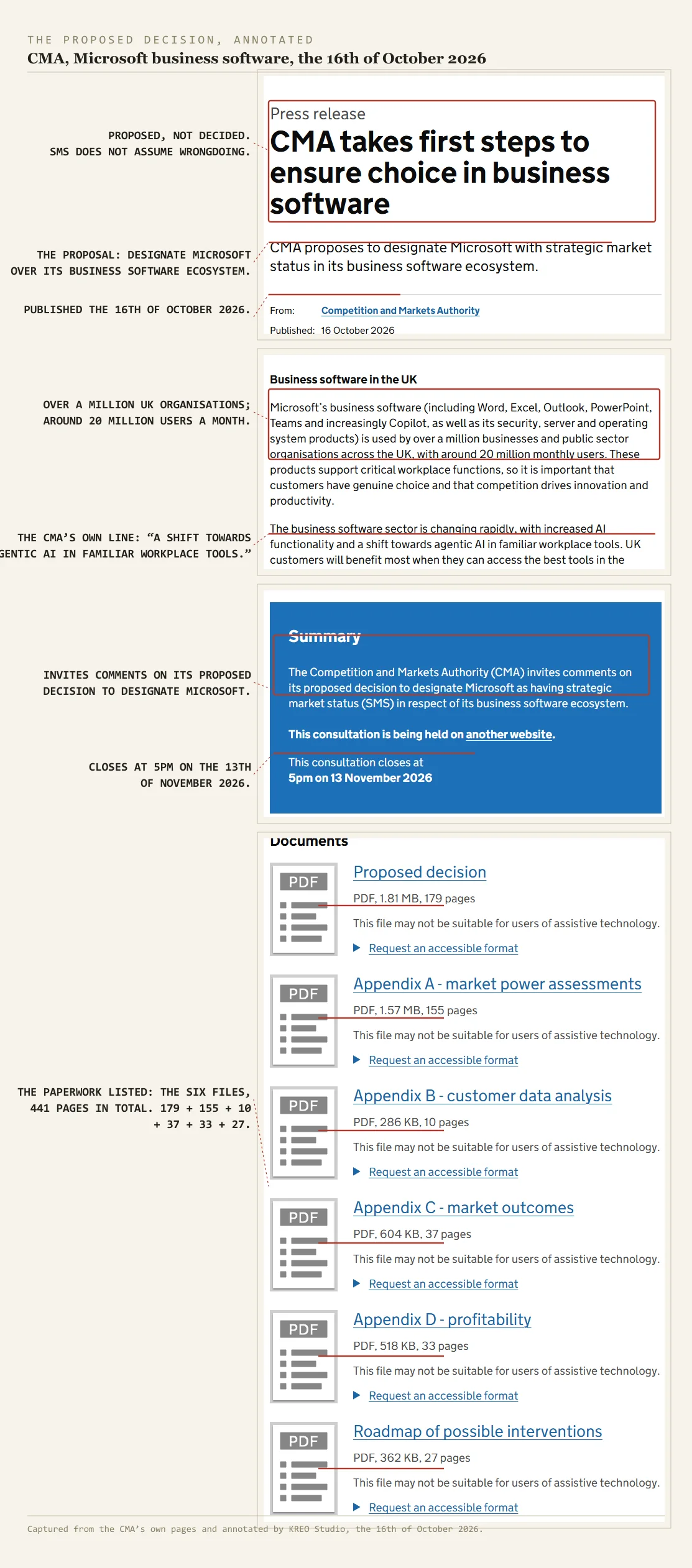
On the 16th of October 2026, the Competition and Markets Authority put a document online: a proposed decision to designate Microsoft with strategic market status in its business software ecosystem. In law, that phrasing marks a platform too important to leave to the market. The regulator is careful: designation does not assume wrongdoing, and this one is proposed, not decided. Word, Excel, Teams and Copilot are used by more than a million British organisationsConfirmedthe CMA’s own news release, read on the day: around 20 million monthly users.
Microsoft does not share the view. “All our products, including Copilot, are open and interoperable,” a Microsoft spokesperson said, “giving customers the ability to use them alongside competing services.”
What the regulator said
It opened in May and reached its midpoint: a provisional finding that Microsoft is strong in all five areas, operating systems, productivity suites, security software, servers and databases. The strength rests on the joins between them. Customers stay because switching costs more than staying; bundles and deep integration leave rival tools working at a disadvantage. The paperwork matches: 441 pagesCalculatedthe page counts listed on the consultation page, added up: 179 + 155 + 10 + 37 + 33 + 27, from the 179-page proposed decision to a 155-page market-power assessment.
Its chief executive, Sarah Cardell, said:
Organisations should be able to choose the products that work best for them, switch provider when they want to and combine services from different suppliers.
Outside any designation, a quieter line: the CMA reported that Microsoft and Amazon have removed data transfer fees for switchers, opened links to rivals beginning with Google, and automated the switch.
The new room in the house
The CMA’s own words show where the case heads: “increased AI functionality and a shift towards agentic AI in familiar workplace tools.” The roadmap asks first whether customers can freely choose their AI tools, and whether rivals can compete with Copilot; then whether security bundling limits choice; then whether licences can live where you choose.
Microsoft’s filed answer, from the 4th of June, argues the opposite direction: “AI is making competition more intense, not less.” The company points to its own joinery, the Model Context Protocol carried across GitHub, Copilot Studio, Azure AI Foundry and Windows 11, and notes Copilot is an optional paid add-on.
Interactive · the window
Swing it open.
Closed, one supplier. Open, the four enquiries on the roadmap.
Meanwhile, the window changed
While the case was assembled, the platform became a place where one builder can stand up a serious thing. In April 2026, Microsoft made Foundry Local generally available: a runtime that lets an application ship its own language model inside the installer. No cloud in the request path, no per-token meter, an open catalog, and hardware acceleration from the operating system. Microsoft’s documentation shows the same ladder: device first, cloud last. The packaging is checkable; the experience is the company’s claim.
I write software on a Windows machine, and I read the proposal and the reply the day they landed. The hinges matter because the window is good, and the fittings get measured because everyone lives through them.
The hinge test
A hinge is the boring part of a window and the only part that decides whether it opens. The CMA’s case is that Microsoft’s hinges, the bundles, defaults, licences and integration points, decide too much of what Britain’s workplaces can do next: which AI they may choose, and where their software may live. Microsoft’s answer: the hinges are already open. Both are testable. Designation is a gate, not a verdict; remedies come later, if at all.
One rule to carry: test your own window. Can the files and models leave with you if the terms change? Yes: you can build on anyone’s ground. No: you are renting the view. A window is only a window if it opens.
If you are weighing what your stack lets you keep, email brandon@kreostudio.co.uk.
Readout: what is confirmed, and what is not
- Confirmed, read on the day: the CMA’s news release of the 16th of October 2026 (the proposed designation; the five areas examined; the findings on switching barriers, bundling and integration; the three roadmap lines of enquiry, AI tools first among them; the cloud update on Microsoft and AWS; “SMS designation does not assume wrongdoing”; consultation closes at 5pm on the 13th of November 2026; final decision by the 13th of February 2027).
- Confirmed, from the primary documents: the scale figures, more than a million UK businesses and public sector organisations, around 20 million monthly users (the CMA’s news release); the document list and page counts (the consultation page; 179 + 155 + 10 + 37 + 33 + 27).
- Confirmed, from Microsoft’s own filings and statement: the company does not share the CMA’s provisional view; “open and interoperable”, the 16th of October 2026, as sent to The Register and Reuters; the claims in its 4th of June 2026 response on openness, the Model Context Protocol carried across GitHub, Copilot Studio, Azure AI Foundry and Windows 11, and Copilot as an admin-controlled, optional paid add-on, labelled as the company’s account of itself.
- Confirmed, product documentation: Foundry Local general availability (the 9th of April 2026), its open model catalog and the bundle-inside-the-installer packaging; Windows ML; the three-tier fallback pattern. The capability and performance claims remain Microsoft’s own.
- Reported, not confirmed here: the colour that Microsoft is the largest provider of business software in the UK, from The Register’s reading of the 179-page proposed decision, which was not read in full for this piece; the precedent (Google designated in general search on the 10th of October 2025 and in mobile platforms on the 22nd of October 2025; Apple in mobile platforms on the 22nd of October 2025; Microsoft would be the third company), from Reuters and the CMA’s decision notices.
- Not confirmed: whether the CMA will designate (final decision due by the 13th of February 2027), and what remedies, if any, would follow; Microsoft disputes the provisional findings.
- What would change the picture: a final decision that drops the case; remedies so narrow the AI layer is never touched; or Microsoft shipping the joins open, unforced, before the deadline. The piece will be corrected here either way.
Sources & references
- CMA, CMA takes first steps to ensure choice in business software, the 16th of October 2026. The primary news release; read in full. The source of every scale figure and roadmap line quoted in the piece.
- CMA, Proposed decision: SMS investigation into Microsoft’s business software ecosystem, the 16th of October 2026, with its case page. The consultation closes at 5pm on the 13th of November 2026; the documents listed (179 + 155 + 10 + 37 + 33 + 27 pages) are the source of the 441-page arithmetic.
- Microsoft, Response to the CMA’s invitation to comment, the 4th of June 2026, published on the CMA’s case assets. Read in full.
- The Register, British watchdog seeks tougher terms around Microsoft’s dominance of business software, the 16th of October 2026. The source of Microsoft’s statement to the press and of the reported colour on the proposed decision’s internals.
- Reuters, UK competition regulator targets Microsoft’s business software grip, the 16th of October 2026. The 20 million monthly users figure and the third-company precedent.
- CMA, Google’s general search and search advertising services (final decision, the 10th of October 2025) and Apple’s mobile platform and Google’s mobile platform (final decisions, the 22nd of October 2025). The designations that make Microsoft the third company in the regime.
- Microsoft Foundry, Foundry Local is now Generally Available, the 9th of April 2026; Microsoft Learn, Choose your Windows AI solution and What is Windows ML?. The builder paragraph’s sources; product documentation, not press coverage.
Reader signal
Was this useful?
Work with KREO Studio
AI engineering, data science and design architecture, from Plymouth to the wider UK.
Next Article
Twelve in Ten Thousand
From the KREO Journal · kreostudio.co.uk/blog/the-window-and-the-hinges · published the 16th of October 2026. Corrections are dated, never silent.
