Twelve in Ten Thousand
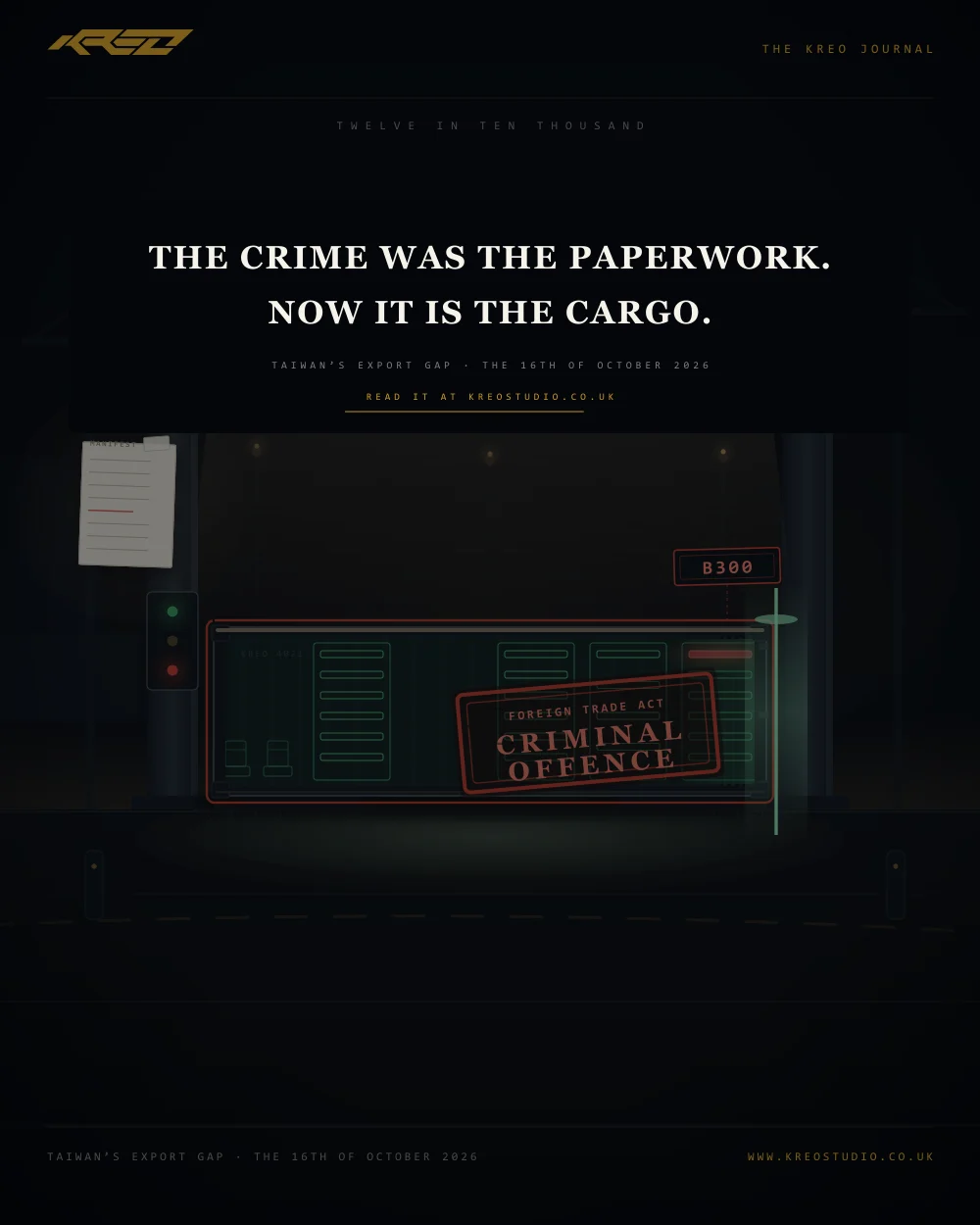
The island that makes the world’s most advanced chips spent three years watching them leave, and could prosecute only the lies in the paperwork, because the export itself was not a crime. On the 16th of October 2026, that changed.
Key · companies amber, places red
There are two offences in every smuggled rack. The first is the lie: the invented customer, the copied serial, the invoice that names Singapore. The second is the export itself. For three years, the courts could charge only the first: exporting to China was a licence problem, not a crime.
That is the change Kung Ming-hsin described. Interviewed on the 12th of October 2026, published by Bloomberg on the 16th, the economics minister said Taiwan will add AI servers and cutting-edge semiconductors to its controlled export list. Unauthorised shipments of restricted AI hardware to China will become a criminal offence under the Foreign Trade ActConfirmedthe interview, read via its syndication. He tied the measures to the Agreement on Reciprocal Trade. No date.
On the 19th of March 2026, Manhattan prosecutors unsealed an indictment against three men tied to a US server maker: its co-founder, a Taiwan sales manager, a contractor. From October 2023, the papers allege, they diverted about $2.5 billion of AI servers to China: a Singapore customer as a front, dummy machines staged for inspectors in December 2025 while the real servers were gone. The contractor pleaded guilty on the 9th of October 2026.
Taiwan’s own dockets filled in parallel. In May 2026 came the first detentions: three people accused of forging documents; in July, a man reported to be an Nvidia employee was detained. On the 24th of August 2026, Keelung prosecutors indicted nine people, two from Super Micro’s Taiwan unit, over 130 AI servers of the B300, barred from China. Seventy-four reached ChinaReportedthe prosecutor's document, via AP: fifty via Indonesia, sixteen direct, eight via Japan and Hong Kong. Fifty-six never left the quay. The charges were forgery and breach of trust, not the export.
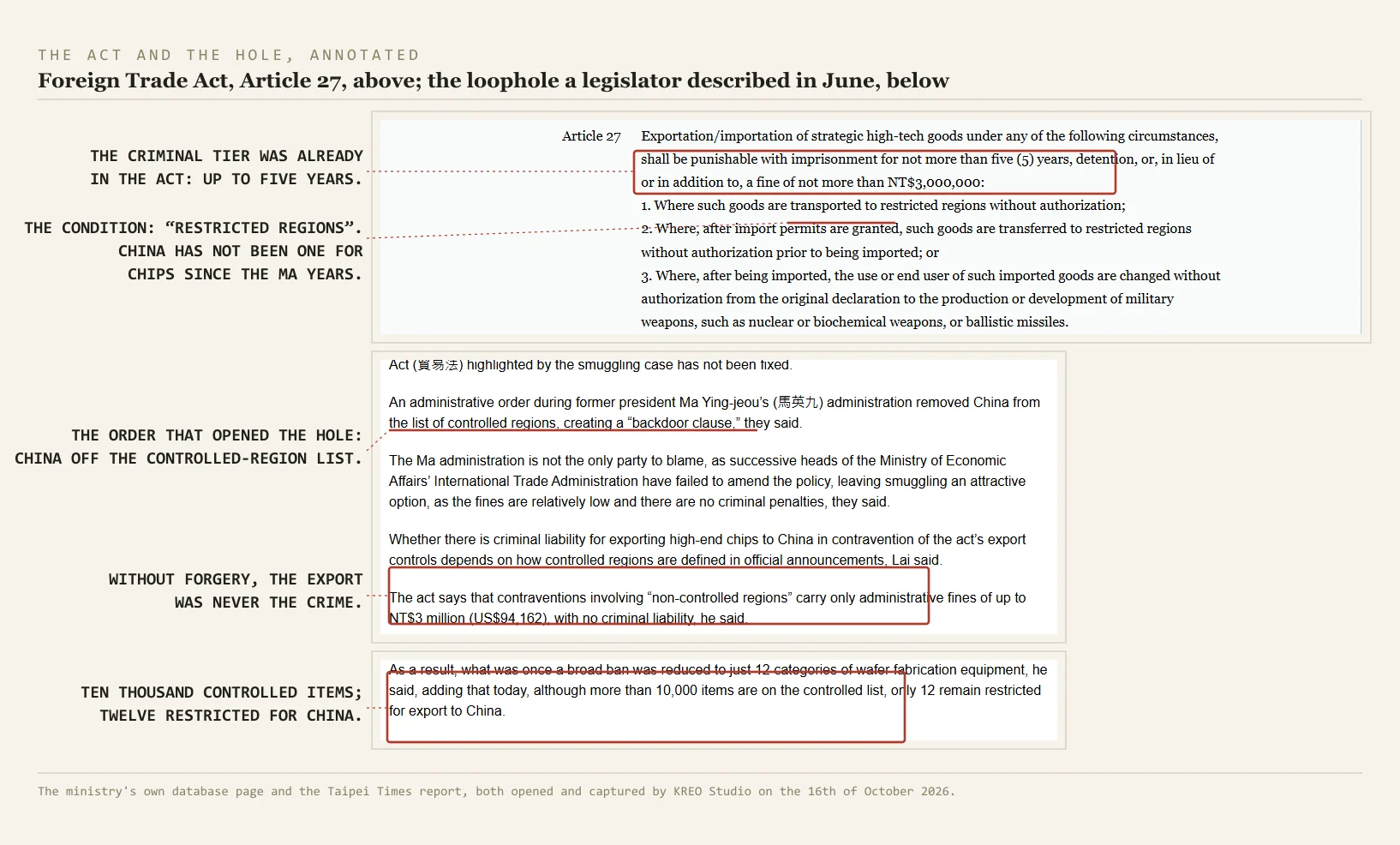
The export was not the crime because of a hole in the law, twelve items wide. Article 27 already prescribed up to five years for strategic goods sent to a restricted region. But a Ma-era order removed China from that list, leaving just twelve categories of wafer-fab equipment: of more than ten thousand controlled items, only those twelve applied to China. Without forged papers, the worst a diversion drew was a fineReportedthe lawmaker's figures, Taipei Times reaching NT$3 million, about $92,600.
The gap has been on the ministry’s file since June 2026, when Kung told a committee the measures were being drafted and were “certain”. What stiffened it was the trade deal. The Agreement on Reciprocal Trade, signed on the 12th of February 2026, cuts US tariffs on Taiwanese goods from 20 to 15 per cent and commits a five-hundred-billion-dollar investment programme, awaiting the island’s legislature. A legislator, Chung Chia-pin, has drafted the clause making the shipping itself an offence.
Interactive · the docket
One shipment, two laws. Flip the switch.
From the minister’s sentence, Article 27 and the charge sheets. Drafted, not yet law.
The stakes are the island itself. TSMC reported its sixth consecutive record quarter on the 15th of October 2026: NT$763.1 billion, up almost seventy per cent. That output’s last physical checkpoint is Taiwanese customs, whose criminal law was thinner than the trade it policed: the maximum fine, one twenty-seven-thousandthCalculatedUS$92,600 against a $2.5 billion haul of a single haul. Criminal liability rewrites the arithmetic run before a bill of lading is signed, and puts assemblers and forwarders under two codes at once.
Read the docket, not the drama. The clause is drafted, the list promised, the date unset. What is settled is the direction: the island will name the crime at the point of departure. The offence in a smuggled rack was its paperwork; now it is the cargo.
If you are weighing what your AI supply chain carries across which borders, email brandon@kreostudio.co.uk.
Readout: what is confirmed, and what is not
- Confirmed, read on the day: the minister’s interview through its syndication (AI servers and cutting-edge semiconductors joining the controlled list; unauthorised shipments to China becoming a criminal offence under the Foreign Trade Act; the Agreement on Reciprocal Trade link; the refusal to date the measures; that Taiwan does not currently treat such exports as a crime itself).
- Confirmed, from the primary text: Article 27 of the Foreign Trade Act at the Ministry of Justice’s database (imprisonment for not more than five years for strategic high-tech goods transported to restricted regions without authorisation; a fine of not more than NT$3,000,000).
- Confirmed, from the record: the Ma-era proviso and the twelve-of-ten-thousand figures (the legislator’s press conference, read via the Taipei Times of the 27th of June 2026); the June 2026 drafting (Taiwan News, the 18th of June 2026); the August indictments and the routes (Reuters and AP, the 24th of August 2026, the AP text read in full: 130 servers, 74 arriving, 50 via Indonesia, 16 direct, 8 via Japan and Hong Kong, 56 blocked; B300; breach-of-trust and forgery charges); the May detentions (Bloomberg headline, the 21st of May 2026); the October indictments in New Taipei (Taipei Times and Focus Taiwan, the 6th and 7th of October 2026); the Manhattan indictment and the plea (the Department of Justice, March 2026; Reuters, the 9th of October 2026); TSMC’s quarter (CNBC, the 15th of October 2026); the trade terms (USTR and the Hudson Institute).
- Reported, not directly read: Bloomberg’s own page is paywalled and was read via its Yahoo Finance syndication; the FT’s headline on the first indictment of an Nvidia worker was seen but not read; the route counts come from the prosecutors’ document as relayed by AP.
- Calculated, mine: the fine against the haul (NT$3 million, about US$92,600, one twenty-seven-thousandth of $2.5 billion); the routes arithmetic (50 + 16 + 8 = 74; 74 + 56 = 130), re-asserted in the chart’s code.
- Not confirmed: when the measures take effect; whether the clause passes as drafted; how transit cases will be charged once it does; whether the twelve-of-ten-thousand count is still current.
- What would change the picture: a final list that omits AI servers, or an enforcement that stays dormant once the clause exists. If either happens, this piece is corrected here.
Sources & references
- Bloomberg, Taiwan to Curb AI Chip Exports to China as Part of US Trade Deal, the 16th of October 2026. Read in full via the Yahoo Finance syndication; the Bloomberg page itself is paywalled. The source of every quoted sentence from the minister.
- Taiwan News, Taiwan to impose strict controls on AI chip exports to China, the 16th of October 2026: the same-day check of the interview and its CNA sourcing.
- Taiwan Ministry of Justice, the Foreign Trade Act, Article 27, Laws & Regulations Database. Opened and quoted; captured for the plate.
- Taipei Times, China tech export rule gaps need fixing: lawmaker, the 27th of June 2026. Read in full: the Ma-era proviso, the twelve-of-ten-thousand figures, the fine with no criminal liability. Captured for the plate.
- Taiwan News, Taiwan moves to tighten AI chip export controls to China, the 18th of June 2026: the minister’s “certain” line and the cross-agency drafting.
- Reuters, Taiwan indicts 9 over alleged illegal export of AI servers to China, the 24th of August 2026: the charge counts and the company statements.
- AP via PBS NewsHour, Taiwan charges 9 over illegal AI server exports to China, the 24th of August 2026. Read in full: 74 arrived (50 Indonesia, 16 direct, 8 Japan then Hong Kong), 56 blocked, B300, the five-year sentences sought.
- Reuters, Taiwan detains Nvidia employee in Super Micro probe, the 28th of July 2026.
- US Department of Justice (SDNY), Three Charged with Conspiring to Unlawfully Divert Cutting Edge U.S. Artificial Intelligence Technology to China, March 2026: unmarked boxes, dummy servers, the October 2023 start.
- BBC, Trio charged over alleged plot to smuggle Nvidia chips from US to China: the Singapore front.
- Reuters, Super Micro contractor pleads guilty in scheme to divert AI servers with Nvidia chips, the 9th of October 2026.
- Financial Times, Nvidia employee charged with smuggling advanced chips into China, headline and standfirst only (paywall): the first indictment of a chipmaker worker.
- Bloomberg, Taiwan Moves to Detain Three Over Nvidia AI Chip Smuggling to China, the 21st of May 2026. Headline and standfirst (paywall).
- Taipei Times, Ten indicted for smuggling chips, fraud, the 7th of October 2026, with Focus Taiwan, the 6th of October 2026: the New Taipei case.
- CNBC, TSMC posts record profit for a sixth straight quarter, the 15th of October 2026.
- USTR, Fact Sheet on the U.S.-Taiwan Agreement on Reciprocal Trade, February 2026, with the Hudson Institute’s reading of its terms: the 20-to-15 tariff cut, the five-hundred-billion-dollar programme, and its pending ratification.
Reader signal
Was this useful?
Work with KREO Studio
AI engineering, data science and design architecture, from Plymouth to the wider UK.
Next Article
Closed From the Inside
From the KREO Journal · kreostudio.co.uk/blog/twelve-in-ten-thousand · published the 16th of October 2026. Corrections are dated, never silent.
