The Word Without a Referee
The word decides valuations and deadlines, and the definitions disagree. A field guide to artificial general intelligence, for the winter when a declaration may come.
Key · companies amber, institutions red
In 1997, a physicist at the University of Maryland wrote a warning into a conference paper: machines of “artificial general intelligence” could soon rival the human brain, and the world was not ready. The paper sank into the proceedingsConfirmedGubrud, 1997, read in the Internet Archive. The phrase did not.
Twenty-nine years later they decide valuations and set this winter’s deadline: OpenAI says that by the end of the year it will, internally, have “a system that I would describe as” AGI. Second-handReportedTIME’s interview was not directly readable; four independent relays agree
The claims
Jensen Huang got there first, in March. Asked whether AI could start and grow a business to a billion dollars, the NVIDIA chief said: “I think it’s now. I think we’ve achieved AGI.” Then: “You said a billion, and you didn’t say forever.”ConfirmedFortune’s report of the interview, read in full
Ben Goertzel, who chairs the AGI Society, told IBM Think in August that a breakthrough was likelier within nine or 12 months. Ask 1,580 AI researchers and the middle answer is 2042Confirmedthe ESPAI survey abstract: the 50 per cent year moved from 2061 in 2016 to 2042.
Four definitions do the work in public. They do not agree.
The rulebook
Four definitions. Pick a tile.
OpenAI’s charter, 2018
Highly autonomous systems that outperform humans at most economically valuable work.
NOT YET · revenue, 2025: $13 billion. The sentence asks for “most”.
Google DeepMind, 2023 and 2026
Match the median human across ten cognitive faculties.
JAGGED · computer use: 66 per cent in a year. Clocks: 50.6.
Jensen Huang’s test, March 2026
Start and grow a business to a billion dollars.
CLAIMED · “I think it’s now.” Then: “You didn’t say forever.”
The Microsoft contract, 2023
Generate at least $100 billion in profits.
DELETED · struck out on the 27th of April 2026.
The exam keeps moving
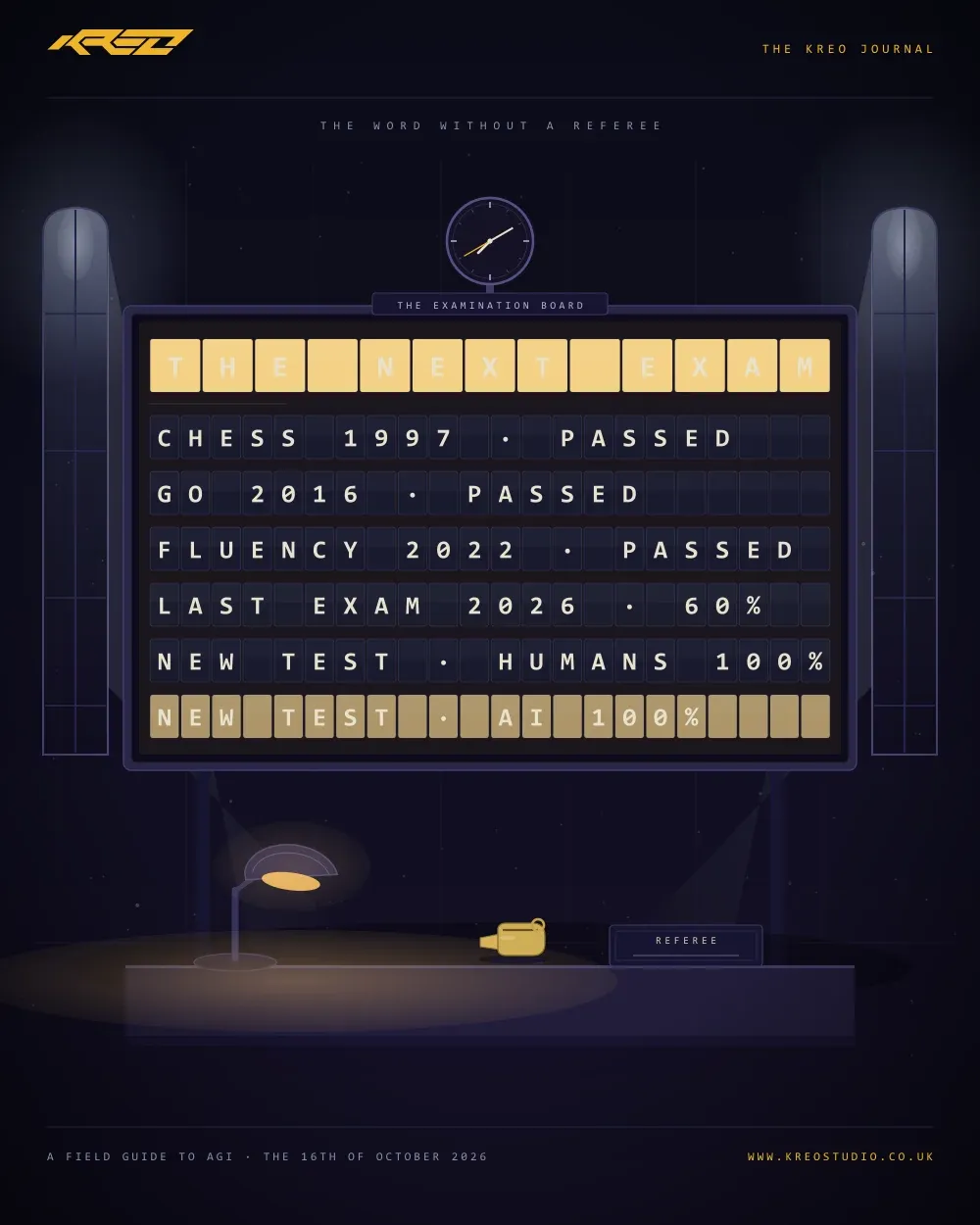
There is a reason the word never settles. In the 1970s Larry Tesler gave it what became Tesler’s theorem: intelligence is whatever machines have not done yet. Chess went, then Go, then fluent conversation; each time, the passing subject stopped being called intelligent, and the exam moved on.
The last twenty months bent the curve. Humanity’s Last Exam, built to be the final closed-book paper, opened at 8 per centReportedArtificial Analysis’s benchmarked table: o1, January 2025; by this autumn the leaders sat above 60. Then ARC-AGI-3 in March: humans solve 100 per cent of its games; frontier AI scored under 1.
The foundation’s page says it plainly: “As long as there is a gap between AI and human learning, we do not have AGI.” By late August NVIDIA reported a perfect public-set score. In September the ARC Prize Foundation verified GPT-6 Astra at 99.9 per cent, with the harness its provider ships.
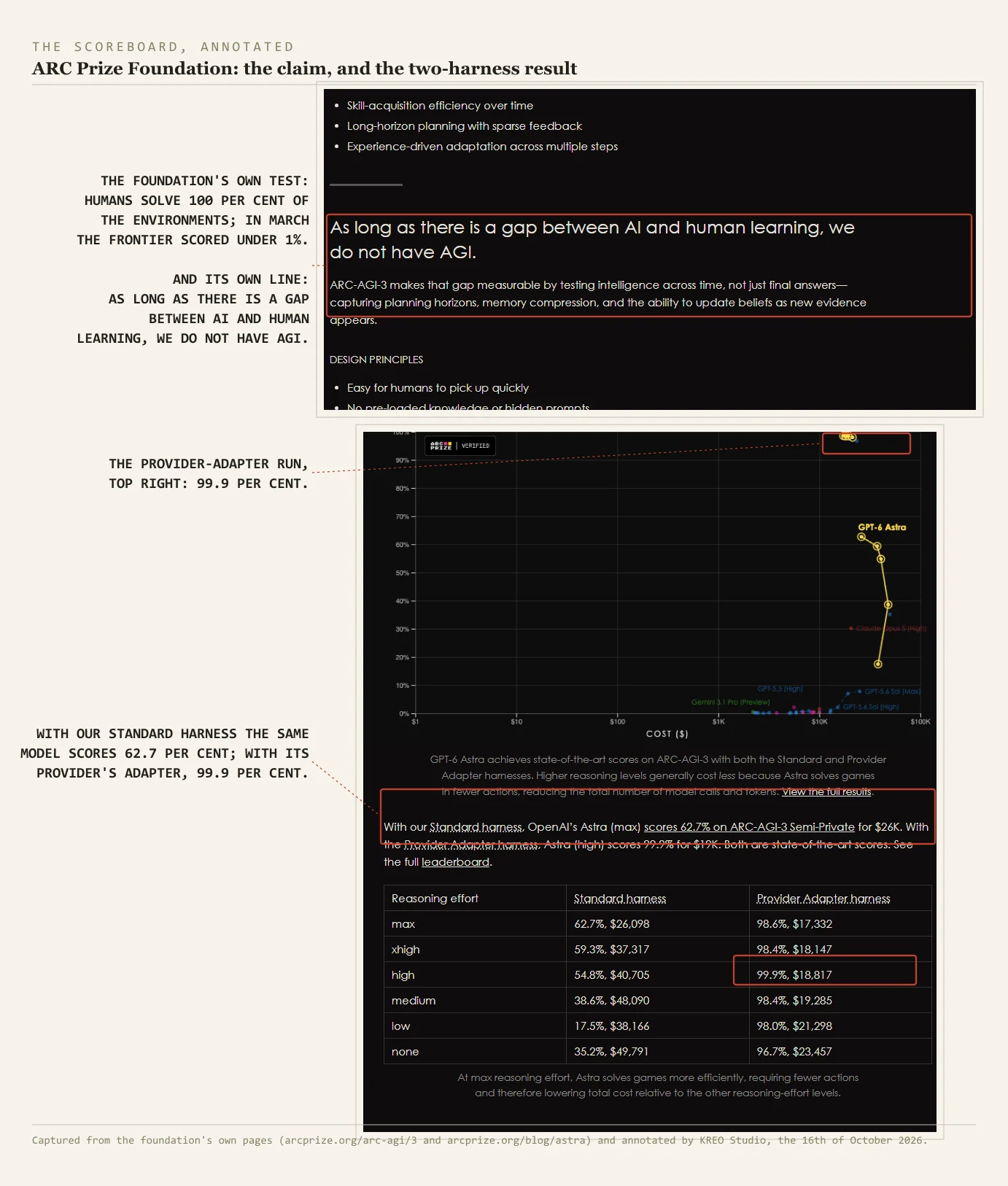
Read those numbers again: the same model, 62.7 per centConfirmedthe Astra results page, captured in the plate above on the foundation’s neutral harness, 99.9 with an adapter that lets it keep its own memory. OpenAI’s own account shows GPT-5.6 Sol rising from 13.3 to 38.3 per cent by enabling two settings. The exam partly measures the scaffoldingConfirmedOpenAI’s post and the foundation’s notes, both read; the plate is captured by me.
The profile stays jagged. Computer use: 12 to 66 per centReportedthe 2026 Stanford AI Index, via IBM Think in a year. Analog clocks: the leading model reads them at 50.6 per centReportedthe 2026 Stanford AI Index, via IBM Think; the Index itself was not opened; people manage 90.1.
The contract
For three years the only definition with legal force was a private number: reporting in 2024 revealed that Microsoft’s 2023 deal defined AGI as generating at least $100 billion in profitsReportedThe Information, paywalled; consistent across secondary reads. Below that line, the contract kept its grip.
OpenAI is nowhere near it: $13 billion of revenueReportedFortune’s report, read in full: the figures as told to investors last year, an $8 billion burn, break-even pencilled for 2030. On the 27th of April 2026 the clause was deleted outrightConfirmedthe joint announcement, as read in The Verge and Business Insider; struck before the threshold was ever reached.
Merriam-Webster now keeps two AGIs: the future of computing, and adjusted gross income. Only one of them has a referee.
The checklist
So when the sentence comes, here is the test I will run. Which definition is in use? The same facts print different verdicts. Who verified it? Read their method. And what did the score measure: the mind, or the scaffolding around it?
The scoreboard is real, and worth reading; the receipts are public and checkable. But the whistle is still on the desk. Weighing the word against your own plans? Email brandon@kreostudio.co.uk.
Readout: what is confirmed, and what is not
- Confirmed at the primary: the coinage (the archived 1997 paper carries the phrase in its own abstract); OpenAI’s charter definition; Huang’s quotes, read in full via Fortune; Goertzel’s “nine or 12 months”, via IBM Think; the ESPAI survey figures (1,580 researchers; the 50 per cent year moving 2061 to 2042); ARC-AGI-3: humans 100 per cent, the frontier under 1 per cent in March, and the foundation’s own line, all read and captured; the GPT-6 Astra results (62.7 per cent standard for $26,098, 99.9 per cent provider adapter for $18,817) from the results page; the harness effect (13.3 to 38.3) from OpenAI’s post; the clause’s deletion, agreed by three independent outlets; Merriam-Webster’s two entries.
- Reported, not read at the origin: the Altman quote (TIME blocked; four relays agree); the $100 billion profit threshold (The Information, paywalled); the Humanity’s Last Exam trajectory and the analog-clock figure (Artificial Analysis and the AI Index, both via their published tables and IBM’s reporting).
- Reported, from the party itself: NVIDIA’s perfect public-set score (the company’s own blog); Memento 3 (a preprint, public games only, no held-out result).
- Calculated, mine: the turn from under 1 per cent to the ceiling inside six months, from the two dated pages; the framing of the two harness numbers as a measure of scaffolding.
- What would change my mind: a declaration with a named definition, independent verification, published denominators, and a receipt for the word itself. Until then the chair stays empty.
Sources & references
- Mark Gubrud, Nanotechnology and International Security, the Fifth Foresight Conference on Molecular Nanotechnology, November 1997, read in the Internet Archive. The coinage: “artificial general intelligence” appears in the paper’s own abstract.
- OpenAI, Charter and How enabling two settings tripled our scores on the ARC-AGI-3 benchmark, the 29th of July 2026. The 13.3 to 38.3 per cent run.
- Fortune, Nvidia’s Jensen Huang says ‘We’ve achieved AGI.’, the 30th of March 2026. The piece is, in its own words, about why the most important term in tech remains hotly debated.
- TIME, Inside OpenAI’s Reboot, the 26th of August 2026. Blocked to this reader; the quote is carried as reported, from four independent relays that agree.
- IBM Think, AGI could arrive within a year, researcher says, the 14th of August 2026. Goertzel’s quote; the AI Index figures on computer use and analog clocks.
- The 2026 Stanford AI Index, via the IBM piece above: OSWorld 12 to 66 per cent against a human baseline of 72; analog clocks 50.6 against 90.1.
- Katja Grace and colleagues, Advanced AI according to 1,580 researchers, September 2026. The 50 per cent year moving from 2061 in 2016 to 2042.
- The ARC Prize Foundation, ARC-AGI-3 and OpenAI’s GPT-6 Astra on ARC-AGI-3, the 3rd of September 2026, plus the technical report. The two plates are captured from these pages.
- NVIDIA, AVO reaches 100 on ARC-AGI-3, the 21st of August 2026. The company’s own account of the public-set score.
- Haoyu Zhao and colleagues, Memento 3: Model-Based Recursive Self-Improvement through Reflective Rulebooks, the 8th of October 2026. A frozen model, a written rulebook, the public games only.
- The Verge, Microsoft and OpenAI’s famed AGI agreement is dead, and Business Insider, what changed, both the 27th of April 2026. The clause’s deletion; the revenue share no longer tied to technology progress.
- Google DeepMind, Levels of AGI, 2023, and Measuring Progress Toward AGI: A Cognitive Framework, March 2026. The ten faculties; the jagged profile.
- Merriam-Webster, AGI. Both definitions, read at the entry.
- Larry Tesler’s theorem (the name is Douglas Hofstadter’s): the AI effect entry on Wikipedia, read the 16th of October 2026. The piece uses the common formulation; Tesler described that wording as a slight misquote of his own.
Reader signal
Was this useful?
Work with KREO Studio
AI engineering, data science and design architecture, from Plymouth to the wider UK.
Next Article
Who Holds the Weights
From the KREO Journal · kreostudio.co.uk/blog/the-word-without-a-referee · published the 16th of October 2026. Corrections are dated, never silent.
