The Students Are Not the Problem: What the UK University Crisis Actually Exposes
Some sentences stop you. Over the past week I have been reading what UK students are saying to each other online, and a handful of lines kept coming back to me: "I'm only at university because it's my only chance of getting somewhere." "My rent goes on my accommodation, and after that I have nothing." "The loan gives me five pounds a day." "You can't help feeling scammed when you are going into debt for a course where the teachers don't understand the AI curriculum themselves."
Those quotes are paraphrases, tidied to protect the people who wrote them. The feelings behind them are not rare. They are the norm, and the numbers say so.
The loan does not cover the rent
Start with the arithmetic, because the arithmetic is the part nobody argues about. For a student living away from home outside London, the maximum maintenance loan in England is £10,830 for 2026/27, and only students from households earning £25,000 or less get that maximum. The minimum is £5,048. The average student rent is £575 a month, which is about £6,900 across a year. On the maximum loan, rent alone eats roughly 62% of everything you have. On the minimum loan, rent costs more than the entire year's support, before food, before travel, before a single book.
It was not always like this. The Institute for Fiscal Studies has shown that maintenance support was cut in real terms by around 10% over two years, the sharpest fall since the early 1960s, and that the shortfall became permanent because forecast inflation errors were never corrected. The household income threshold that decides who gets the maximum has been frozen at £25,000 since 2008. The result is baked in: support shrinks a little more each year while costs do not.
A loan that does not cover rent is not a loan. It is a subsidy for landlords, paid for by the people with the least to spare.
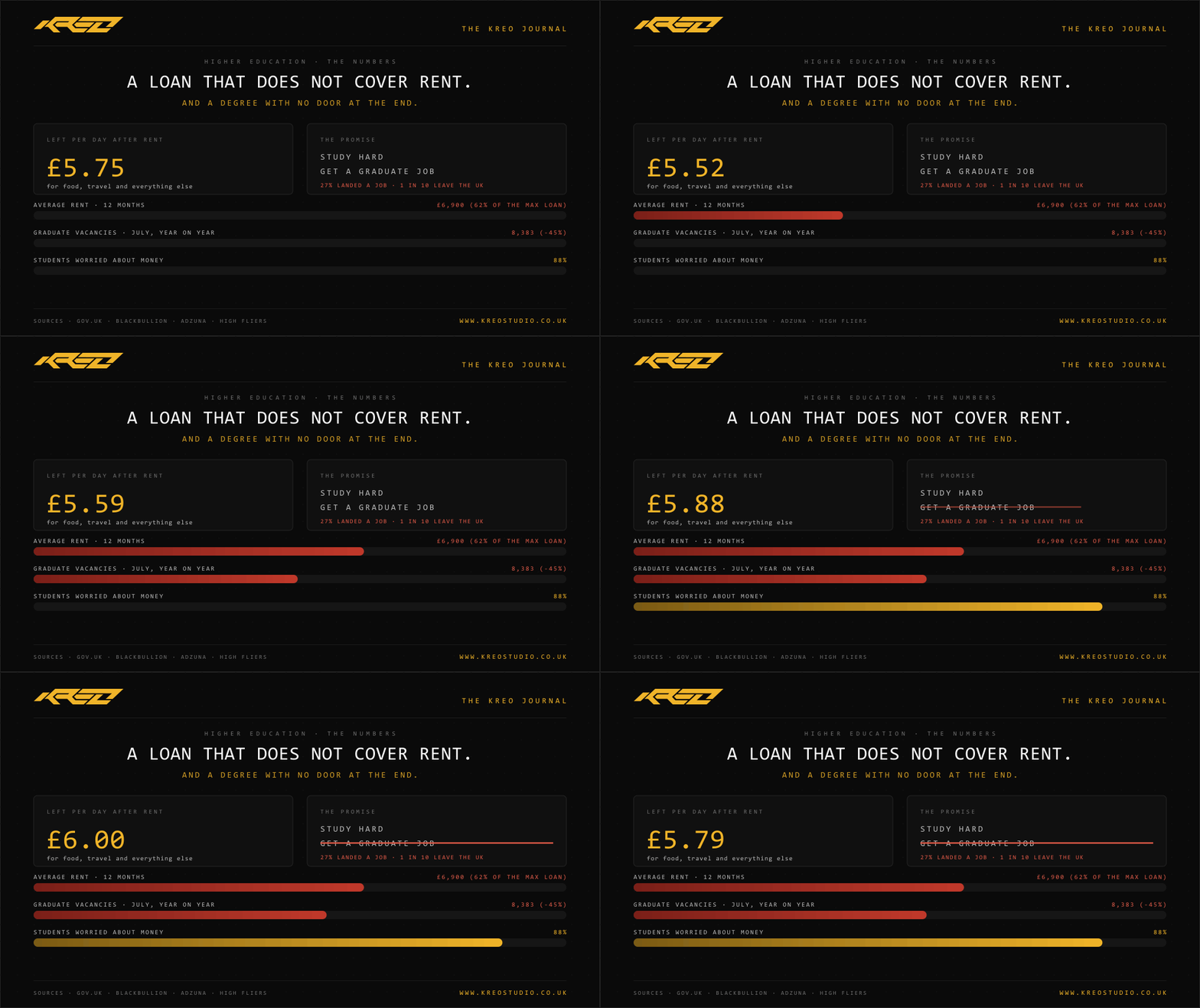
The lived version is worse than the chart. Blackbullion's 2026 Student Money and Wellbeing report, built on a nationally representative survey of more than 2,000 students, found that 88% worry about money, the highest in six years, and that 63% say those worries are directly harming their mental health, up from 54% two years earlier. Students told Save the Student that their loan falls short of living costs by £502 a month. More than three in five skip meals to save money. One in ten has used a food bank.
A degree with no door at the end
Then there is the question of what the debt is buying. This year, UK graduate vacancies fell to 8,383 advertised roles in July, the lowest since records began in 2016, and down 45% on the year before. There were more jobseekers than vacancies for the first time in a decade. High Fliers found that one in ten final-year students now plans to leave the UK to find work, and that the number who had already secured a job, 27%, was a record low. The advertised graduate market is the thinnest it has ever been.
None of that is the fault of the student. The debt was signed for on a promise: study hard, and a graduate job follows. When the jobs evaporate, the promise is broken, but the balance is not.
And some of them are being taught AI by people who do not build it
Here is the part I know from the inside. Artificial intelligence is now a flagship subject, sold to students as the future they are paying to enter. But a survey of undergraduates found that only 20% at Russell Group universities believe AI in the workplace is taught thoroughly on their course, against 30% at newer institutions. A Times Higher Education investigation reported that many staff are self-taught, with a gap between policy and practice, and that only 37% of UK higher education institutions have delivered any AI development for their teaching staff. A student put it best: if we handed in AI work, we would be thrown out, but we are being taught by an AI.
I have made this argument before, in a piece asking who should actually teach AI. The answer is people who have built systems, not only people who can describe them. When a curriculum is written for a future the teacher has never worked in, the student is paying for a lecture, not a skill.
You cannot teach a frontier by reading about it. You can only teach it by having crossed one.
What the government is doing, and not doing
To be fair, this is not invisible to policy. The government will reintroduce maintenance grants in 2028/29, worth up to £1,000, which the Commons Library notes is around 80% less in real terms than the grants of 2015/16. The £2.5 billion youth employment package is real: a £3,000 grant to employers who hire a long-term unemployed young person, a guaranteed job after 18 months on Universal Credit. Those measures are welcome.
But they aim at the school leaver, not the undergraduate already three years into a loan. None of it touches the arithmetic inside the decision to advertise a graduate role. And none of it changes the fact that for a student with no parents to fall back on, the loan is not support. It is survival.
Readout: the numbers worth quoting
- 88% of UK students worry about money, and 63% say it damages their mental health (Blackbullion 2026).
- The average loan falls £502 a month short of living costs; 61% skip meals; 10% use food banks (Save the Student 2025).
- Graduate vacancies hit 8,383 in July, the lowest since 2016 and down 45% year on year (Adzuna, via the Guardian).
- One in ten final-year students plans to leave the UK for work (High Fliers 2026).
- Only 37% of higher education institutions have given staff AI development (Jisc 2025).
- Maximum maintenance loan, living away from home outside London, is £10,830 for 2026/27 (GOV.UK).
What a system that supported students would look like
This is not a demand for free money. It is a demand for honesty. If the state wants a graduate workforce, it has to fund the years that produce one. That means restoring maintenance support to its real 2020/21 level and tying it to a mechanism that corrects forecast errors instead of quietly cutting every year. It means unfreezing the household income threshold that has sat at £25,000 since 2008. It means a hardship fund with teeth, so no student is choosing between a lecture and a meal. And it means holding universities to a higher bar on who teaches AI: practitioners who have shipped, not slide-readers.
The students are not fragile. They are doing the hardest thing a young person can do in a bad economy, which is bet their twenties on a future. The least the country can do is stop making that bet harder to place.
I work with teams and institutions on putting real AI engineering, not AI theatre, in front of students. If you are a university or employer who wants an honest view, email brandon@kreostudio.co.uk.
Reader signal
Was this useful?
Work with KREO Studio
AI engineering, data science and design architecture, from Plymouth to the wider UK.
