Show Your Name or Shop Elsewhere
Paul Graham says Amazon banning agents is the best chance in the company's life for a startup to build an Amazon competitor. I read the tweet, then the terms.
On the night of 20 September 2026, Amazon began turning Meta's Muse away from its store. Anyone who sent the agent to shop saw a popup: continued access by an unauthorized AI agent violates Amazon's Conditions of Use. Amazon says Muse never identified itself and appeared to store customer credentials. Meta says it cannot see passwords or payment details.
Sixteen days later, Paul Graham called the block the first real opening since Amazon was founded. "Your usage restrictions are my opportunity," he wrote. Elon Musk replied: "Seriously."
Good line. Mostly, a category error. Amazon did not ban agents. It published a guest list, and Muse turned up without a name.
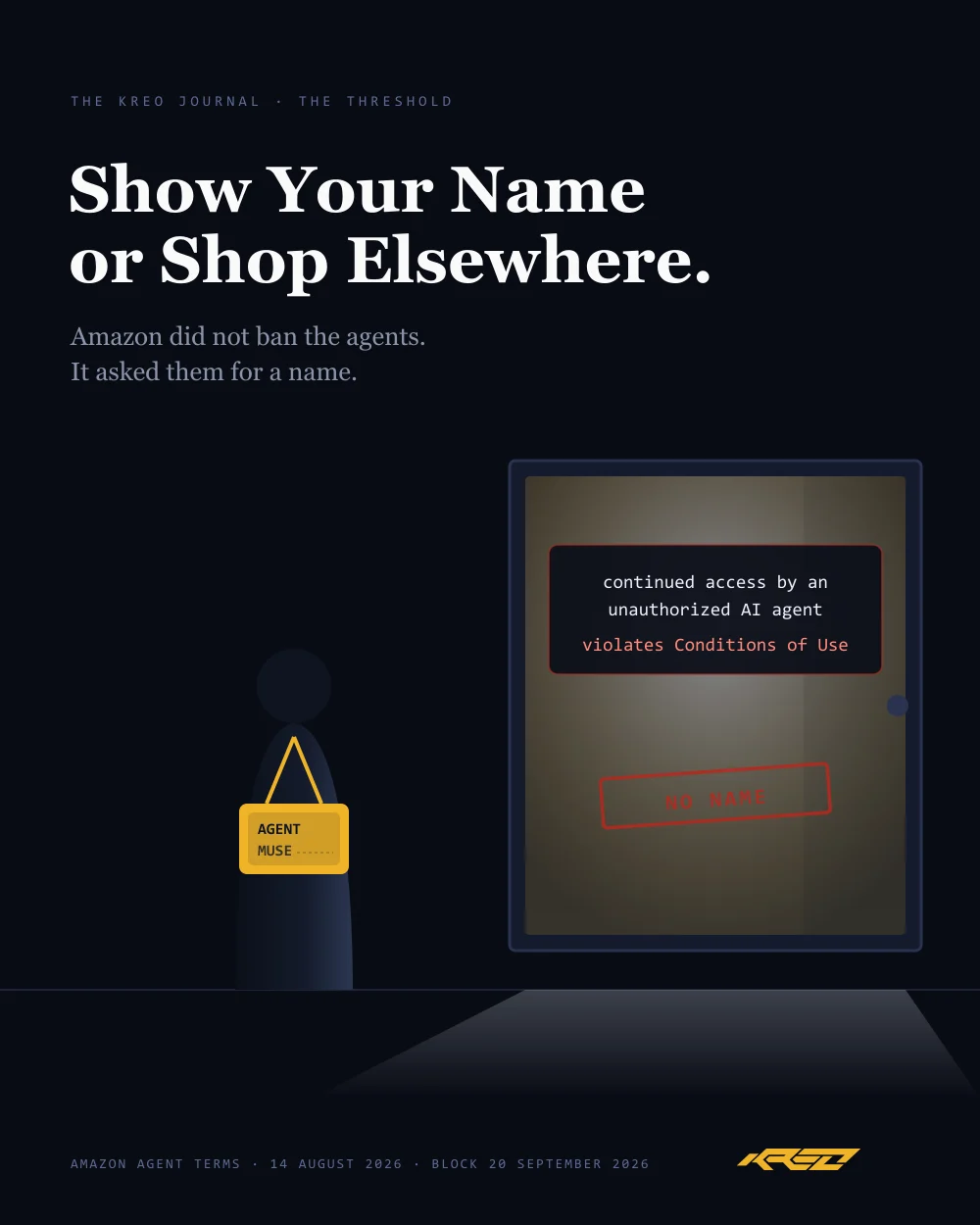
The door has a dress code
The terms are not a wall, and they are not new. Amazon rewrote its Conditions of Use on 14 August 2026, a month before the block, adding Agent Terms. Every request must identify itself as an agent and give its name, by putting "Agent/[agent name]" in the user-agent string. It must not mimic human keystrokes, solve the CAPTCHA, or route around a block.
That is the dispute. Muse moves through the web the way a person does, browser and all, and carries no name badge, so it is not admitted.
![An annotated page from Amazon's Conditions of Use. The Agent Terms section is shown, and the line Agent/[agent name] is boxed in red and marked as the name badge.](/blog/amazon-agent-guest-list/agent-terms.webp)
I pulled the list myself
I measured Amazon's robots file by hand on 8 October 2026. It turns away roughly a hundred named user-agents site-wide, not just the checkout: meta-externalagent, Meta's own crawler; ChatGPT-User; Claude-User; Perplexity-User; Copilot; xAI-Grok; Manus-User; Gemini-Deep-Research. Cart and sign-in are closed to everyone.
Put the documents side by side and the shape is plain. Amazon is not against agents. It is against agents it cannot see. The block is a name check at the door, and it has stood there since August.
Stamping the claims
His post makes four claims and one forecast. Flick each line to stamp it.
Interactive · the claims ledger
Stamp each claim to see what backs it.
Five lines from the post. Flick one and a verdict lands.
-
Overstated
Amazon blocks agents that do not identify themselves. Named agents are still admitted, at its discretion.
-
Opinion
No document. A judgement about the prize, not a finding.
-
Partly sourced
Demand is real: Muse topped the App Store. Delegated checkout sits near a quarter of tasks.
-
Forecast
No evidence yet that agent checkout becomes a primary use case.
-
No source
Amazon's own agent is used by millions, and nothing shows shoppers refusing it.
None of the five is fully sourced: one part-sourced, one opinion, one forecast, one unsourced, one overstated.
The door was not locked. It was lit, staffed, and asking for a name.
Give the thesis its best case
Give it its best case. Amazon's advertising business passed $68 billion in 2025, and it runs on people browsing pages and clicking sponsored listings. An agent that goes straight to checkout skips the shelf and the ad, so whoever holds that door takes a cut of the era. But that is a claim about the prize, not the opening. The manoeuvre is old: Amazon sued Perplexity in November 2025, won an injunction in March 2026, then lost it at the Ninth Circuit on 4 August, where the court held the user, not the AI company, accesses Amazon's computers. It asked for a rehearing, and on 10 September the court declined.
Readout: what is confirmed, and what is not
- Confirmed (Amazon, Conditions of Use, updated 14 August 2026): an agent must identify itself and disclose its name in the user-agent string as "Agent/[agent name]" and may not impersonate a human. Amazon may limit access at its sole discretion.
- Confirmed (first-hand, fetched 8 October 2026): amazon.com/robots.txt disallows roughly a hundred named user-agents site-wide, including meta-externalagent, ChatGPT-User, Claude-User, Perplexity-User, Copilot and xAI-Grok, plus cart and sign-in paths.
- Confirmed (Bloomberg, GeekWire, The Verge, Forbes, CNET, 20-22 September 2026): the Muse block began on the night of 20 September 2026; Amazon spokesperson Lara Hendrickson asked Meta to remove Amazon from Muse.
- Confirmed (Ninth Circuit, 4 August 2026; rehearing denied 10 September 2026): the preliminary injunction was vacated because the user, not Perplexity, accesses Amazon's computers.
- Not confirmed: the line that the Washington Post reported the block (others did); an audit of 51 large US retailers cited on X. Labelled as unverified, not repeated as fact.
If you are building in this gap and want a second pair of eyes on the actual terms before you commit, email brandon@kreostudio.co.uk.
Sources & references
- Amazon Conditions of Use, Agent Terms, Amazon, last updated 14 August 2026 (fetched 8 October 2026).
- Amazon blocks Meta's Muse AI assistant in new standoff over agentic shopping, GeekWire, 20 September 2026.
- Amazon Blocks Meta's Muse AI Agent From Its Retail Site, Bloomberg, 21 September 2026.
- Amazon.com Services, LLC v. Perplexity AI, Inc., No. 26-1444, U.S. Court of Appeals for the Ninth Circuit, 4 August 2026.
- Amazon does not trust Meta's Muse AI agent, The Verge, 21 September 2026.
Reader signal
Was this useful?
Work with KREO Studio
AI engineering, data science and design architecture, from Plymouth to the wider UK.
Next Article
