You Can Own the Box. You Still Don't Own the Intelligence.
Ghost's Core is a $3,499 computer that promises your AI belongs entirely to you. It is well built, and the price is fair. It also cannot run the models you actually want, and the reason is one number.
Imagine you have bought it. You carry home a steel cube, switch it on, and ask for the model you were most excited about. DeepSeek. GLM. The answer is no. It does not fit.
That number is 24 gigabytes. It is the whole story, and it is the part the launch film does not lead with.
The company is called Ghost. It came out of stealth on Monday with $11 million led by Andreessen Horowitz, a founder named Zain Javaid who is 19, and a product called Core. It is a screenless desktop that runs AI on your own hardware, learns from your life, and, in Ghost's words, keeps the intelligence, its memory, and everything it learns about you entirely yours. The pitch is aimed straight at the moment we are in, where the best AI is rented by the token and lives on someone else's servers. Ghost is betting that enough people would rather own the machine.

What you are actually buying
The specification is public. A Nvidia RTX PRO 4000 Blackwell SFF Edition with 24GB of GDDR7 memory and 432 GB/s of bandwidth. A six-core AMD Ryzen 5 7600. 64GB of DDR5. A 1TB drive. Brushed stainless steel. Ghost quotes 770 AI TOPS. Four models come installed, the largest of which is Gemma 4-31B, and it ships in the last week of October.
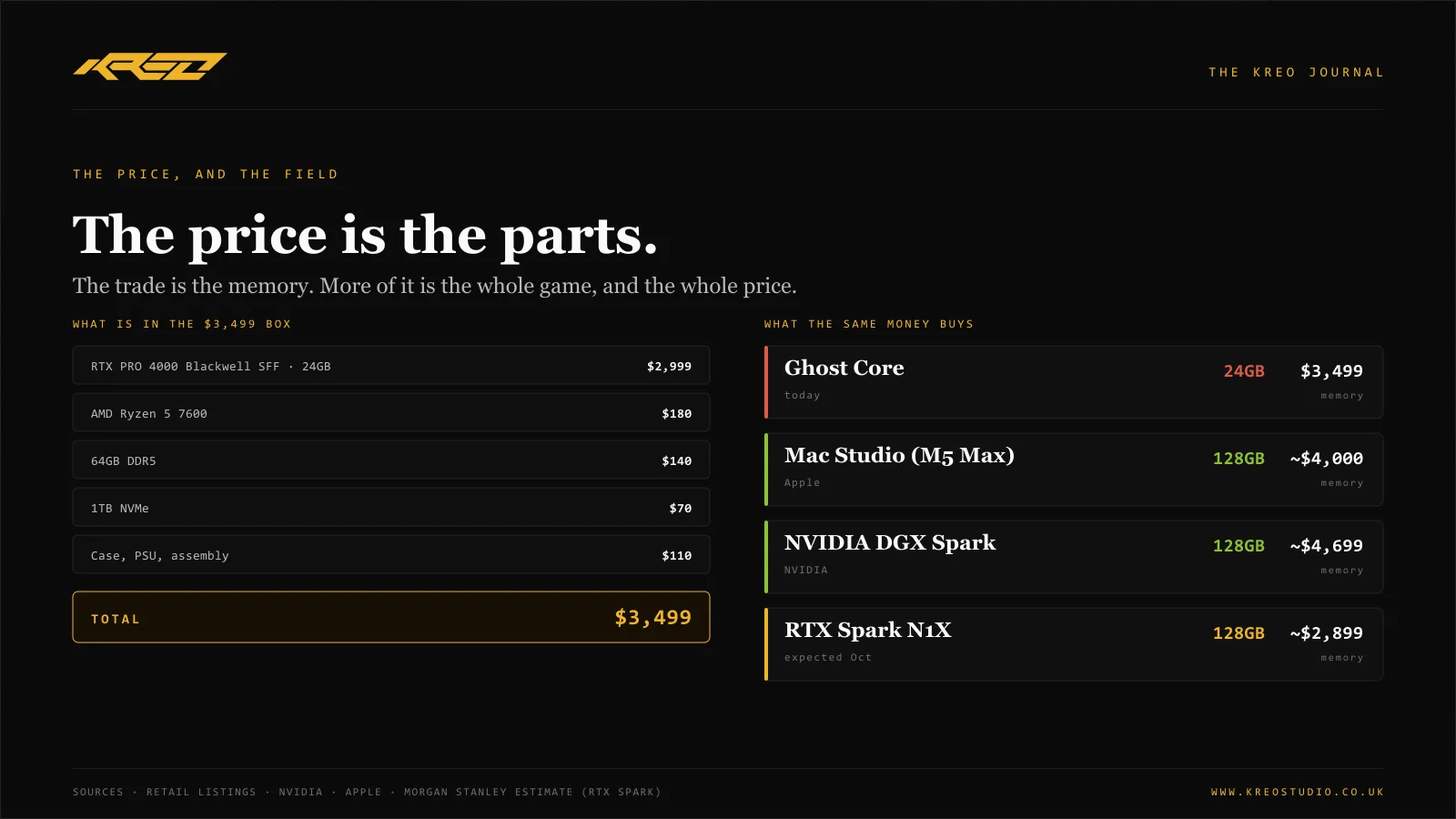
The price is close to the parts, and that matters, because it means this is not a cheap computer marked up seven times. That Blackwell workstation GPU alone sells for roughly $2,300 to $3,000 at retail. Add the processor, the memory, the storage, the case and the power supply and you arrive near the sticker. What you are buying is a serious GPU with a small computer built carefully around it. That part is honest.
The wall at 24GB
Memory is the constraint that decides everything, because a model has to sit in memory entire to run. Memory is the desk it fits on, and four-bit is a standard way of folding a model to about a quarter of its size.
The models that fit in 24GB are the small ones, quantised: the 7B to 32B class. Ghost's own installed list is the honest tell, because its flagship model is 31 billion parameters.
The models the local-AI world is genuinely excited about do not fit. DeepSeek's V4 Flash is a 284-billion-parameter model, and run locally at four-bit precision it needs about 160GB of memory. Compress it hard to two bits and it still wants roughly 80GB. Zhipu's GLM-5.2 is a 744-billion-parameter model. On 24GB, none of these run. Not slowly. At all.
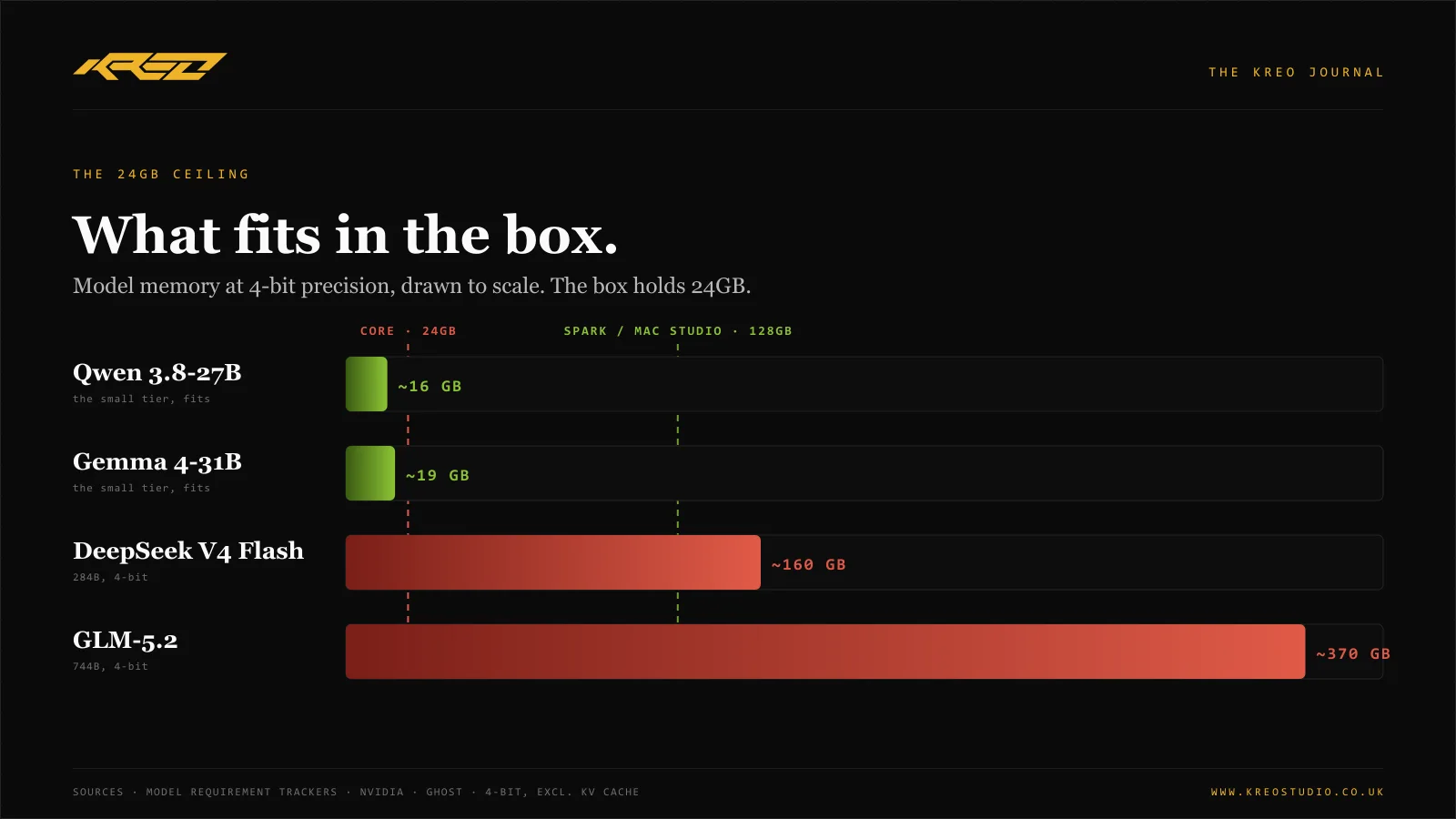
So the honest reading is not that Core is a bad computer. It is that Core stops exactly where the frontier open models begin. You are buying the box that will run last year's intelligence, at home, forever, while the intelligence that made you want it grows every few weeks and no longer fits.
That is the quiet gap in the promise. You can own the jar. The lightning is made by someone else, on someone else's schedule, and it does not always stay in the jar you bought.
The part that is genuinely good
Within its size class, Core is fast. Its memory moves at 432 GB/s, comfortably above the DGX Spark's 273 GB/s. For a 27B model, that bandwidth is the difference you feel in tokens per second, and this box has more of it than the machine everyone will compare it to.
It also owns the whole stack, which is the real product. No subscription, no tokens, models preinstalled, a stated promise that nothing leaves the house. Javaid's case is that the hard part is not silicon but software: how a model reasons over your life, remembers, and chooses when to act. That may well be right, and it is not something you can rent from a cloud.
The field is not kind to the price, though. Nvidia's DGX Spark carries 128GB of unified memory and now costs about $4,699, up from launch. A Mac Studio with 128GB runs to roughly $4,000. Nvidia's consumer RTX Spark, expected this month, is talked about near $2,899 with up to 128GB. Core is neither the cheapest nor the most capacious. It is a different trade: faster memory, smaller capacity, entirely yours.
You can own the jar. The lightning is made by someone else, on someone else's schedule.
What it cannot prove yet
The privacy promise has no independent audit. The operating system has never been tested in public. An always-on agent that holds your logins is a security surface, and a firewall that "monitors every outgoing request" is an intention, not a result. Until units ship and someone credible measures them, the launch film is marketing.
The verdict worth holding
Core bets on an idea this journal keeps returning to: own your layers. But owning the box is worth only what the box can run. At 24GB, Core owns the layer beneath the models, not the models themselves, and the weights are where the intelligence actually lives.
So buy it if you want a fast, private, subscription-free machine for small models you control. That is a real thing, and worth $3,499 to the right person. Just do not buy the slogan. You will own the computer. The intelligence will still be rented, and the rent is paid in gigabytes you do not have.
The number to remember is not 770 TOPS, which is a vendor figure that shrinks under inspection. It is 24GB.
The rule to take from this
Readout: what is confirmed, and what is not
- Confirmed (Ghost, TechCrunch, Dealroom): Core costs $3,499; the $11M seed was led by Andreessen Horowitz; the founder is Zain Javaid, 19; the model stocks ship installed; the first batch ships in the last week of October, with no subscription.
- Confirmed (Ghost spec sheet): RTX PRO 4000 Blackwell SFF Edition, 24GB GDDR7 ECC, 432 GB/s; AMD Ryzen 5 7600; 64GB DDR5; 1TB NVMe; 770 AI TOPS quoted; installed models Qwen 3.8-Next, Qwen 3.8-27B, Gemma 4-31B, Muse-Glimmer-30B.
- Confirmed (retail listings): the RTX PRO 4000 Blackwell sells for roughly $2,300 to $3,000, most of the $3,499 sticker.
- Confirmed (NVIDIA, retailers): the DGX Spark has 128GB of unified memory, 273 GB/s, and now costs about $4,699.
- Reported (vendors, analysts): a 128GB Mac Studio runs to roughly $4,000; the RTX Spark N1X is expected this month with up to 128GB at around $2,899, an analyst estimate, not a confirmed price.
- Calculated (model requirement trackers): DeepSeek V4 Flash (284B) needs about 160GB at four-bit and about 80GB at two-bit; GLM-5.2 (744B) is far larger again. Figures exclude KV cache and assume a short context.
- Unverified: Ghost's privacy and security claims, the behaviour of its operating system, and real-world throughput, none of which independent testing has measured.
If you are working out which layer of your own stack you actually own, and what it would take to hold it, email brandon@kreostudio.co.uk.
Sources & references
- At 19, founder raises $11M for Ghost, maker of a $3,499 computer for personal AI, TechCrunch, 5 October 2026.
- Core specification and pricing, Ghost, October 2026.
- NVIDIA RTX PRO 4000 Blackwell SFF Edition, NVIDIA.
- NVIDIA DGX Spark: 128GB unified memory, 273 GB/s, NVIDIA.
- NVIDIA RTX Spark N1X: 128GB, October 2026, TechPowerUp GPU Database.
- Mac Studio (M5 Max or M5 Ultra) tech specs, Apple Support, 2026.
- DeepSeek V4 memory requirements: ~160GB for Flash at 4-bit, Oflight, 2026.
- Can DeepSeek-V4-Flash run on 24GB? No: 159.5GB needed at 4-bit, LLMeter.
- PNY NVIDIA RTX PRO 4000 Blackwell, 24GB GDDR7, retail listing, Micro Center.
- Zain Javaid, founder and CEO of Ghost, personal site.
Reader signal
Was this useful?
Work with KREO Studio
AI engineering, data science and design architecture, from Plymouth to the wider UK.
