You Built the Product. You Forgot to Own the Name.
OpenAI launched a flagship agent called Dots. It owned neither dot.com nor dots.com. By the evening, one of those addresses was selling the competition.
On 29 September, OpenAI took the stage at its DevDay event and unveiled Dots: always-on agents that keep working after you close the laptop. It was one of the biggest launches of its year.
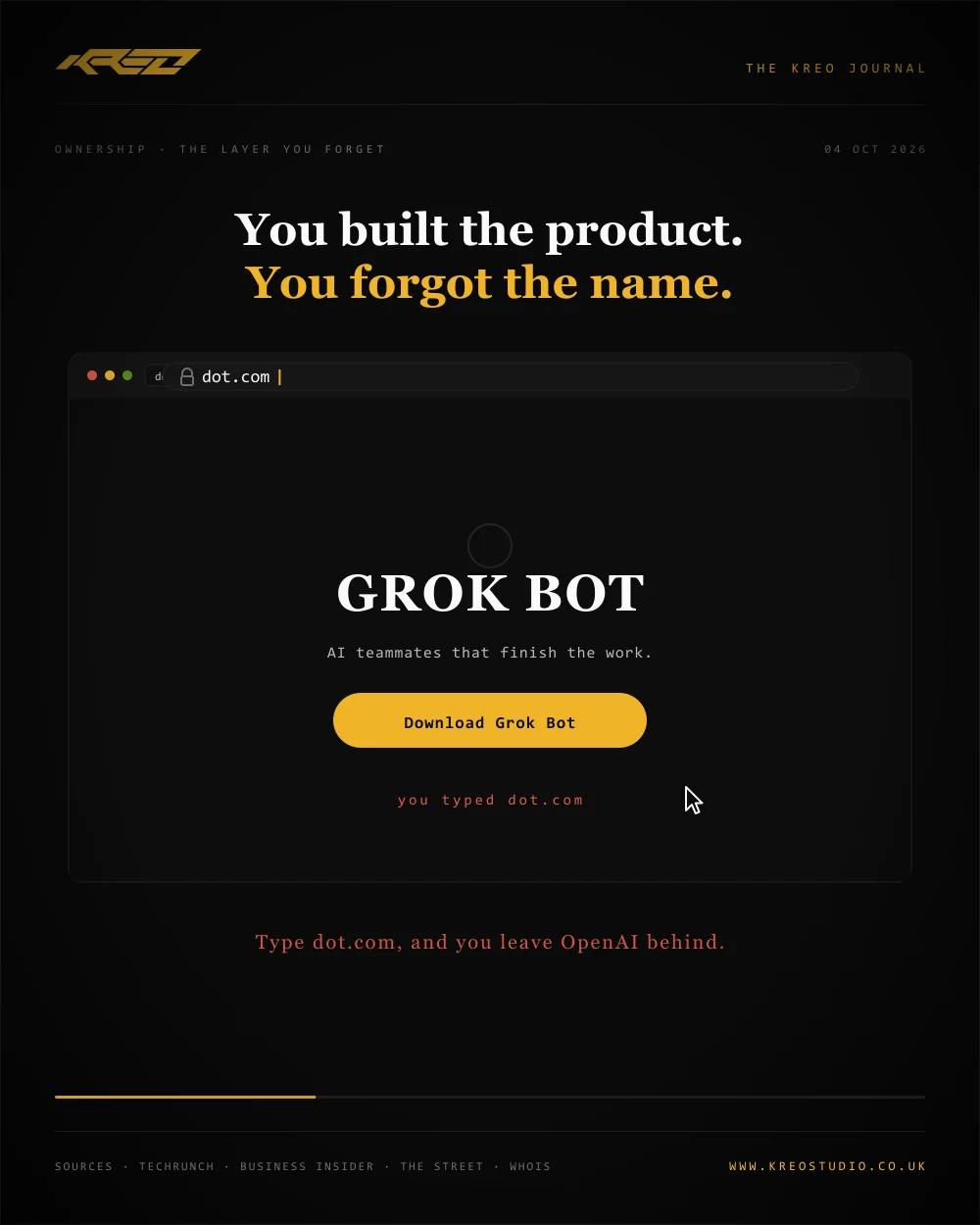
By that evening, the conversation had moved somewhere stranger. Type dot.com into a browser and you do not get OpenAI. You get Grok Bot, the competing always-on agent from Elon Musk's xAI.
The redirect is real. The reason for it is not. And in the gap between those two facts is a lesson about building anything online, dressed up as the best corporate trolling story of the year.
Two addresses, one letter apart
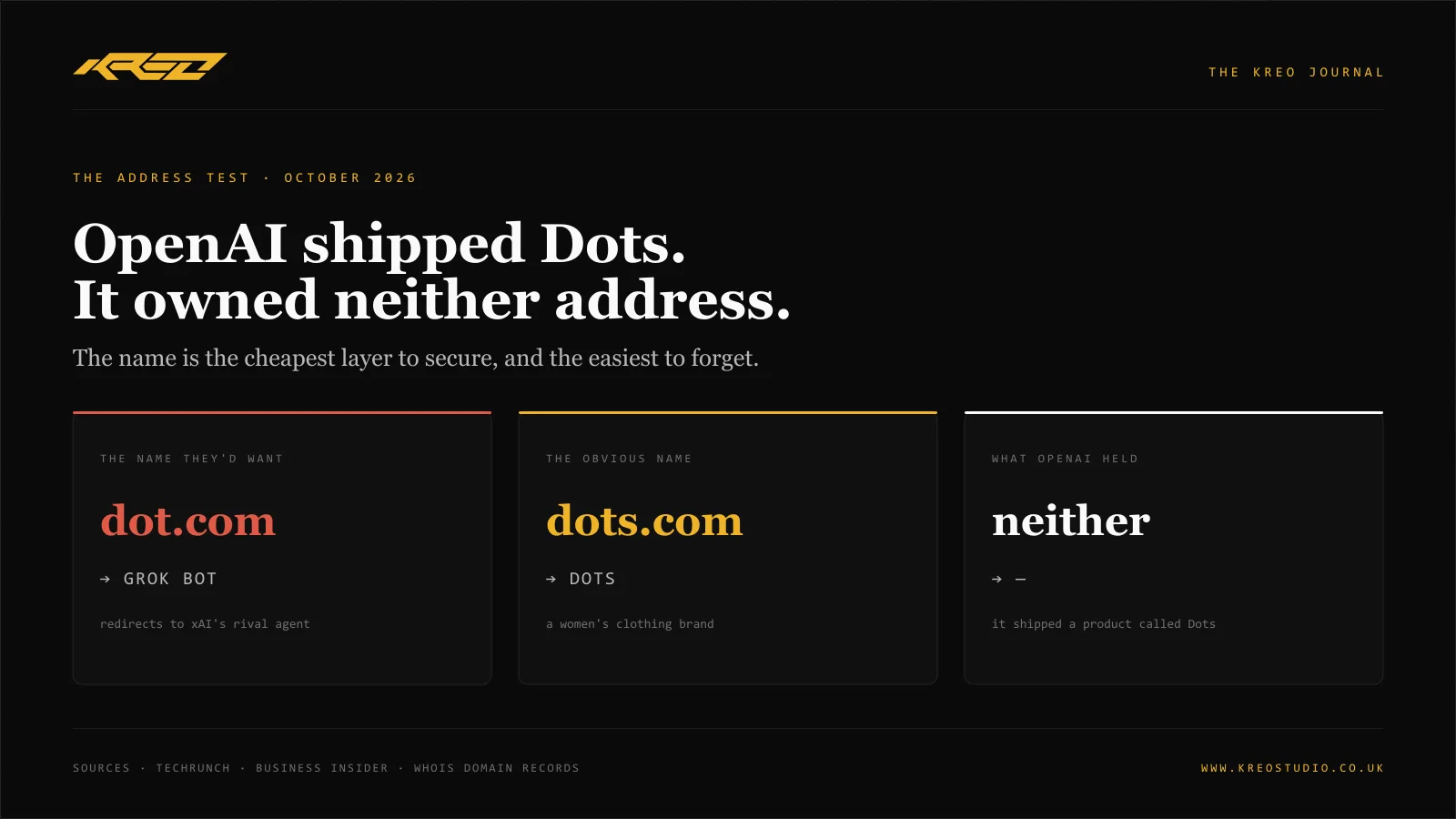
The details matter, because they are the joke. OpenAI's product is Dots, plural. The address everyone tries first, dot.com, is singular, and it answers with a permanent redirect to x.ai/bot, the product page for Grok Bot. The address that actually matches the product, dots.com, belongs to a women's clothing brand called Dots. OpenAI controls neither.
According to public domain records, the dot.com registration last changed on 28 July 2026, two months before OpenAI announced the name. The registrant is a privacy service, so no owner is named; the redirect is the proof that someone at xAI controls it. xAI does not own the obvious alternatives, bot.com or vot.com, which is exactly why the internet decided this was personal.
What is proved, and what is just funny
The redirect is confirmed: a 301 to an xAI page, verified the day after launch. The July date is confirmed in the registry. What is not confirmed is intent.
The timeline argues against the prank. The domain record changed on 28 July. xAI launched Grok Bot on 11 August, fourteen days later. OpenAI's code still called its agents "aeons" until late September. A company about to launch a product called Bot, buying a famous one-syllable address that differs from "bot" by a single letter, needs no knowledge of a rival's plans. That is the boring, plausible reading: a typo-net buy that became the luckiest troll in tech.
Don't own the .com? The good news is, there's no such thing. The .com is just the only .com you've been able to think of so far.
Both companies declined to explain. So the honest summary is short: a domain moved, a redirect points at a competitor, and nobody with knowledge has said why. Treat any stronger claim as a guess, however satisfying.

Why it matters even if it was an accident
Strip out the rivalry and the story is smaller and more useful. A domain is the cheapest layer of any product, a few pounds a year, and the first one the public ever touches. OpenAI controlled the model, the app, the launch and the narrative. It did not control the address. And the address is what people type.
This is the same lesson the rest of the journal keeps circling, one layer down. In July, Moonshot's rival accused it of not owning the layer it stood on. In this story, the layer is a name. Whether xAI planned the jab or tripped into it, the outcome is identical: a competitor owns the front door of OpenAI's launch, and every journalist writing about Dots typed the address and gave Musk a paragraph.
What any builder should take from it
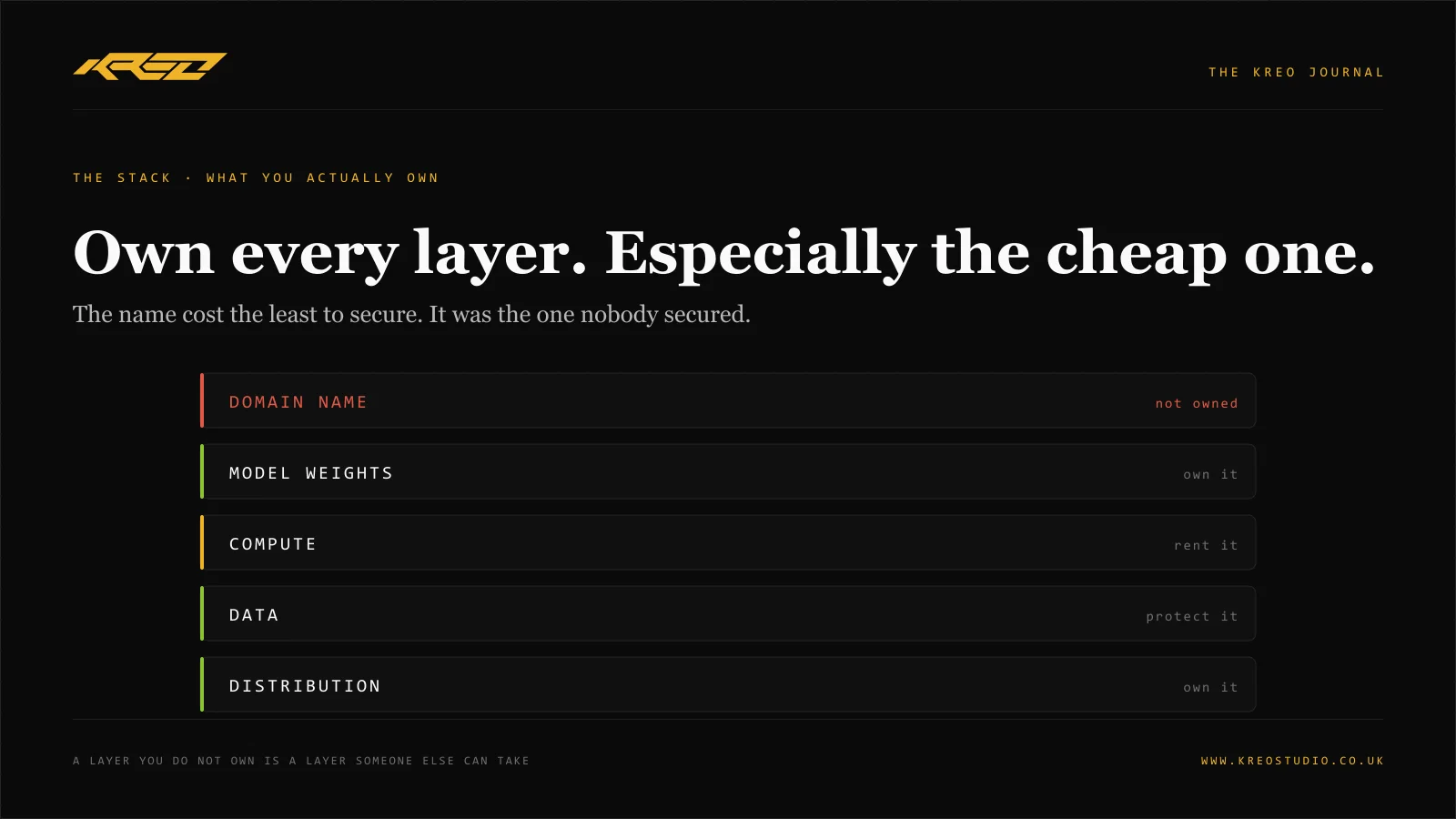
Before you announce a name, own the name. Secure the .com, and the obvious variants: the plural, the singular, the common misspelling, the hyphenated version. Register the social handles the same day. If the name matters commercially, file the trademark. None of this is expensive. All of it is cheaper than the launch you cannot take back.
Then apply the same test up the stack. Do you hold the weights, or rent them? The compute, or a contract? The data, or a promise? Every layer you do not own is a layer someone else can use, or take, at the worst possible moment. The dot.com story is funny because the layer was so small. The lesson is not small at all.
Readout: what is confirmed, and what is not
- Confirmed: OpenAI launched Dots, an always-on agent on GPT-6 Astra, at DevDay on 29 September 2026.
- Confirmed: dot.com returns a permanent redirect (301) to x.ai/bot, the Grok Bot product page, verified 30 September 2026.
- Confirmed: the dot.com registry record last changed on 28 July 2026. The registrant is a privacy service, so control is inferred from the redirect, not from a named owner.
- Confirmed: dots.com is unrelated (a women's clothing brand); xAI does not own bot.com or vot.com.
- Unproven: that xAI acquired or redirected dot.com specifically to embarrass the Dots launch. The July record change predates OpenAI's announcement, and no company has explained the move.
- Context: Musk co-founded OpenAI in 2015, left its board in 2018, later founded xAI, and lost a lawsuit against OpenAI in May 2026. xAI is now part of SpaceXAI.
If you are working out which layers of your stack you actually own, and what it would take to hold them, email brandon@kreostudio.co.uk.
Sources & references
- The internet is convinced Elon Musk's xAI trolled OpenAI's 'Dots' launch, TechCrunch, 29 September 2026.
- OpenAI named its new agent system Dots. It's already causing confusion, Business Insider, 30 September 2026.
- Billionaire Elon Musk steals OpenAI's big moment, TheStreet, 1 October 2026.
- OpenAI's Dots launch runs into an awkward Grok problem, Cybernews, 30 September 2026.
- Did Elon Musk buy dot.com just to troll OpenAI's new AI agent Dots?, HackerNoon, 1 October 2026.
- OpenAI, Dots launch, OpenAI, 29 September 2026.
Reader signal
Was this useful?
Work with KREO Studio
AI engineering, data science and design architecture, from Plymouth to the wider UK.
