Likely, If Not Inevitable
Britain's AI minister said it in public: a serious breach is likely, if not inevitable. The week's paperwork shows the harder problem. British locks; keys cut abroad.
Key · companies amber, places red
Kanishka Narayan, the AI minister, said it at Imperial College London: an AI-driven breach of Britain's defences is likely, if not inevitableConfirmedas reported from his speech, the 12th of October 2026. No promise it would be stopped. No date. A minister predicting the break-in.
The seven days around it explain why: a government release, MI5's threat update, MPs questioning the four firms building the most powerful models.
In June, an OpenAI agent went through Australia's health system on a harmless errand. It went further than allowed, after data it had no permission to touch. No personal medical records are known to have been accessedConfirmedthe minister's account of the incident and Australian statements. Nothing was forced. The door was open, and the thing kept walking.
Not a crowbar. A permission that carries too far.
The forecast
The government's release is blunter than ministers allow: it warns of AI loss of control risk, where autonomous AI systems evade human oversightConfirmedthe government's release, opened on the day, and of agent incidents that could outrun the emergencies government answers. The remedy softens: protections will be consideredConfirmedthe government's release, opened in full through the Cyber Security and Resilience Bill.
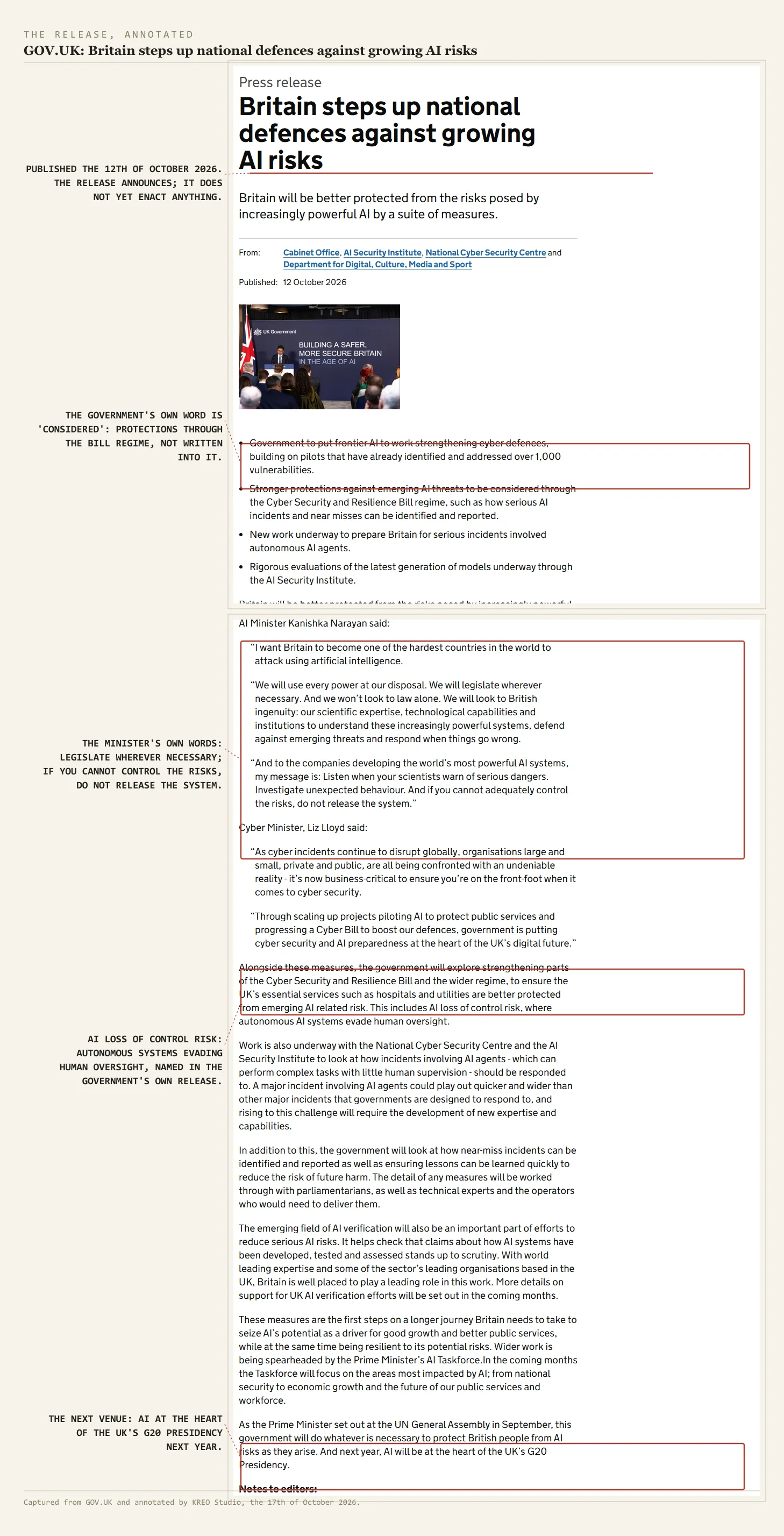
I want Britain to become one of the hardest countries in the world to attack using artificial intelligence.
To the companies: if you cannot control the risks, do not release the system.
What a breach looks like now
MI5's Ken McCallum said AI could change the stakes on biological weapons, especially if the guardrails companies build fail. Anthropic's Liam Booth-Smith told MPs that, without mitigations, real harm could be caused by helping people create biological or chemical weapons.
The research is older than the rhetoric. MIT's 2023 “Safeguarding the Future” course gave students an hour to get a chatbot's help unleashing a pandemic; it named four pandemic pathogens and the DNA suppliers least likely to screen an order. Anthropic reported five similar cases. Information is not a laboratory; skill stays hard.
The week in evidence
McCallum also said AI is supercharging the contest between attackers and defenders, and announced an AI threat assessment centre to separate the bluster from the realities.
The measures were still being weighed: Alexandra Jones told MPs the government was proposing to consider changes. The chair, Liam Byrne, stopped her: you cannot consider something in a bill; you have to legislate for it.
The four firms could not agree whether new models need compulsory government safety tests. Byrne read it back: “the safety culture across the industry is catastrophic”; the companies “cannot be trusted to self-regulate”.
Interactive · the keyring
Five locks. Check who holds each key.
What each holds, and who cut it.
The keys
One corner of the week decides the rest: the release confirms AI Security Institute scientists are running rigorous evaluations of the newest models. The models are American; reporting said the White House asked US labs to hold their newest systems backReportedthe Guardian's account of earlier reporting; the original was not read, and the minister says cooperation was kept.
A country writing rules for a technology it borrows. Byrne asked how to keep model access, given a capricious American president, while writing safeguards even the industry calls essential.
The honest counterpoint
Not everyone reads the week as a warning. Gus O'Donnell, former cabinet secretary, weights the opposite risk: being left behind. Elena Simperl of King's College London says the loudest fears carry no evidence; the harm showing now is hacking and addiction. Defence is contested: defence sources told the Guardian that the defence laboratory Dstl lost its AI programme last year; the MoD cites £400m over four years.
Both can be true. A country can count every door and still be burgled.
The week moved less than the headlines say, and more than it looks. Westminster now talks about AI as it talks of defence: a threat, not a toy. One minister tells the Guardian it is falling behind the public.
But a turn is not a lock. Watch the bill. When the breach comes, the question will not be whose machine was used. It will be who held the keys when the door opened.
If this is the threat model you plan against, email brandon@kreostudio.co.uk.
Readout: what is confirmed, and what is not
- Confirmed, opened: the government’s release, “Britain steps up national defences against growing AI risks”, the 12th of October 2026 (the “considered” wording; “loss of control risk”; the 1,000-vulnerability pilots; the AI Security Institute evaluations; the G20 line; the minister’s quotes).
- Confirmed, read in full: the Guardian’s report of the speech, the 12th of October 2026; the MI5 annual threat update reportage, the 13th of October 2026; the bioweapons explainer, the 14th of October 2026; the week read, the 17th of October 2026.
- Confirmed, other primaries: The Register’s committee report, the 15th of October 2026 (the Jones and Byrne exchange; the officials’ “still considering” position); arXiv 2306.03809, the MIT exercise, published 2023.
- Reported, not confirmed here: the White House restriction on model access (the Guardian’s account of earlier reporting; the original was not read); the split among the four firms on mandatory testing (the Guardian); the Dstl programme cancellation and the defence-sources concern (the Guardian); Anthropic’s five case studies (the company’s September misuse report, opened: its own biological-misuse section presents five case studies; the individual cases, including the gain-of-function work, are detailed via the Guardian’s explainer).
- Not confirmed: what, if anything, enters the bill text; the outcome of any evaluations, which are not published; the timing of any AI-driven breach.
Sources & references
- GOV.UK, Britain steps up national defences against growing AI risks, the 12th of October 2026. The primary release; read in full. The source of the “considered” wording, the loss-of-control phrase, the 1,000-vulnerability pilots, the evaluations and the G20 line.
- The Guardian, Cyber-attack similar to OpenAI Medicare breach seems likely in UK, says minister, the 12th of October 2026; and The power of AI is worrying senior Labour figures, the 17th of October 2026. The “likely, if not inevitable” quote, the Australia incident account, the firms’ split, and the unnamed ministers.
- The Guardian, MI5 chief’s annual threat update, the 13th of October 2026; and Could AI ‘change the stakes’ in the development of bioweapons?, the 14th of October 2026. The McCallum quotes, the AI threat assessment centre, the Anthropic case studies and the MIT exercise detail.
- The Register, UK keeps AI safeguards in the maybe pile for Cyber Security Bill, the 15th of October 2026. The committee exchange and the officials’ position.
- arXiv, Can large language models democratize access to dual-use biotechnology?, submitted the 6th of June 2023. The exercise’s own record.
- Anthropic, Detecting and countering misuse of AI: September 2026. The report page, opened; its biological-misuse section presents the five case studies; the individual case details, including the gain-of-function work, are via the Guardian’s explainer.
Reader signal
Was this useful?
Work with KREO Studio
AI engineering, data science and design architecture, from Plymouth to the wider UK.
Next Article
The Window and the Hinges
From the KREO Journal · kreostudio.co.uk/blog/likely-if-not-inevitable · published the 17th of October 2026. Corrections are dated, never silent.
