The $20 Billion Hole
For two weeks the AI boom had a headline number: OpenAI, seventy billion dollars a year. Then a set of documents went to investors, and the number lost twenty billion dollars without the company selling a single thing less.
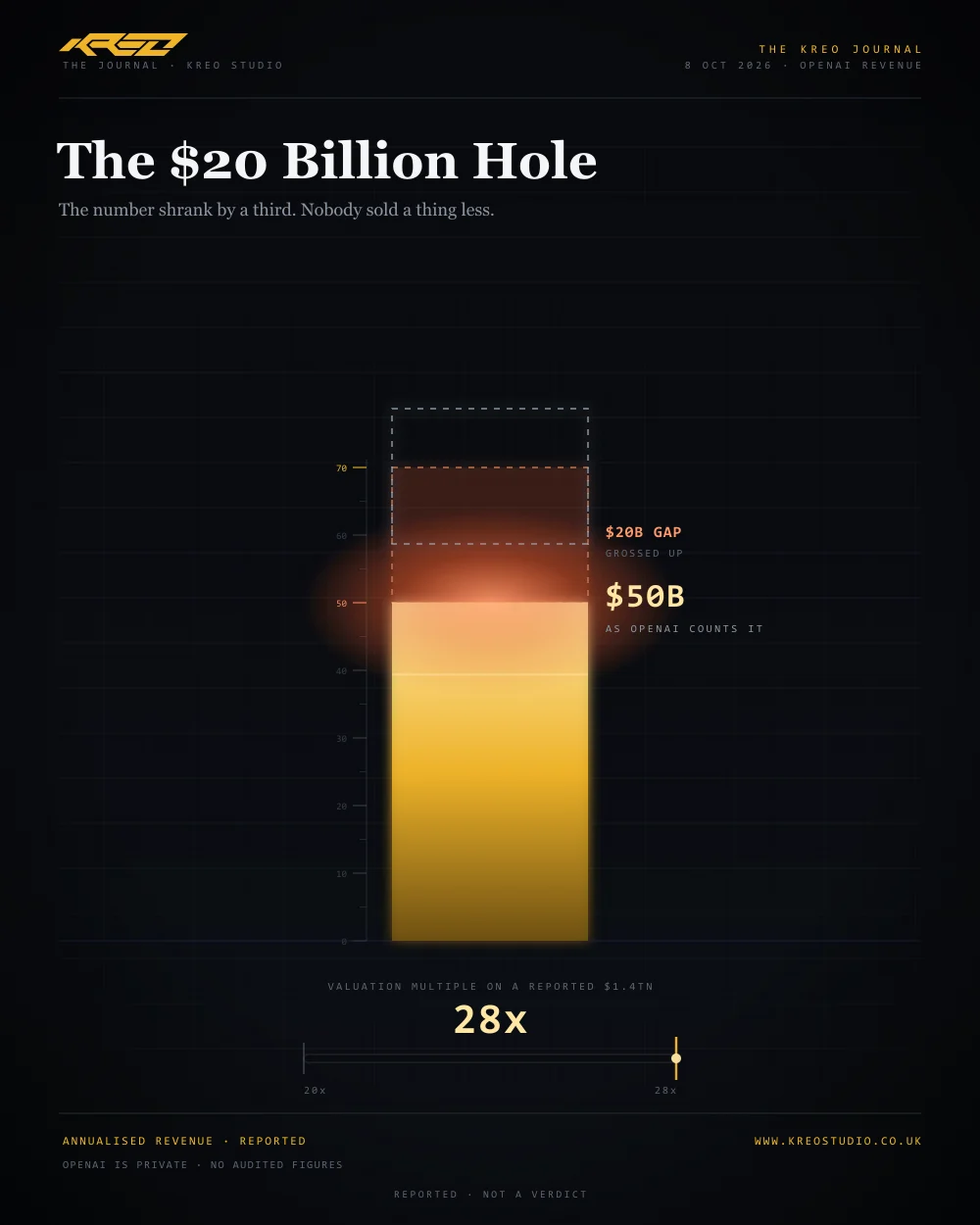
On 8 October the Financial Times reported that OpenAI had told investors its annualised revenue was approaching fifty billion dollars at the end of September. That is about twenty billion below the roughly seventy billion figure that had travelled through markets since late September.
Nothing was withdrawn. The company is private, publishes no audited accounts, and its sales are still climbing. What changed was the ruler.
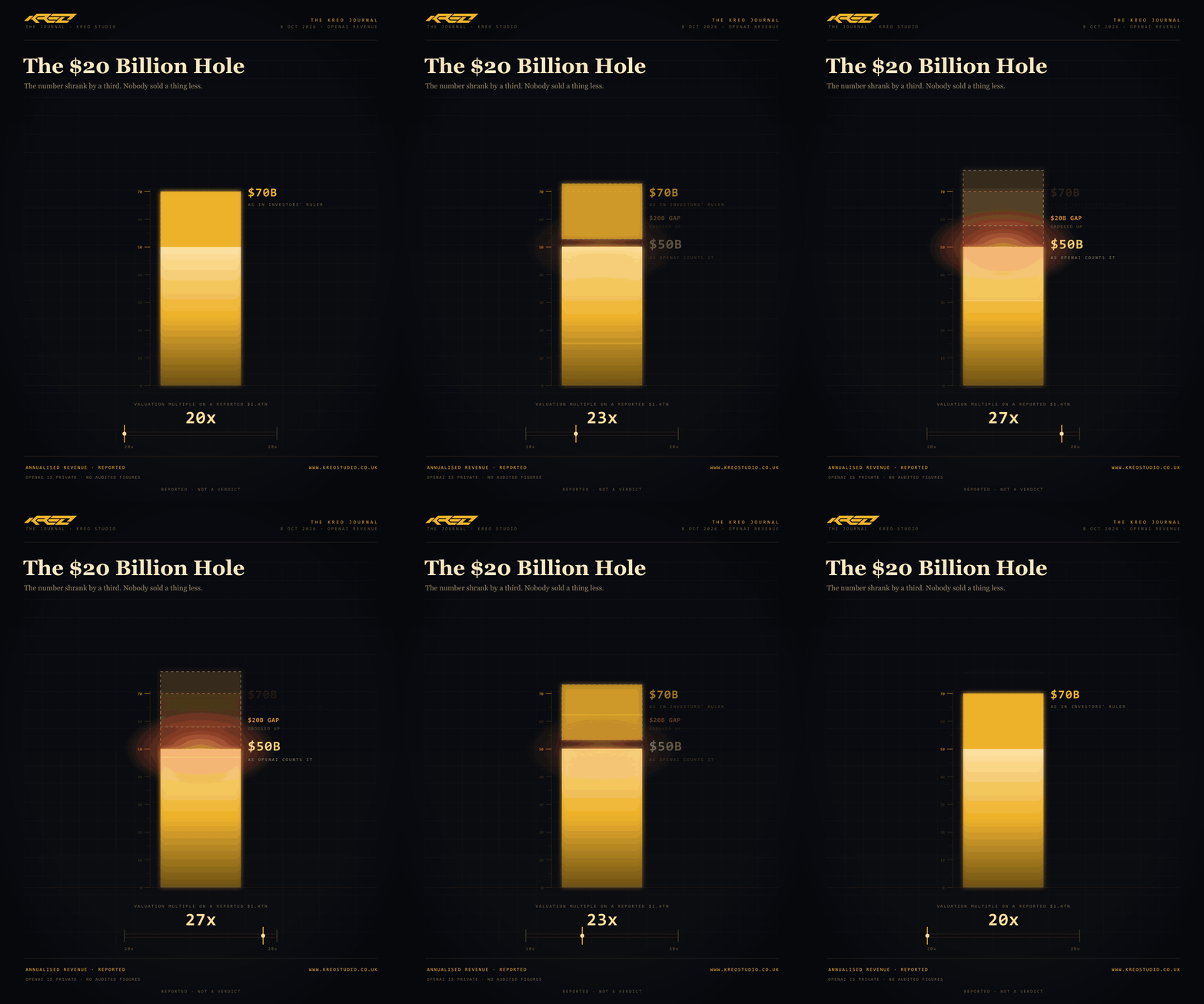
The ruler, not the number
The two companies count one sale differently. If a customer pays a hundred dollars for AI through a cloud provider, Anthropic records the full hundred as revenue and lists the provider's cut as a cost. OpenAI records only the slice it keeps. Both methods comply with accounting rules.
Investors, wanting an apples-to-apples line against Anthropic, grossed OpenAI's figure up. That produced the seventy billion: arithmetic done on the company's behalf, not a number OpenAI handed over.
Annualised revenue is a speed reading: recent months projected over a year. It is not a bank balance, and it is not audited.
Why a definition moved the market
The market did not wait to ask which ruler it held. On 8 October the Nasdaq Composite fell more than 1 per cent, the iShares Semiconductor ETF about 3.4 per cent, Oracle roughly 5 per cent and CoreWeave nearly 8 per cent, CNBC reported.
Here is the arithmetic the headline hides. The company is reported to be raising thirty billion dollars or more at a valuation of about 1.4 trillion. I measured it myself: divide that by seventy billion and you get twenty times sales; divide it by fifty billion and you get twenty-eight. Same company, same customers, a forty per cent swing in the multiple, decided by a definition.
Interactive · flip the ruler
One company, two rulers.
The revenue did not move. The way it was counted did. Flip the ruler and watch the value and the multiple change together.
$70B$50B
Valuation 20×28×
Counted the partners' money.Counted its own.
The climb is still real
Set the revision beside the growth and this is not a collapse. OpenAI's own line ran from about twenty billion at the end of 2025, to about forty billion in August, to approaching fifty billion in September, the Financial Times and Reuters report. Bloomberg reported that the company now expects seventy billion or more by December, mostly from enterprise. Anthropic's tally, on its gross basis, reached about sixty-five billion by the end of July.
The honest counterpoint
A fair objection is that this is a story about a footnote, and that the demand underneath is plainly growing. The growth rates bear that out: OpenAI told investors its third-quarter run rate grew seventy-seven per cent overall and a hundred and seven per cent on enterprise, CNBC reported. And the seventy billion did not come from OpenAI at all; a source told CNN it came from investors.
Two things would settle it for me: an audited OpenAI statement, or a side-by-side reconciliation of the two rulers published together. I could not read the Financial Times article, because it sits behind a paywall, so the fifty billion is a figure I confirmed through Bloomberg, Axios, Reuters and TechCrunch, not the primary.
Readout: what is confirmed, and what is not
- Confirmed (Axios, 8 October 2026; TechCrunch, 8 October 2026): OpenAI told investors annualised revenue was approaching $50bn at the end of September, about $20bn below the roughly $70bn figure reported in late September; the gap is gross-versus-net accounting, and both methods comply with accounting rules.
- Confirmed (Axios, 8 October 2026, citing accounting professor Francine McKenna): Anthropic books the full value of cloud-partner sales as revenue and the partner's cut as an expense; OpenAI records only its own share of partner sales.
- Reported (Financial Times, 8 October 2026; I did not read the paywalled primary): annualised revenue approaching $50bn, about $20bn less than previously signalled; the higher figure came from investors grossing the number up to compare with Anthropic.
- Reported (Reuters, 8 October 2026): September annualised revenue near $50bn, less than previously indicated; OpenAI began 2026 near $20bn.
- Reported (Bloomberg, 9 October 2026, via Financial Post): OpenAI expects $70bn or more in annualised revenue by the end of 2026, mostly enterprise; it is in talks to raise $30bn or more at a $1.4tn pre-money valuation.
- Reported (CNBC, 8 October 2026, corroborated across outlets): third-quarter run rate grew 77 per cent overall and 107 per cent on enterprise; a source said the presentation showed these figures.
- Reported (CNBC, 8 October 2026): after the report, the Nasdaq Composite fell more than 1 per cent, the iShares Semiconductor ETF about 3.4 per cent, Oracle roughly 5 per cent, CoreWeave nearly 8 per cent and Nvidia about 3 per cent.
- Not confirmed: any audited OpenAI figure. OpenAI is private and has published no audited accounts, so every number here is what the company told investors, or what investors calculated from it.
If you are weighing an AI vendor's numbers and want a second pair of eyes on what is actually being counted, email brandon@kreostudio.co.uk.
Sources & references
- OpenAI annualised revenues $20bn less than previously signalled, Financial Times, 8 October 2026.
- OpenAI annualized revenue $20 billion less than previously reported, Axios (Madison Mills), 8 October 2026.
- OpenAI's revenue $20 billion less than previously projected, TechCrunch (Lucas Ropek), 8 October 2026.
- OpenAI's September annualized revenue nears $50 billion, less than previously indicated, source says, Reuters via CNA, 8 October 2026.
- OpenAI expects US$70 billion in annualized revenue by end of 2026, Financial Post (Bloomberg News), 9 October 2026.
- OpenAI's annualized revenue nears $50 billion, FT says, Bloomberg Law, 8 October 2026.
- Nvidia, Oracle, other AI stocks sink on OpenAI revenue report, CNBC, 8 October 2026.
Reader signal
Was this useful?
Work with KREO Studio
AI engineering, data science and design architecture, from Plymouth to the wider UK.
Next Article
