Rewire the Degree: What University Becomes When Students Come First
On a Sunday morning in Plymouth, with a coffee going cold, a question arrived and would not leave. Why do so many students arrive at university full of ambition, only to leave feeling disengaged?
I am a second-year computer science student at the University of Plymouth, and I have watched it happen around me. People who turned up buzzing with ideas, three terms later going through the motions for a mark. Not because they stopped caring, but because the machinery asked for something other than care.
Too much of that experience is dominated by box-ticking, mandatory group work, endless evidence gathering, and assessments designed more to satisfy a process than to inspire learning. The more I look at it, the less this is a story about lazy students. It is a story about design.
The question is not whether students need to work harder. It is whether universities need to think differently. So I did the only thing I know how to do with a problem like this. I designed a version of it.
Start by treating students as professionals
If I were designing a modern university, I would begin with one principle: treat students as future professionals from day one. Give them real projects from the first week, not assignments built only for a mark but challenges that mirror the problems industry actually faces. Let them build, experiment, fail, improve, and make something that matters to someone outside the room. Learning becomes far more powerful when it has purpose.
I have made a version of this argument before, in a piece asking who should actually teach AI. The answer was people who have built systems, not only described them. The same test applies to the whole degree.
Education should not feel like a process of compliance. It should feel like participation in the future.
The degree as a switchboard
An institution is not a force of nature. It is a set of decisions someone made, and decisions can be unmade. So think of a degree as a switchboard, where each switch is one of those decisions. Flip one and a university changes shape, with the same buildings, staff, and students. This is the board I wanted to see, so I built it.
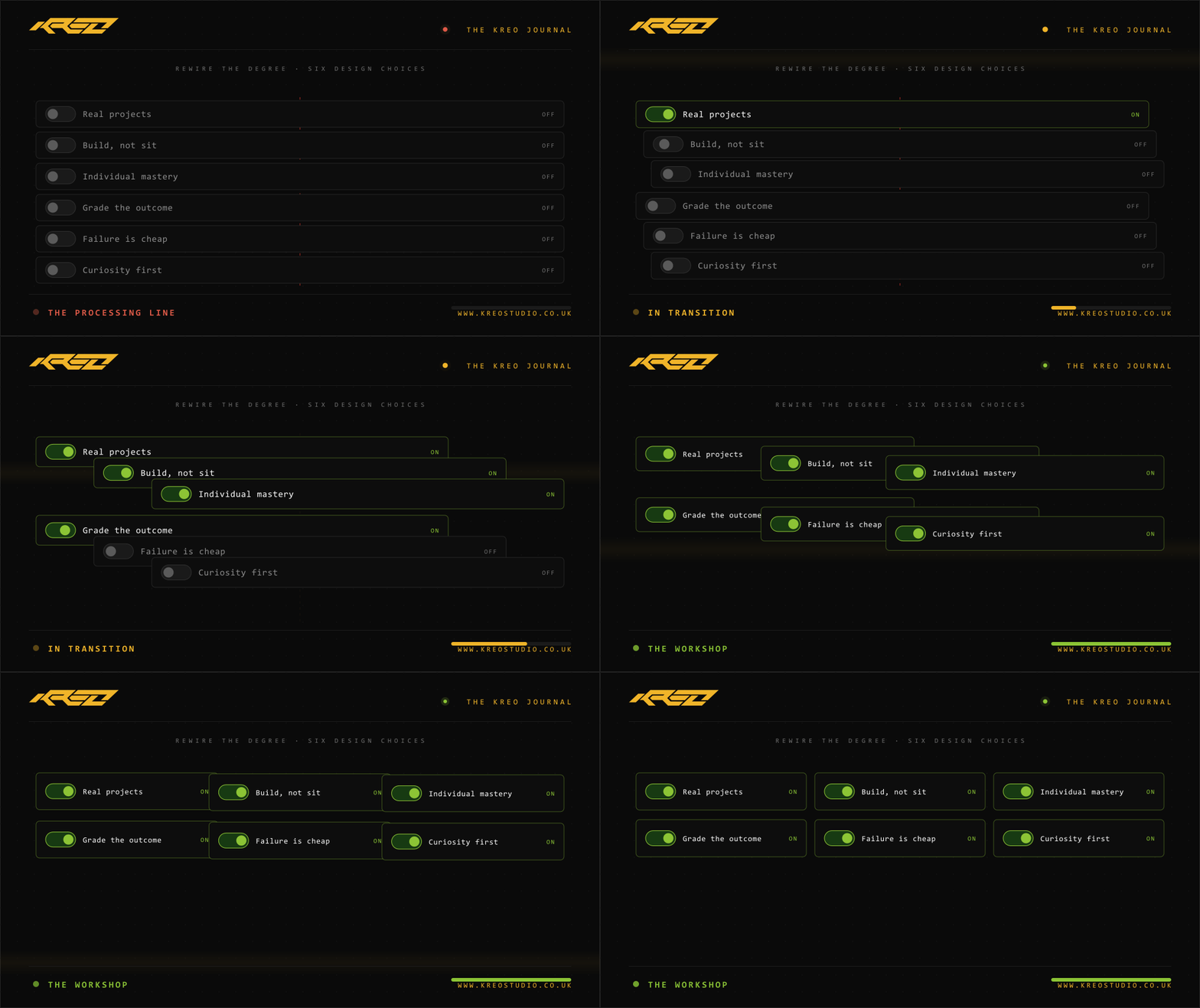
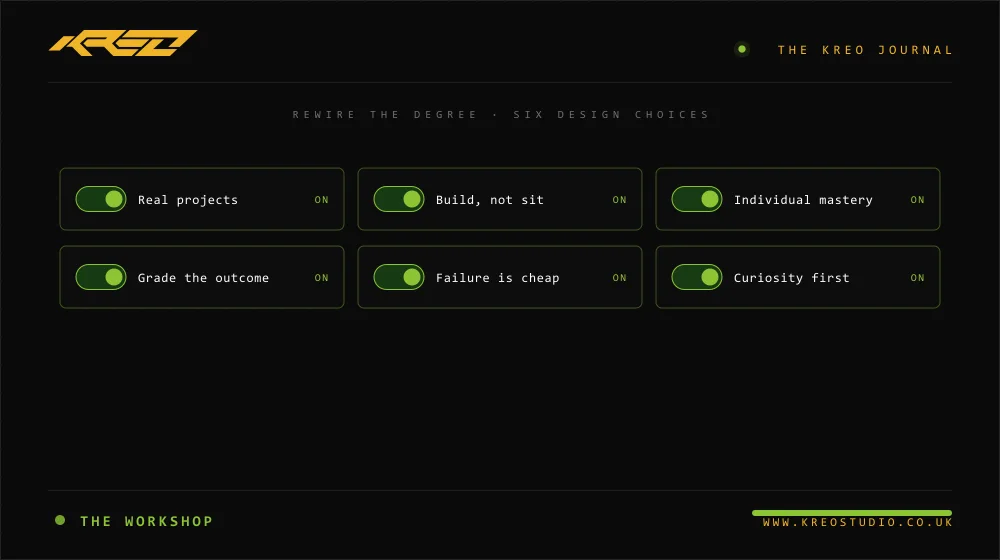
That is the whole argument, made visible. Nothing on that board costs a new campus. Every item is a decision about what the institution rewards.
It is a line or a workshop
Zoom in and the abstraction becomes concrete. On the left, four stations a student is pushed through whether or not they learn anything: collect evidence, group mark, tick box, exam grade. On the right, four stations that build a person: build real work, fail and learn, master a strength, ship something.
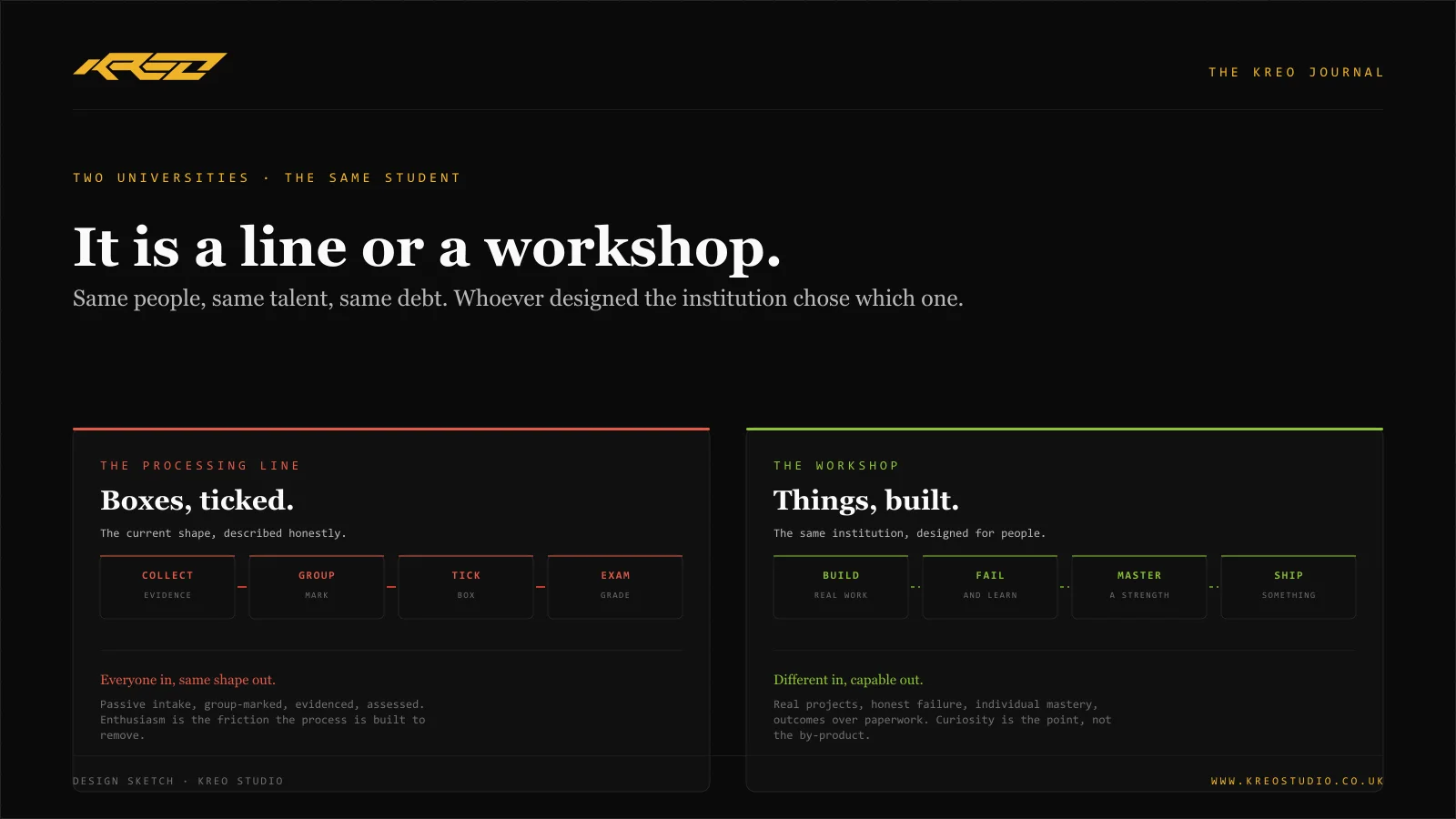
On the left, the student is the raw material. On the right, the student is the point. I have watched the left version drain people I respect, and it is not a failure of effort. It is a failure of design, and design is fixable.
Not every learner is a team
I would also move away from the assumption that everyone learns best through group work. Collaboration is a real skill, and I value it. But not every learner benefits from being assessed through the performance of others. I have seen strong students marked down because their team did not pull its weight, and quieter students carry a group so nobody else has to. It is efficient for the institution, often unfair to the individual, and it hides the very strengths a university should be looking for.
The individual, restored
Collaboration is a skill, not the only skill. A degree should recognise individual strengths as deliberately as it rewards teamwork, and be honest that the two are not the same measure.
One student, read two ways
A university only sees what its instruments measure. Point one at a student and it returns everything an administrator can count. Point a different one at the same student and it returns the things that predict whether she can actually do the work. Below, one person is read both ways. She is identical in both columns. The only difference is what the institution chose to measure.
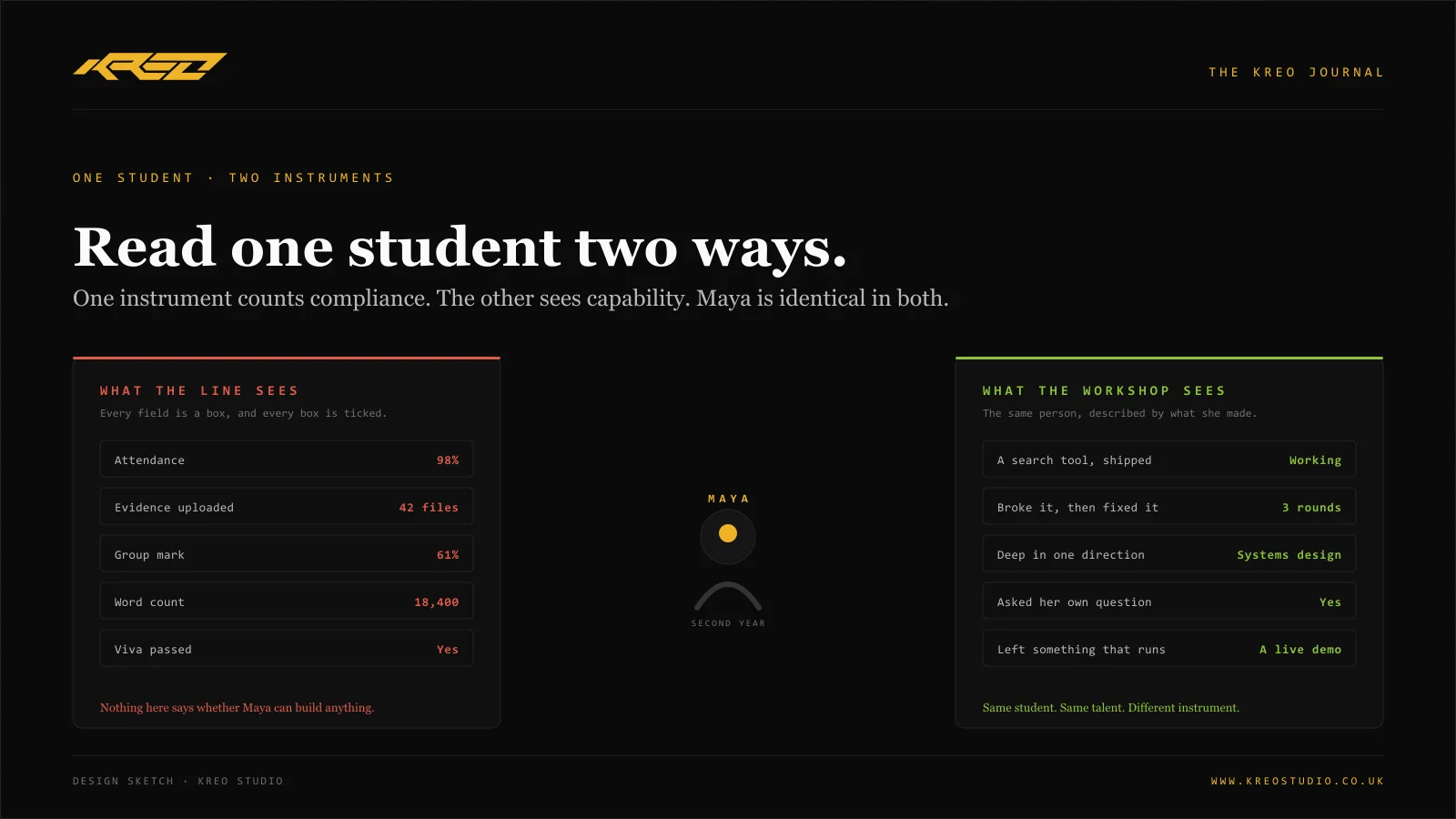
Some students are natural researchers, others designers, engineers, programmers, leaders, communicators, or problem-solvers. Rather than forcing everyone through one template, a university should find those strengths early and help each student reach mastery in the areas that fit them.
That also means being honest about paperwork. Higher education has become overly focused on proving work rather than producing it. Research and planning matter, and I am not arguing for less rigour. But there is a point where documentation stops serving the work and starts burying it, draining enthusiasm from the very subject a student chose.
The most valuable lessons I have ever learned did not come from slides on a screen. They came from creating something, breaking it, understanding why it failed, and then building it better.
The honest counterpoint
There is a serious case for the way universities run now. Large courses need fair marking at scale; group work is cheap to assess and mirrors professional life; evidence gathering exists because employers and regulators ask for proof. A university that tore up process wholesale might hand out confidence without competence.
I accept that. But rigour and bureaucracy are not the same thing, and a process built for the administrator should not define the student. The fix is not to remove structure. It is to point it at outcomes: judge the system a student built, not the volume of paper around it.
What I hope for
I hope the future brings institutions that choose capability over bureaucracy, experience over theory alone, and growth over process. Because the true purpose of education is not simply to award a qualification. It is to equip people with the confidence, the skills, and the curiosity to build the future for themselves.
So let us examine the systems that shape our world, discuss how they were built, and debate why they failed and what could be improved. That is not compliance. That is participation in the future.
Readout: what this article argues, and what it does not
- The switches are a design argument, not a policy from any named university. No institution is quoted as adopting all six.
- Group work and evidence gathering are not worthless: they are efficient at scale and mirror professional life. The claim is about balance, not abolition.
- The account of disengagement is drawn from my own experience as a second-year Computer Science student at the University of Plymouth, and from students I study alongside.
- Nothing on the board requires new buildings or new staff. Each item is a decision about what the institution rewards.
If you run a course, a department, or an institution and want an honest view of what a practice-led, outcomes-first programme could look like, email brandon@kreostudio.co.uk.
Reader signal
Was this useful?
Work with KREO Studio
AI engineering, data science and design architecture, from Plymouth to the wider UK.
