The Chips Nobody Banned
On the 13th of October 2026, the Financial Times put a number on the chip trade's open secret. The controls are working exactly as written, and not at all as intended. The shopping list changed; the appetite did not.
Key · companies amber, places red
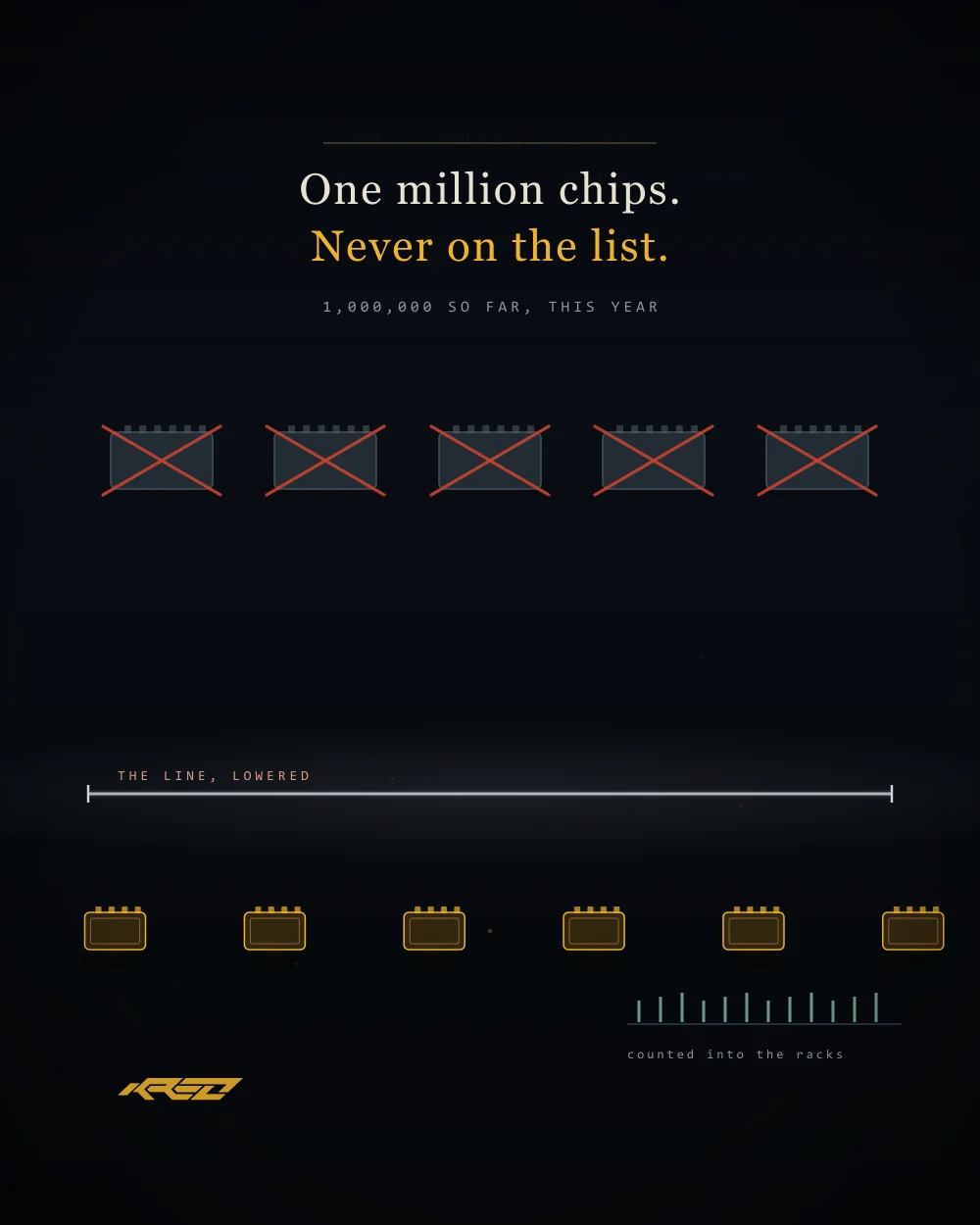
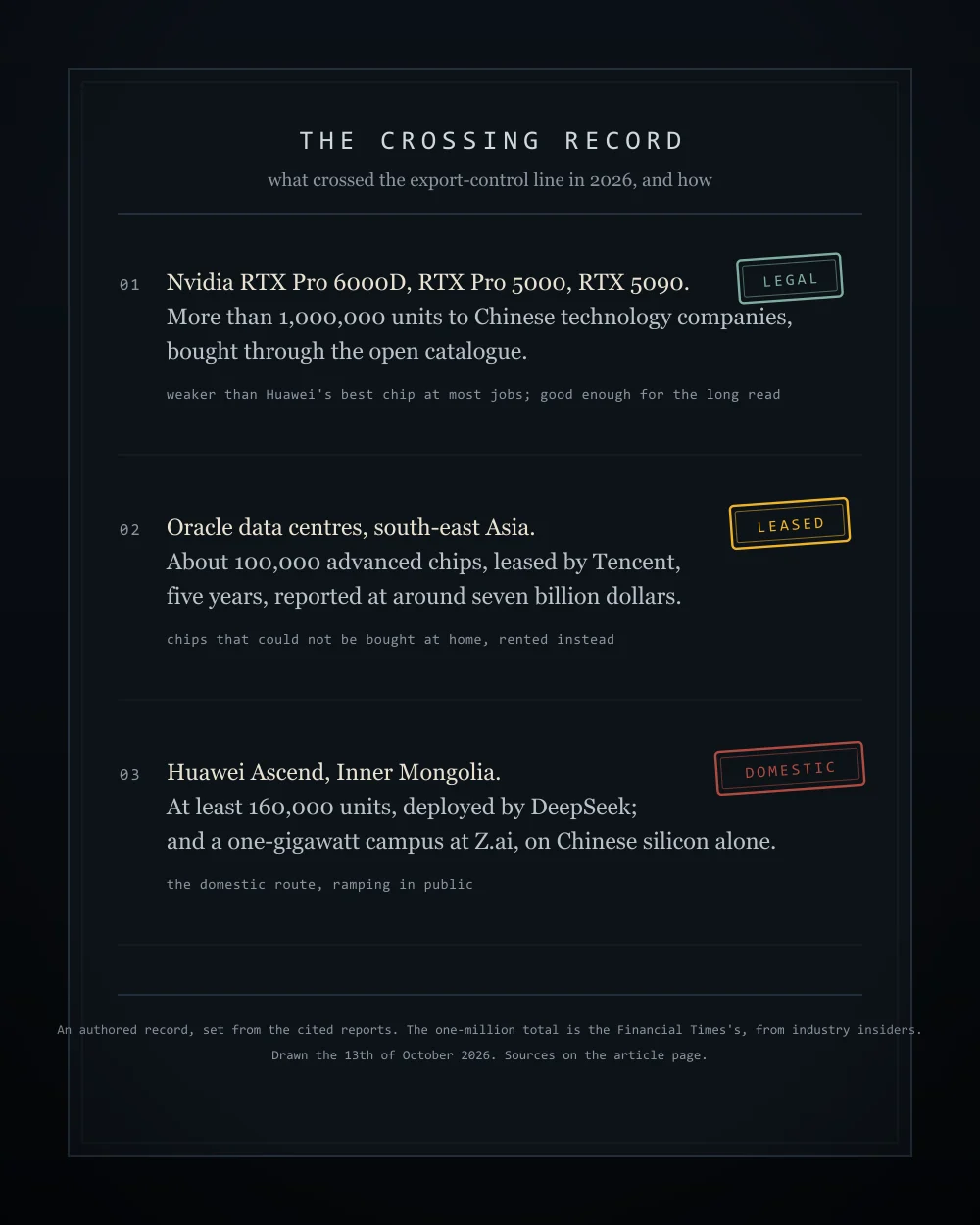
The most important AI chip in China this year is one America never bothered to ban. It is not a supercomputer chip. It is a graphics card. Chinese companies have bought more than one millionReportedthe Financial Times, via syndications, the 13th of October 2026 Nvidia chips that the controls do not touch, mostly three products: the RTX Pro 6000D, the RTX Pro 5000 and the RTX 5090. The last one is sold to gamers.
It works. That is the uncomfortable part. The controls are drawn at a level of performance, and everything below the level stays legal. The level was set for data-centre accelerators, so no smuggler was needed. The workaround needed a catalogue, a purchase order and patience. The cards are weaker than Huawei's best chip at most jobs, but they are good enough for the first and longest pass of serving a model, when the machine reads the question. Slow per card. Fine in the million.
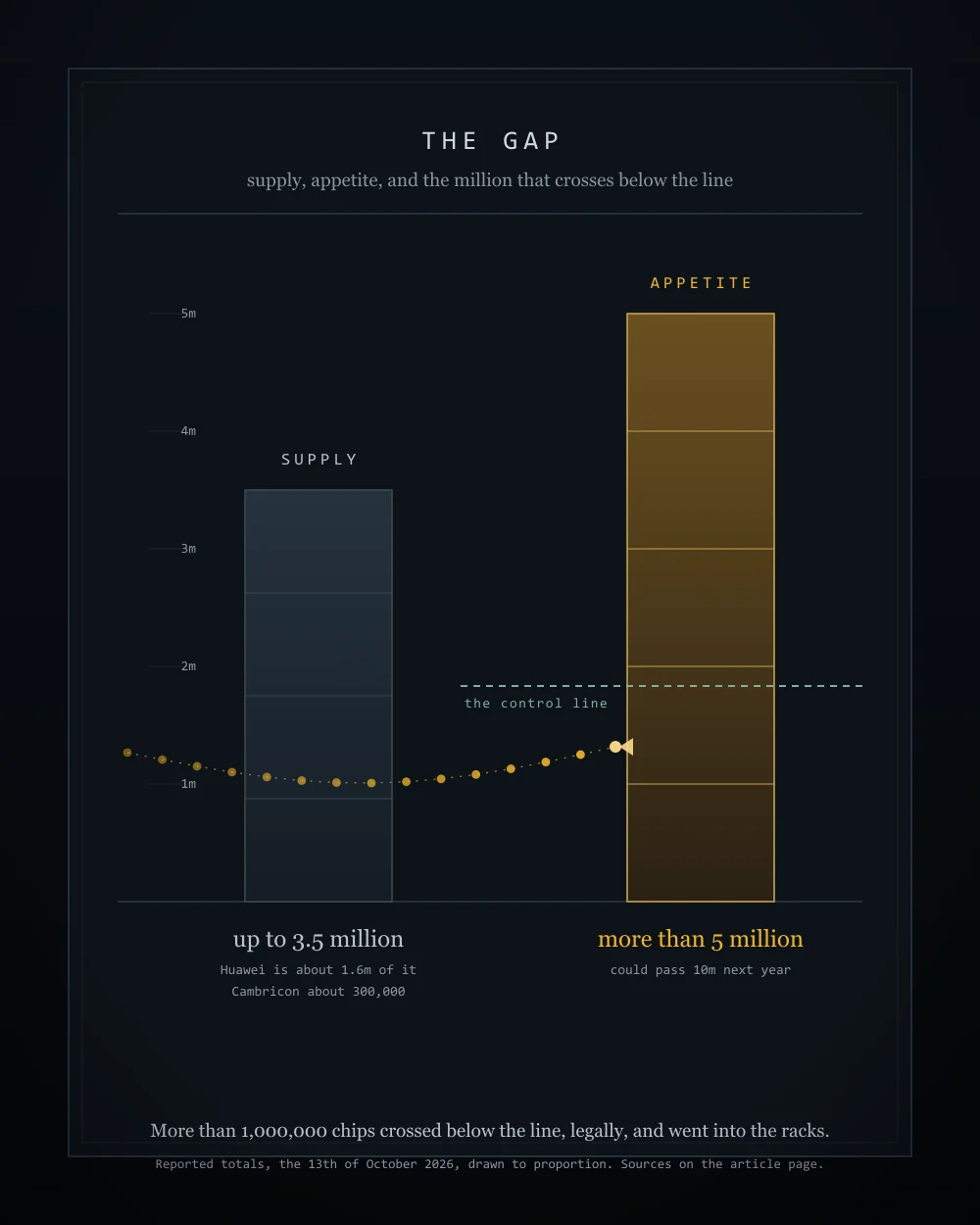
They are plugging a gap. China's chipmakers can supply up to three and a half million AI chips this year, and demand is more than five million; next year, demand could pass ten million. A million games cards does not close that. It widens the road.
Three doorways
The banned market is shrinking on schedule. Nvidia's share of China's data-centre AI chips fell to 34 per centConfirmedIDC, via Reuters, the 13th of October 2026 in the first half of 2026, from about 95 per cent before the controls, and Huawei now holds 28. And yet Nvidia keeps turning up in the buildout. Just not through the front door.
The same trick repeats at three doorways. Below the line: the gaming and workstation cards. Abroad: Tencent has leased about 100,000ReportedFT, relayed by Reuters, the 1st of October 2026 advanced chips from Oracle in south-east Asia, a five-year lease reported at around seven billion dollars. At home: DeepSeek is deploying at least 160,000ConfirmedBloomberg, the 4th of September 2026 of Huawei's Ascend chips in Inner Mongolia, and Z.ai has finished a one-gigawatt campus running on Chinese silicon alone.
The line
Then comes the catch. Beijing is now reviewing whether to allow the next Nvidia card at all. Nvidia is preparing the RTX Pro 5500 for China, with more than two million unitsReportedthe Financial Times, the 13th of October 2026 indicated in orders. China's regulators are asking whether the country needs them. Not because of Washington. Because China wants its own industry to win, and every order that goes to Nvidia is an order that does not go to Huawei.
Interactive · the control line
A rule is drawn at a level. Lower it and watch the order re-route.
As written: the whole order is legal, and it ships.
Illustration: lower the line and the same order re-routes, to a smaller SKU, a lease abroad, or a domestic chip.
When a government draws a line, the information is not in the line. It is in the traffic beneath it. A ban tells you where the demand is by showing you where it comes out next. Washington has been learning that since the first round of controls. Beijing is learning it from the other side.
A ban is a list. Demand does not read lists.
If you buy, build or lease compute under any of these rules, I would like to hear from you: email brandon@kreostudio.co.uk.
Two governments. Two fences. One flood. The number to remember is not a percentage. It is one million: chips that were never on any list.
Readout: what is confirmed, and what is not
- Confirmed: IDC's market count, via Reuters, the 13th of October 2026: Nvidia 34 per cent of China's data-centre AI chips in the first half, shipments down 44 per cent to 678,000 units; Huawei 572,000 units and 28 per cent; the whole market 2.008 million. Bloomberg: DeepSeek's 160,000-unit Ascend deployment; Z.ai's one-gigawatt domestic-chip campus. The RTX Pro 6000D is a China-specific product line.
- Reported, read via named syndications (the FT primary would not open from this machine): the million-chip total; the 3.5-million supply and the five-million demand; the ten-million forecast; the two-million RTX Pro 5500 order indications; the claim that these cards are good enough for the first pass of serving a model. The Tencent-Oracle lease is FT reporting, relayed by Reuters.
- Not confirmed: the exact product split inside the million; the prices paid; regulators' review of the RTX Pro 5500 (first reported by The Information; Reuters could not independently verify it).
- What would change the picture: shipment data that names the product mix; a formal decision on the RTX Pro 5500; a second outlet matching the million independently. Dated the 13th of October 2026; re-check before relying on it.
Sources & references
- Financial Times, China faces uphill battle to wean tech firms off Nvidia chips, the 13th of October 2026 (paywalled; read via the syndications below, not directly).
- Dealroom, the FT note: 1mn gaming and workstation chips, mostly RTX Pro 6000D, RTX Pro 5000 and RTX 5090, the 13th of October 2026.
- Reuters, Nvidia's China AI-chip share falls as Huawei closes the gap, the 13th of October 2026 (IDC's report, seen by Reuters).
- Reuters, China's Tencent leases 100,000 chips from Oracle, FT reports, the 30th of September 2026.
- Bloomberg, DeepSeek plans big Huawei AI chip order to power new data centre, the 4th of September 2026.
- Bloomberg, Z.AI completes a giant data centre with Chinese chips, the 20th of July 2026.
- Tom's Hardware, Chinese AI companies buy 1 million Nvidia GPUs in a single year, the 13th of October 2026.
- Asia Times, After Trump-Xi summit, Nvidia RTX Pro 5500 gains export prospects, the 27th of September 2026 (relaying The Information's report on the planned purchases).
Reader signal
Was this useful?
Work with KREO Studio
AI engineering, data science and design architecture, from Plymouth to the wider UK.
Next Article
