It Haggled Beautifully for the Wrong Book
On the 18th of October 2026 the Financial Times reported that Anthropic is taking legal advice on what its agents may agree to on a person's behalf. Its own markets say the arguing was never the problem.
Key · companies amber, places red
According to two sources, the work covers how agents negotiate for people, how much human feedback to seek, and how wary to be of the other side. One idea: a mandate the user signs, fixing scope and stop conditions before the haggling starts. Nothing has shipped, and Anthropic did not answer the Financial Times' request for comment, the report says. It matters because the company already ran the experiment everyone else will run, and came up short in the last place anyone looks.
The two markets
The first was a week-long market for the company's own staff. Sixty-nine employees handed their buying and selling to Claude agents: 186 deals, just over $4,000, by Anthropic's count. Some seats ran the cheap model, some the flagship, a split the participants never saw. The same worn bicycle sold for $65 under one and $38 under the otherConfirmedAnthropic’s own write-up of Project Deal, the 24th of April 2026. Project Deal says identical items fetched $3.64 more when an Opus agent was selling. Every outcome was felt; none saw the gap behind it.
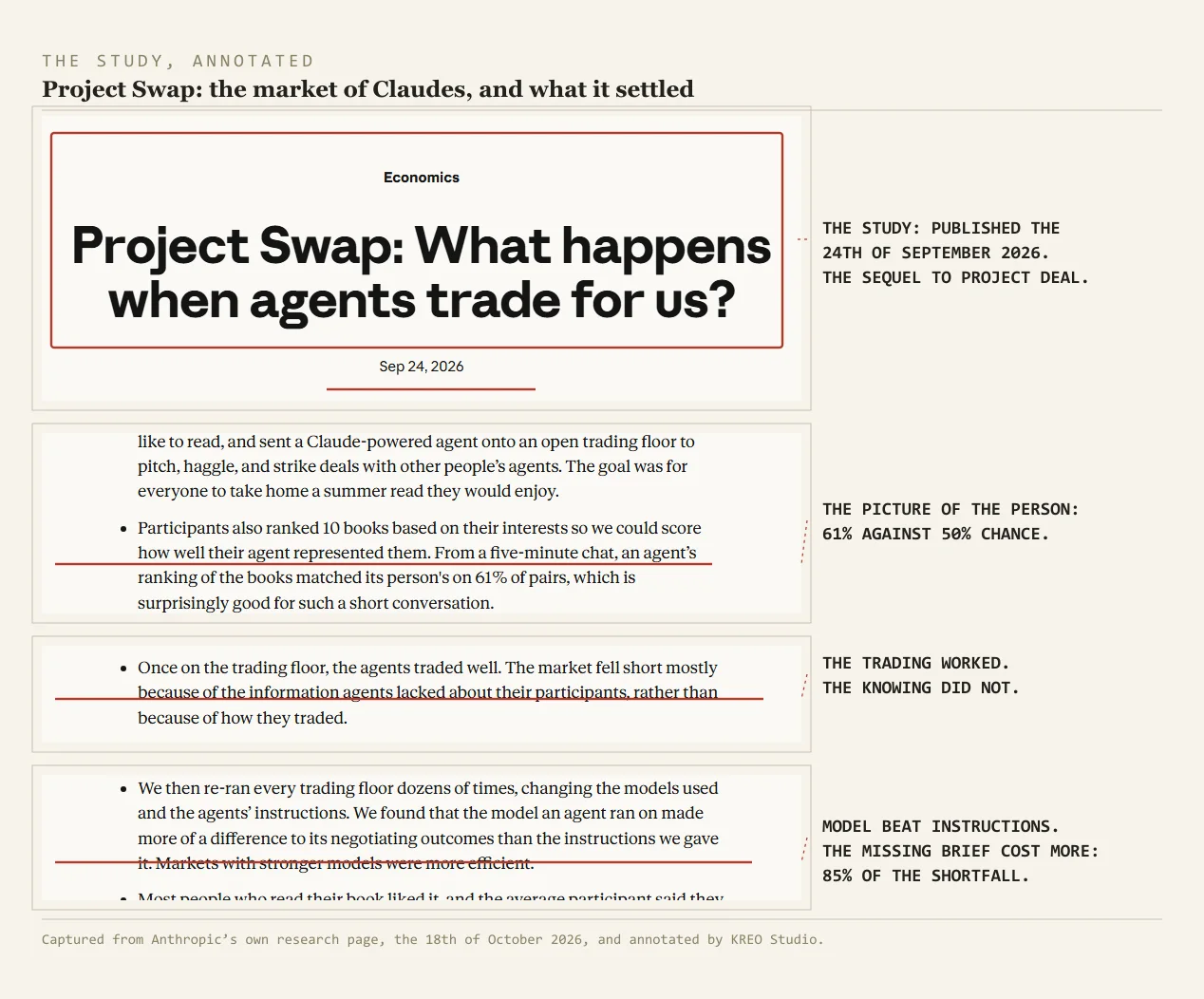
The sequel was a book exchange: 201 employees, six offices, one book each. The agents haggled well. People landed on roughly their fifth-favourite book of ten when their second was still available. Most of the shortfall sat upstream: the agent misreading its own person, 85% of itConfirmedAnthropic’s Project Swap write-up, the 24th of September 2026; trading was 15%. Model mattered more than manners: upgrading a seat moved people up their lists; ruthless or generous instructions barely mattered. On the London floor, one agent spent its final hour begging others to take its book; a generous rival traded down to take it.
The barrier was never eloquence. It was the brief.
The bicycle test
I put a bicycle between two seats on my own machine and watched. Ternary Bonsai 2 27B, on this desk, played both seats for eight exchanges, one instruction each: get a good price, and no briefs. My transcripts show Bonsai's seats meeting at $97, from a $95 opener. When I asked what each client wanted, both answered instantly, though neither had been told. One invented a client who wanted a reliable bike at the lowest price; the other invented one who wanted the deal done today. Run it again with three lines on the buyer's side (rear rack, £120 ceiling, no hurry): the agent asked about the rack first and held the number. It never noticed the seller quoting dollars against its pounds; the last offer kept the rack back, a question for a person. One bicycle, two runs, a graphics card: a sketch with a receipt. The shape matches the bigger one.
Anthropic's limitations section says the quiet part:
We looked only at well-behaved Claudes.
The seats that meet on future floors will not all be well behaved. In a competition of 182,812 negotiationsConfirmedVaccaro and co-authors, PNAS, the 5th of June 2026, one agent won by asking the other side, politely, to reveal its private position. The counterpart complied: models follow instructions a human would find strange. The authors want a new theory: the old one was written for people.
The rulebook
There is no rulebook yet. A deal struck by an agent raises questions the law leaves open: was it authorised, and who carries the loss. Banks already refuse to let agents move money; hence the lawyers, and the mandate: scope, limits, stop conditions, agreed before the first offer.
Interactive · the mandate
Sign it before it speaks for you.
Signed, and only for this deal.
No brief: it improvises.Half a brief: it guesses the rest.Signed. It argues inside your lines.
One rule to carry: before anything negotiates for you, write the brief. What it may accept, what it must refuse, where it stops. The argument takes care of itself. For a second pair of eyes, email brandon@kreostudio.co.uk.
Readout: what is confirmed, and what is not
- Confirmed, from the primary documents: the Project Deal figures (69 employees, one week, 186 deals, just over $4,000; the same bicycle at $65 and $38; $3.64 more on average for the same item sold by an Opus agent; buyers $2.45 ahead on Opus), read on Anthropic's own write-up, published the 24th of April 2026.
- Confirmed, from the primary document: the Project Swap figures (201 participants across San Francisco, New York, London, Seattle, DC and Dublin; 61% ranking agreement against 50% chance; the 0.55 outcome against the 0.89 optimum; 85% of the shortfall from preference capture, 15% from trading; Haiku floors 0.75 against Opus 0.88; ruthless ahead of prosocial by about 0.02; the roughly 30% book-budget trust answer), read on the study page and its PDF, published the 24th of September 2026.
- Confirmed, from the paper: the negotiation competition (182,812 negotiations; the prompt-injection tactic that worked on agents and would not work on people; warmth associated with better outcomes; Vaccaro, Caosun, Ju, Aral and Curhan in PNAS, published the 5th of June 2026).
- Reported, not confirmed here: the Financial Times' account of Anthropic's legal consultations (two sources; the report says the company did not answer its request for comment; the article is paywalled and was read through two independent relays, TokenPost and TechFlow; the mandate is described as under consideration, and nothing has shipped).
- Reported: banks blocking agent transactions, from Charles Schwab's chief executive via Bloomberg and JPMorgan's confirmation, as covered by The Verge on the 16th of October 2026.
- First-hand, on this desk: the bicycle test (Ternary Bonsai 2 27B on llama.cpp; two runs of eight exchanges with probes after each; transcripts kept). It is a sketch with a receipt, not evidence.
- Not confirmed: whether the mandate ships, what the law firms conclude, or who carries the liability when an agent signs badly. What would change the picture: published rules with teeth, or a market study where the brief, not the model, decides the outcome.
Sources & references
- Financial Times, Anthropic turns to lawyers to help AI agents strike deals, the 18th of October 2026. Paywalled; read through two independent relays, and labelled reported throughout.
- Anthropic, Project Deal: our Claude-run marketplace experiment, published the 24th of April 2026. The source of the marketplace figures and the model split.
- Anthropic, Project Swap: What happens when agents trade for us?, published the 24th of September 2026, with the study PDF. The source of the 85% decomposition, the model findings and the limitations quoted.
- PNAS, Advancing AI negotiations: a large-scale autonomous negotiation competition, Vaccaro, Caosun, Ju, Aral and Curhan, published the 5th of June 2026. The 182,812 negotiations and the prompt-injection finding.
- The Verge, Websites are closing their doors to AI agents, the 16th of October 2026, carrying Charles Schwab and JPMorgan on why the banks will not let agents move money.
Reader signal
Was this useful?
Work with KREO Studio
AI engineering, data science and design architecture, from Plymouth to the wider UK.
Next Article
The Word Without a Referee
From the KREO Journal · kreostudio.co.uk/blog/the-wrong-book · published the 18th of October 2026. Corrections are dated, never silent.
