Closed From the Inside
China spent four years telling the world its technology should flow. This week it filed the draft of what stays home: forty technologies, twenty-three of them AI, and a quiet line at two trillion parameters.
Key · companies amber, places red
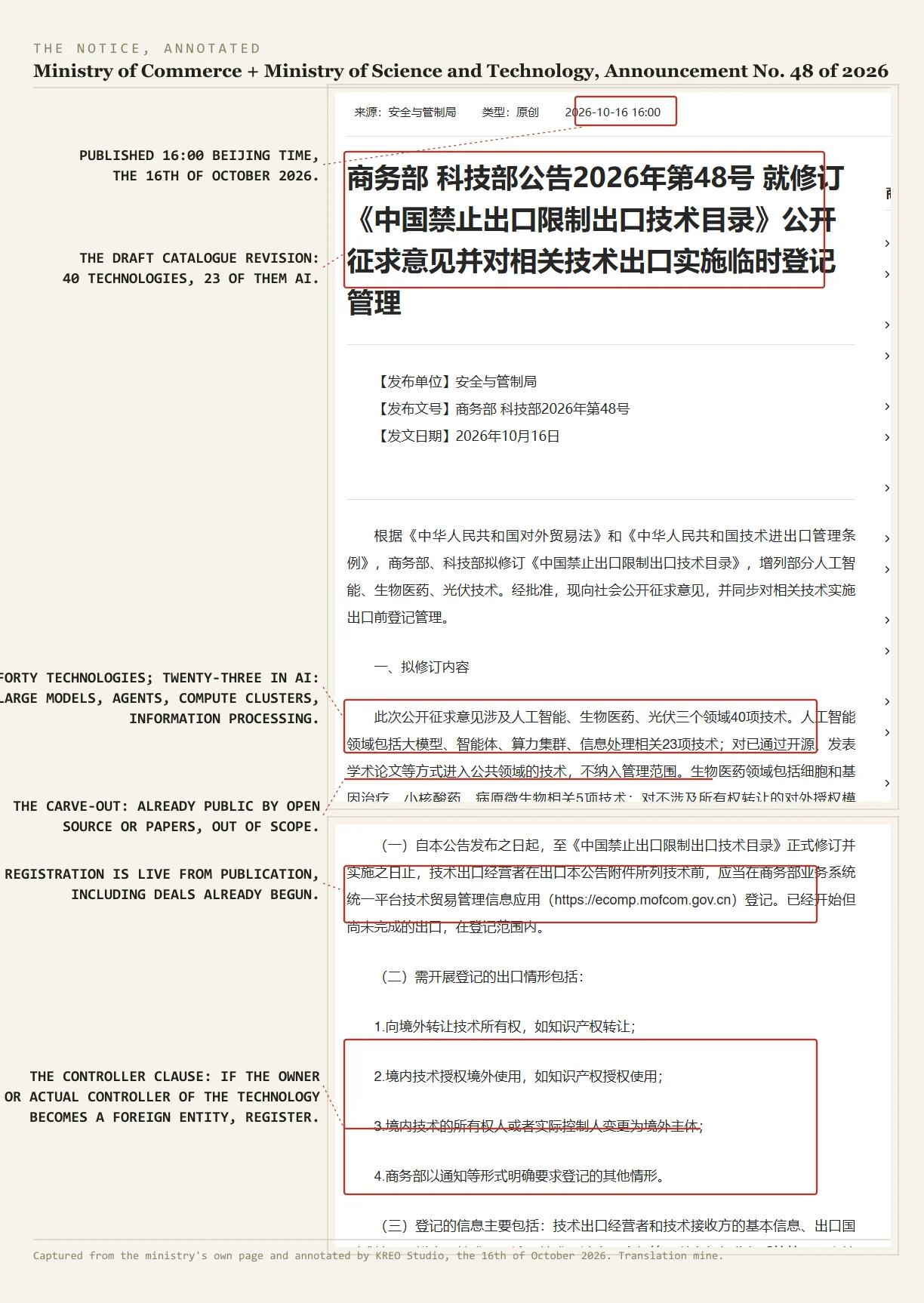
On the 16th of October 2026, at four in the afternoon Beijing time, two ministries put a notice online: a draft revision of the catalogue listing the technologies China will not let leave without permission, and registration rules that start now, months before the list is final. Forty technologiesConfirmedthe announcement, read in the original, the 16th of October 2026 are proposed, twenty-three of them AI. Fourteen would be banned outright; twenty-six restricted.
The direction is the story. For four years Washington has written lists like this; Beijing has answered that technology should flow. The answer was not only a speech: Chinese labs gave their models away. Moonshot’s Kimi K3 and Alibaba’s Qwen 3.8 became two of the most downloaded models on earth. This week the export office turned the pen inward.

What the draft says
The notice is deliberately unglamorous. I read it in the original Chinese, and the spokesperson’s answers beside it. Already-public technology is untouched: anything out through open source or papers is out of scope, and the ministry says so twice. The bans aim at AI-driven malware generation and mutation; the licences at vulnerability discovery and chip design. The stated aim, in the ministry’s words: keep AI “under human control”.
One line carries a number. Models at two trillion parameters or aboveReportedAP and Bloomberg readings of the draft’s annex; the annex is a binary file that was not opened here, or with world-leading capabilities, may be restricted. I ran that line across this year’s flagships: Kimi K3 at 2.8 trillion, Qwen 3.8 at 2.4 trillion, both caught; most of the category sits below and keeps moving. The draft is a sorting desk, and the crown goes in the tray marked home.
You can call it. You cannot take it home.
The decisive passage is in the answers. Send the weights abroad to run on foreign ground and you are in scope, with a fast licence if the cloud is your own. Serve API calls, apps, SaaS or on-device from the same restricted model and you are not in scope at all. Open-source releases, overseas compute you run, offshore tape-outs: report and go. Most AI technology, the ministry notes, remains freely exportable. The door exports influence: the calls cross, the cargo stays.
Interactive · the counter
Six things at the border. Pick them up.
Verdicts from the ministry’s answers, the 16th of October 2026.
The clause with no ceremony
Buried in the registration rules is the sentence that will outlive the line: if the owner or actual controller of the technology becomes a foreign entity, register. In December 2025 Meta agreed to buy Manus, an agent startup with Chinese roots, for more than $2bn; in April 2026 Beijing ordered the deal unwound. By August it was independent again; this week, a reported half-billion-dollar restart. The company may change owners; it may not change sides.
Why the door closes from the inside
Why does a door close from the inside? Because the open-weights play was policy, and it worked too well: a Washington commission concluded this year that China’s open-source strategy reinforces its industrial dominance. The fences went up all round. America asked Anthropic to bar foreign nationals from its two most powerful models; the same week, Washington and Beijing reported progress on AI-safety talks. Two governments, one instrument. The ministry says the revision is routine, and does not target any specific country, region or entity.
What it means if you build on AI
Carry one rule out, whether you ship to China or not: check the custody of your stack. A weight file you have downloaded cannot be recalled; what is public stays public. A call can be priced, throttled or stopped by a border you do not control. When an asset becomes a national treasure, access becomes a rental. The consultation runs to the 15th of November 2026; what would change my mind is a final catalogue that drops the line. Until then, the crown stays home; the hatch stays open.
If you are weighing what you own in your AI stack, email brandon@kreostudio.co.uk.
Readout: what is confirmed, and what is not
- Confirmed, opened on the day: the announcement (forty technologies; twenty-three AI, covering large models, agents, computing clusters and information processing; fourteen proposed prohibitions, twenty-six restrictions; the open-source carve-out; consultation from the 16th of October to the 15th of November 2026; registration live from publication, including deals already begun but not completed).
- Confirmed, from the spokesperson’s answers I read in the original: the prohibited examples (AI-driven malware generation and mutation; cell and gene therapy platform technologies) and restricted examples (AI-assisted vulnerability discovery; polysilicon engineering above 30,000 tonnes a year); the API, app, web and on-device carve-out; overseas localised deployment in scope, with automatic licensing on an overseas self-run cloud; report-and-go conveniences for open source, overseas self-built compute, offshore tape-out and joint research; the controller-change registration trigger; the statement that the revision is not aimed at any particular country, region or entity.
- Reported, not confirmed here: the two-trillion-parameter threshold and the world-leading-capabilities clause (AP and Bloomberg readings of the annex; I could not open the annex); Kimi K3 at 2.8 trillion (Moonshot’s blog via Reuters; the blog itself was not opened here); Qwen 3.8 at 2.4 trillion (SCMP reading of the launch); the Meta-Manus sequence (Reuters, the 27th of April 2026, headline and standfirst; CNBC, the 11th of August 2026; DIGITIMES, the 16th of October 2026, on the $500 million reset); the June Anthropic episode (AP).
- Calculated, mine: the placement of the two flagships against the draft’s line (2.8 and 2.4 against two trillion).
- Not confirmed: the annex’s exact indicators and how “world-leading capabilities” will be judged; how the registration will be administered in practice; whether the final catalogue keeps the two-trillion line after consultation.
- What would change the picture: a final catalogue that drops the parameter line, or a registration regime used to wave deals through rather than hold them. Both are plausible, and the piece will be corrected here if either happens.
Sources & references
- MOFCOM and MOST, Announcement No. 48 of 2026: the draft revision of the catalogue of technologies prohibited or restricted from export, published at 16:00 Beijing time on the 16th of October 2026. The primary document; read in the original and captured for the annotation.
- MOFCOM, the spokesperson’s answers on the revision, the 16th of October 2026. Every quoted distinction in this piece is from here, translated from the Chinese.
- Xinhua, the two ministries open consultation on the catalogue revision, the 16th of October 2026.
- AP, China moves to curb tech exports, including AI, citing national security risks, the 16th of October 2026, read in full. The source of the “necessary” and human-control quotations, and of the Kimi K3 and Qwen 3.8-Max naming.
- Reuters, Beijing seeks tighter grip on AI exports amid US rivalry, the 16th of October 2026. Headline and standfirst only; the article body was behind a CAPTCHA.
- Bloomberg, China plans AI tech export curbs to manage security risks, the 16th of October 2026. Paywalled; headline only. One of the two readings of the annex’s two-trillion line.
- Financial Times, China unveils draft export controls on AI technologies and chips, the 16th of October 2026. Paywalled; not read beyond the headline.
- Moonshot, Kimi K3: open frontier intelligence, July 2026, and Reuters, China’s Moonshot unveils world’s largest open AI model, the 17th of July 2026. The 2.8-trillion-parameter figure.
- SCMP, Alibaba’s Qwen3.8-Max made widely accessible ahead of open-weights release, the 3rd of August 2026. The 2.4-trillion-parameter figure.
- Reuters, China orders Meta to unwind $2 billion purchase of AI startup Manus, the 27th of April 2026; CNBC, Manus to return as an independent company, the 11th of August 2026; DIGITIMES, Manus returns to China’s AI agent race with a US$500 million reset, the 16th of October 2026.
- USCC, Two Loops: How China’s Open AI Strategy Reinforces Its Industrial Dominance, March 2026.
- AP, the June 2026 Anthropic restrictions and their lifting; AP, the US-China notification mechanism. The fences going up around the draft.
- MOFCOM, the technology trade registration portal named by the announcement, where the pre-export registration runs from publication day.
Reader signal
Was this useful?
Work with KREO Studio
AI engineering, data science and design architecture, from Plymouth to the wider UK.
Next Article
The Payroll
From the KREO Journal · kreostudio.co.uk/blog/closed-from-the-inside · published the 16th of October 2026. Corrections are dated, never silent.
