Your Insurer Is the New Banker
A CoreWeave founder says the AI build’s next money is insurance money: “unlimited, that’s all the money in the world”. Its own June accounts show what the patient money buys.
Key · companies amber

On the 14th of October 2026, a man who rents out chips went looking for a new banker, and said so out loud. Brannin McBee, a CoreWeave founder, told the Financial Times the company is courting insurance money. “It’s unlimited,” he said. “Like, that’s all the money in the world.”
The clearest sentence about AI finance’s second act. Banks funded the first build; the next stretch belongs to insurers, the institutions with the scale and the patience.
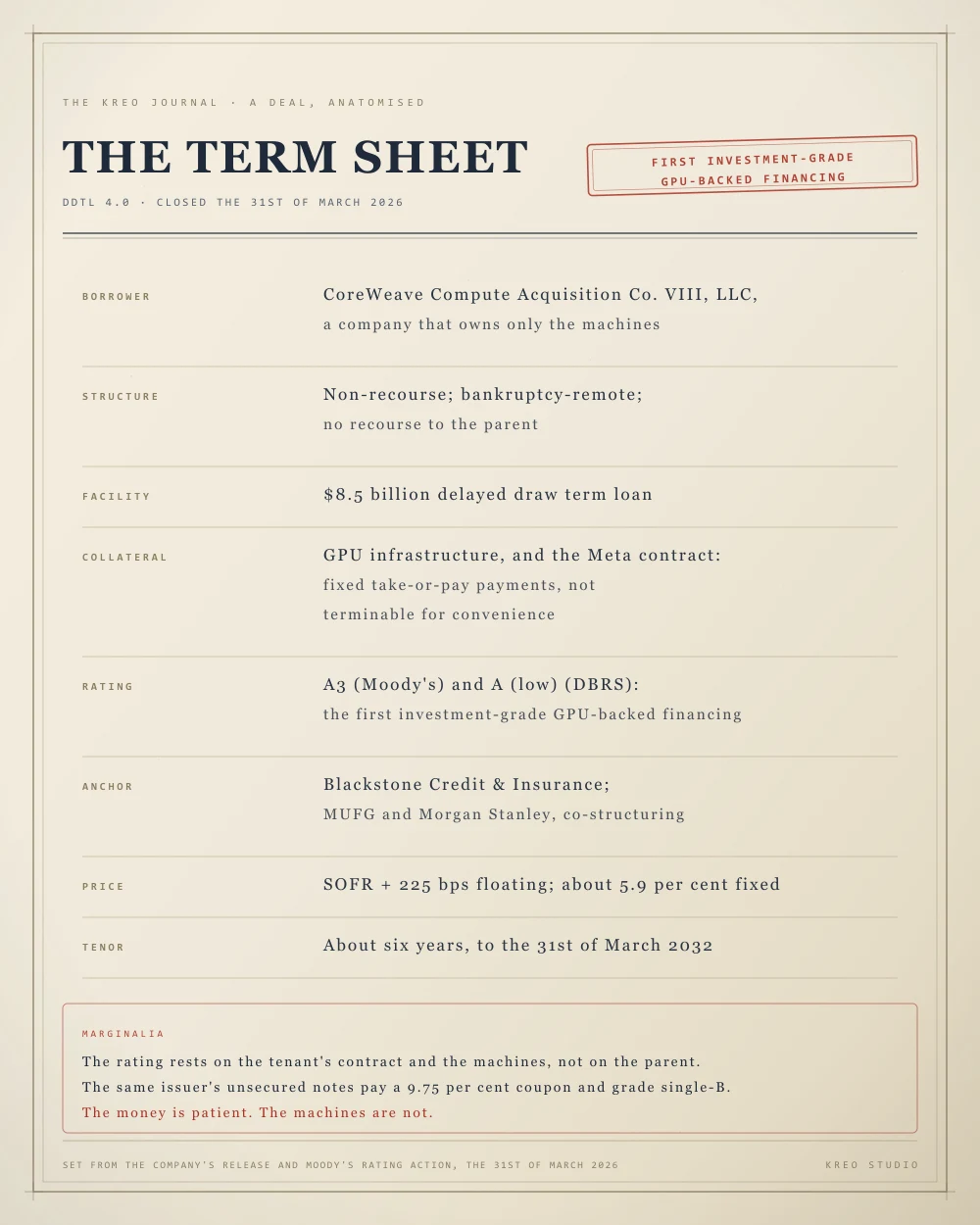
The template is signed. On the 31st of March 2026, CoreWeave closed an $8.5 billion facilityConfirmedthe company’s release, the 31st of March 2026: non-recourse, walled off inside a company that owns only the machines. The collateral: graphics processors and a Meta contract whose fixed take-or-pay payments the tenant cannot cancel.
On that basis the facility drew A3 from Moody’s and A (low) from DBRSConfirmedthe rating action and the company’s release, March 2026: the first investment-grade rating on GPU-backed debt. It was anchored by Blackstone Credit & Insurance, and the company says the book filled with banks, asset managers and insurance investors. The price, per its own deck: about 5.9 per cent fixedReportedthe facility deck, seven and a half points below its 2023 facility.
Why insurers? An annuity promises a payout in fifteen years; a lease runs a decade; a bank has depositors at the door while an insurer has actuarial tables and time. The pools are vast, more than $30 trillionReportedthe Financial Times, read via its named relays, and only a sliver is lent to this build. It is a matched book: long promises out, long contracts in.
So I read the accounts the money is buying. June, the latest: $2.575 billionConfirmedthe June results, filed with the SEC of revenue in the quarter, up 112 per cent; a contracted backlog of $104 billionConfirmedthe June results; it excludes $25 billion more added since; and $72 billion of liabilities against $77 billion of assets. The split: $35.1 billion of debt and $16.5 billion of leasesCalculatedmy sums of the June balance sheet lines, nearly $52 billion of obligations standing on $5 billion of equityConfirmedthe June balance sheet, filed with the SEC. Interest took 42 cents of every operating dollarCalculated$640 million of interest against $1,510 million of adjusted EBITDA before tax and before the wear.
The two ends of that stack say it: the secured paper is rated A3, resting on the tenant’s promise and the machines, not the company. The unsecured notes, with only the company’s word behind them, carry a 9.75 per centConfirmedthe company’s pricing release, April 2026 coupon and a single-BConfirmedStandard & Poor’s marks, June 2026 grade, with recovery marks that say ten to thirty cents in a break-up. Same company, same year: gilt-edged where the machines can be seized, junk where they cannot. This market is not pricing AI. It is pricing collateral.
What keeps the structure awake: the collateral depreciates. Depreciation ran $1.39 billionConfirmedthe June cash-flow statement, filed with the SEC in the quarter, more than half of revenue, because that is what machines do. Machines age on a schedule that owes nothing to a fifteen-year annuity. If usage holds and tenants pay, this is boring and sound. If a depreciation cycle bites while the contracts are young, the patient money finds out how fast its collateral ages.
Interactive · a seat at the deal
Four seats. Pick one.
In: premiums against a promise.
Holds: a payout decades from now.
Breaks: if the insurer fails when claims arrive.
In: money owed in fifteen years.
Holds: secured loans and long leases.
Breaks: if defaults arrive with the claims.
In: the anchor cheque on a rated facility.
Holds: first claim on chips and contract.
Breaks: if the chips sell for less than the loan.
In: $5 billion of equity under $72 billion of liabilities, per June’s filing.
Holds: the upside, if the backlog converts.
Breaks: first, always: $640 million of quarterly interest, per June’s filing.
The money is patient. The machines are not.
Here is the register’s next entry: the AI build is not running out of money. It is running into older money, promises stretching into the 2040s. Ask one question of any AI balance sheet you meet: who gets the machines if it breaks, and what are they worth by then? The answers are in the ratings, and they are public.
If you want your own exposure read line by line: email brandon@kreostudio.co.uk.
Readout: what is confirmed, and what is not
- Confirmed, opened the primaries: the June results, filed with the SEC (revenue $2,575 million; interest expense $640 million; adjusted EBITDA $1,510 million; depreciation and amortisation $1,393 million; total liabilities $72,046 million; total assets $77,070 million; equity $5,024 million). The DDTL 4.0 release and Moody’s rating action: $8.5 billion, non-recourse, a bankruptcy-remote vehicle, GPU collateral plus a take-or-pay Meta contract, A3 and A (low), anchored by Blackstone Credit & Insurance. The 9.750 per cent notes pricing release; the single-B grade with a recovery marking of ten to thirty cents; Fitch’s BB−.
- Calculated, mine, from those statements: debt of $35.1 billion (recourse $31.4 billion plus non-recourse $3.66 billion); leases of $16.5 billion; $51.6 billion combined; interest at 42 per cent of adjusted EBITDA; depreciation at 54 per cent of revenue.
- Reported, via named relays (the FT primary is paywalled and was not read directly): the “unlimited” quotes and the insurer strategy; the $30 trillion pool; the Meta contract’s reported value of at least $19 billion; the pricing comparison from the company’s own deck.
- Not confirmed: no insurer was interviewed; the insurer share of the financing stack is not quantified in any public number, and this piece does not claim one. The strategy is a stated intention, not a closed deal.
- What would change the picture: a second, larger insurance-anchored facility; published evidence on GPU resale values after three to five years; a depreciation cycle that bites before the contracts mature. Dated the 14th of October 2026; re-read each quarter.
Sources & references
- Financial Times, CoreWeave targets “unlimited” insurance money to fund AI build-out, the 14th of October 2026 (paywalled; read via the relays below, not directly).
- Seeking Alpha, CoreWeave seeks insurers’ capital to finance AI infrastructure build-out, the 14th of October 2026.
- Startup Fortune, CoreWeave wants insurers to help bankroll its AI data center boom, the 14th of October 2026.
- CoreWeave, second quarter 2026 results, the 11th of August 2026; the same release is filed with the SEC (EX-99.1).
- CoreWeave, the $8.5 billion facility closes, the 31st of March 2026, and the facility deck (pricing and the 2023 comparison).
- Moody’s, the A3 rating action, the 31st of March 2026.
- S&P Global Ratings, the single-B issue rating and recovery marking, the 11th of June 2026; Fitch, the BB− entity page.
- CoreWeave, the 9.750 per cent notes pricing, April 2026.
Reader signal
Was this useful?
Work with KREO Studio
AI engineering, data science and design architecture, from Plymouth to the wider UK.
Next Article
