The First Entry
The Fund’s check-up on the world’s money landed on the 13th of October 2026, and its first named risk is an AI-driven correction. Last week’s blank page now has its first entry.
Key · institutions amber, places red
Last week I built a register and left its fourth page blank: no total, no name for who holds the risk if the boom ends. In Bangkok, the International Monetary Fund opened its own and wrote the first entry. Not a warning. A measurement.
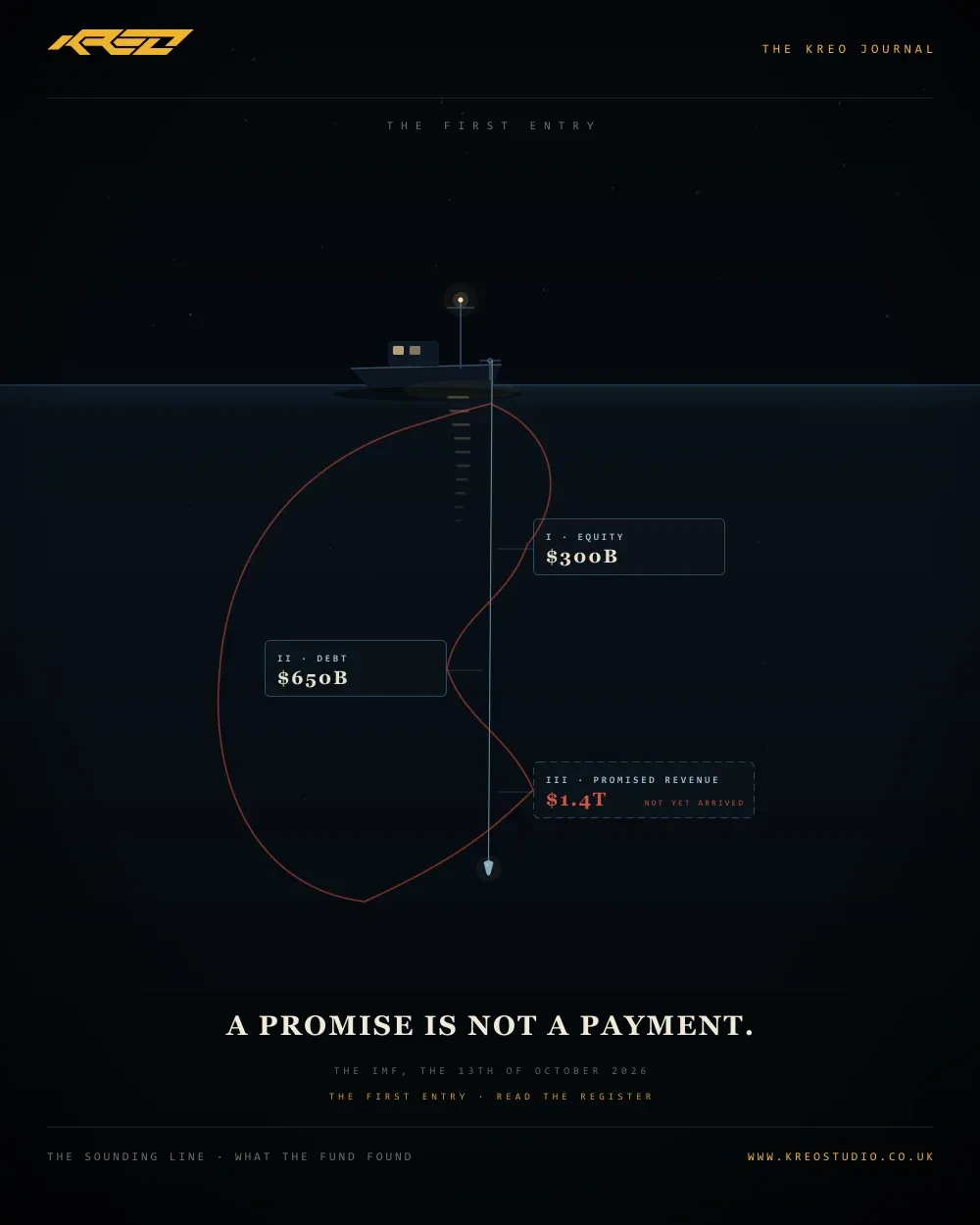
The Global Financial Stability Report is the Fund’s twice-yearly check-up on the world’s money. This October’s edition is titled “Beneath the Resilience”. Three rising risks: a correction in AI-linked assets, a jump in what governments pay to borrow, and a cyberattack on the plumbing that moves money. Markets look calm; the check-up is about what the calm floats on.
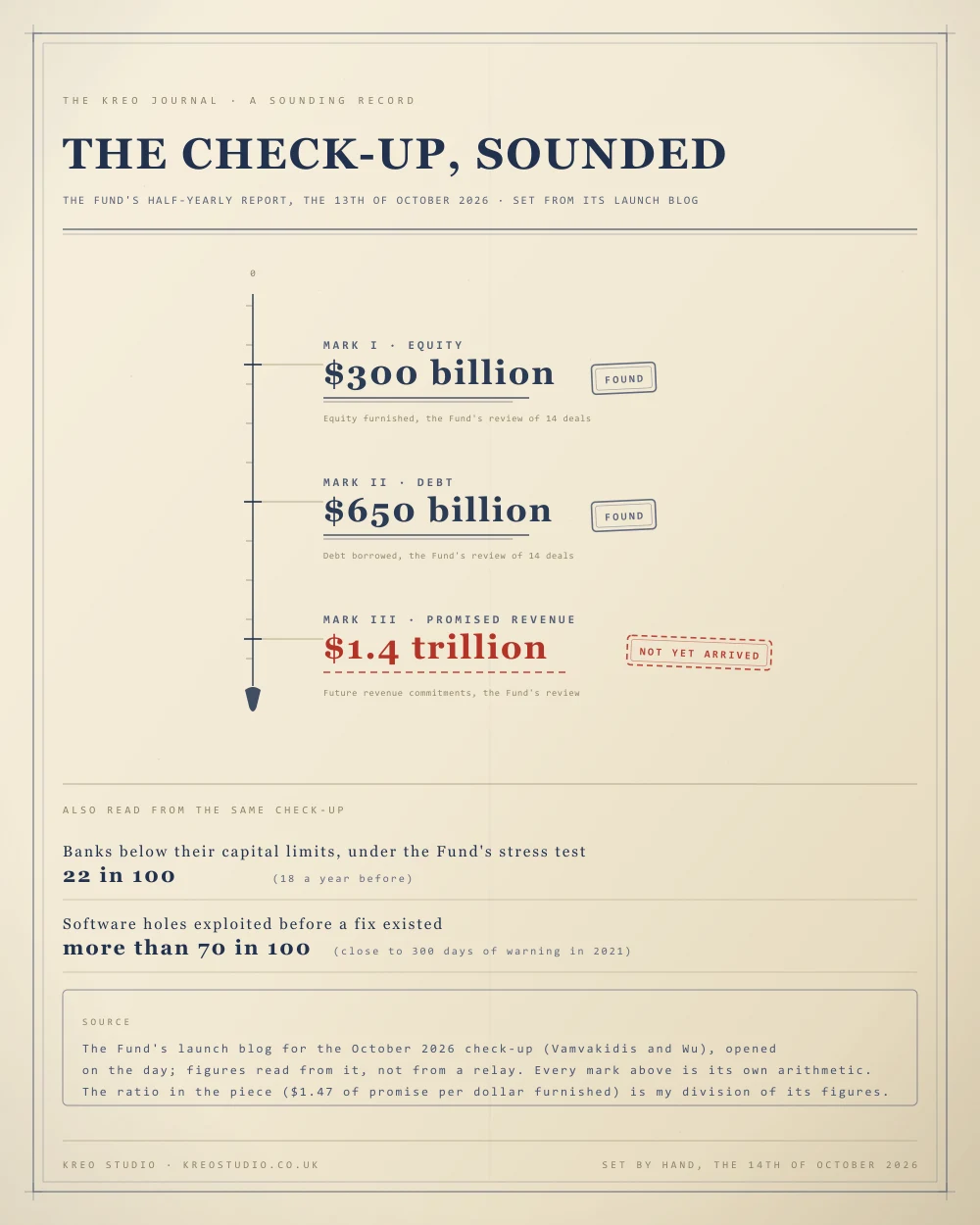
Most of the diagnosis is arithmetic. The Fund reviewed 14 deals since 2023: AI companies took money in exchange for a share of future revenue. In: about $300 billion of equityConfirmedthe Fund’s review of 14 deals, its launch blog, the 13th of October 2026 and $650 billion of debtConfirmedthe Fund’s review of 14 deals, its launch blog, the 13th of October 2026. Out: $1.4 trillionConfirmedfuture revenue commitments, the Fund’s launch blog, the 13th of October 2026 of future revenue promised back. Set side by side: $950 billion furnishedCalculatedmy sum of the Fund’s own figures: 300 billion plus 650 billion, $1.4 trillion promised. Every dollar in carries $1.47 of promiseCalculatedmy division of the Fund’s own figures: 1.4 trillion against 950 billion; 68 cents of money stands behind every dollar promised.
Circular financing: money goes out to the companies, comes back as a promise, and the debt is valued on the promise. If revenue arrives late or small, everything built on it is marked down. A mortgage taken against a salary you have not been offered yet.
Then the number that moves the risk out of tech. Under the Fund’s stress test, banks holding 22 per centConfirmedthe Fund’s stress test, its launch blog, the 13th of October 2026 of the world’s banking assets would end below their capital limits; a year ago, 18. The money is not only venture money: banks, funds, insurers and pensions lend against valuations resting on the promises above. Governments get the same treatment: debt is high, borrowing costs are up, and the next shock gets a smaller answer.
Interactive · the sounding line
Drop the line: the surface, and what the check-up found beneath it.
The surface reads: resilient.
The depth reads: broad deleveraging across asset classes.
The third risk: the same technology stands on both sides. More than 70 per centConfirmedof the holes exploited this year, the Fund’s launch blog, the 13th of October 2026 of the software holes exploited this year were used before a fix existed; in 2021, makers had close to 300 days. The Fund expects frontier models to speed up the attacks, and to be part of the defence. The plumbing is the test.
The asks are deliberately boring. Put government debt on a sustainable path. Limit borrowed money in AI and private credit, with capital rules against concentration. Rehearse the cyberattack: report incidents, test resilience. None of it bans anything. All of it prices the risk.
Strong markets should not breed complacency.
I set the findings as a sounding record: the check-up entered like a ship’s log, with what lies under each mark.
An entry is not a verdict. This scenario is a test, not a forecast; the Fund has flagged AI valuations before and the market shrugged. What is different is the bookkeeping: real banks, real lenders, a real number, written down in public. A promise is not a payment, and the next entry arrives with the revenue.
So carry one question out of the register: who pays if the revenue is late? Ask it before you back anything built on these promises. If the room cannot answer it, you are standing inside the first entry.
If you are measuring your own exposure, I would like to hear from you: email brandon@kreostudio.co.uk.
Readout: what is confirmed, and what is not
- Confirmed, opened on the day: the Fund’s launch blog for the October 2026 Global Financial Stability Report, published with the launch in Bangkok on the 13th of October 2026. From it: the 14 deals since 2023; about $300 billion of equity and $650 billion of debt in exchange for $1.4 trillion of future revenue commitments; banks with 22 per cent of global banking assets below their capital limits under stress, against 18 per cent a year earlier; more than 70 per cent of exploited vulnerabilities used before a fix existed, against close to 300 days of warning in 2021; and the three named risks.
- Reported: no claim above rests on a secondary relay; every figure was read at the Fund’s own launch material, opened on the day.
- Calculated, mine, from the Fund’s own figures: $950 billion furnished; $1.47 of promise per dollar furnished; 68 cents of money behind every promised dollar.
- Not confirmed: the full Chapter 1 was not read page by page from this machine; the launch blog is the Fund summarising its own chapter, and that is the reading used here. The scenario is a test, not a forecast.
- What would change the picture: revenue arriving on schedule, a soft landing, or a revision of the review’s numbers. If a year passes with neither a correction nor a revision, this entry will look like the earlier warnings, and I will say so.
Sources & references
- IMF, Global Financial Markets Face Rising Risks From AI, Bond Yields, and Cyberattacks, by Athanasios Vamvakidis and Jason Wu, the 13th of October 2026. The launch blog every figure above is read from.
- IMF, Global Financial Stability Report, October 2026, Chapter 1: “Beneath the Resilience: Rising Risks, Unresolved Vulnerabilities”, launched in Bangkok on the 13th of October 2026.
- IMF, Global Financial Stability Report press briefing, Bangkok, the 13th of October 2026. The line “strong markets should not breed complacency” is the Fund’s own framing of the launch.
- IMF, Financial Stability Risks Mount as Artificial Intelligence Fuels Cyberattacks, the 7th of May 2026, the road into this October’s cyber chapter.
Reader signal
Was this useful?
Work with KREO Studio
AI engineering, data science and design architecture, from Plymouth to the wider UK.
Next Article
