The Rising Sun Over Malta
Japan will fund two chip factories in a New York town called Malta, and Washington will take a slice of the company that will run them. Watch the hands, not the flag.
Key · companies amber, places red
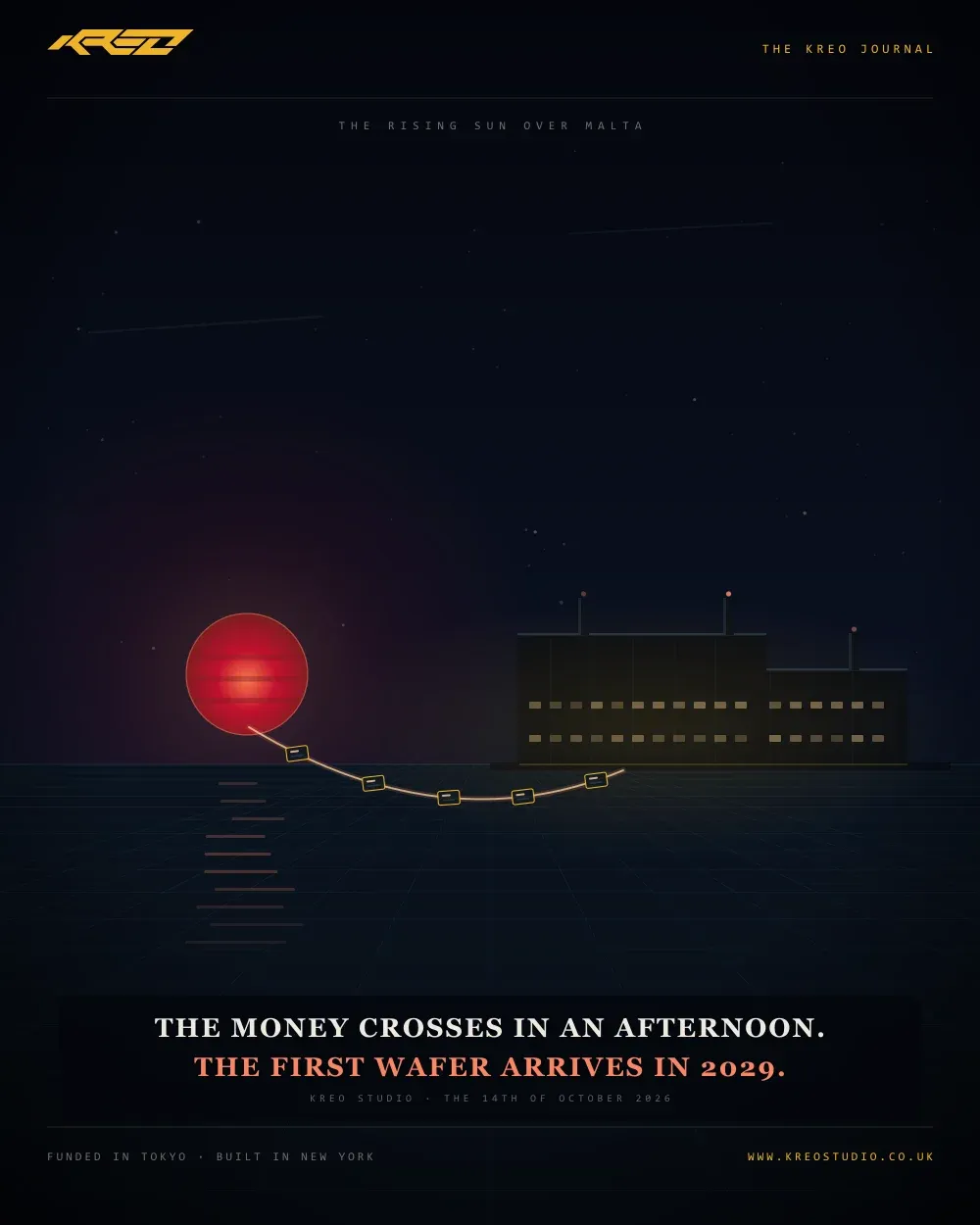
Malta is not a country in this story. It is a town in upstate New York, home to GlobalFoundries and its flagship fab, and on the 14th of October 2026 it became the most interesting address in the chip business. Two more fabs, sited there. Paid for by Japan: up to $21 billionConfirmedthe release, the 14th of October 2026.
Two governments signed it. One pays, one hosts, a third owns the till. The shape matters more than the size: this is chip sovereignty with money moving faster than concrete.
The first $10 billionConfirmedthe release, the 14th of October 2026 accelerates a new 300-millimetre plant expected online in 2029; another ten billion would fund a second fab. Each is rated for about 900,000 wafers a year; the site makes about 400,000 today, the company’s own figure. The release counts about 27,000 construction and ecosystem jobs, more than 1,000 in manufacturing. Ground breaks later this year, on land already permitted.
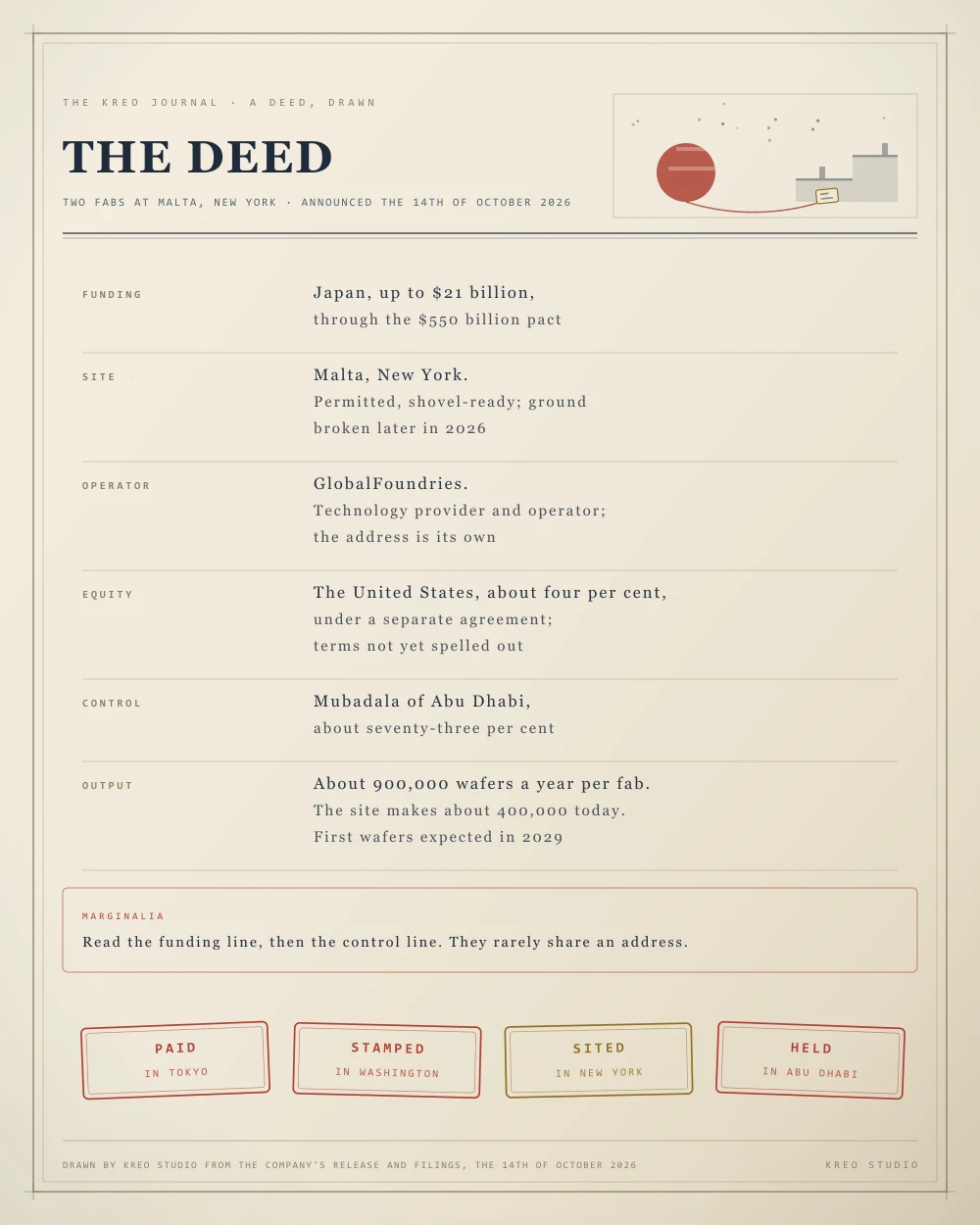
GlobalFoundries is not a frontier company, and that is the point. It is the biggest American made-to-order chipmaker, and it makes the essential kind: automotive, industrial, aerospace and communications silicon. An accredited supplier under the Trusted Foundry programme. Its majority owner, at about 73 per centReportedholder data, the middle of 2026, is Mubadala, the sovereign fund of Abu Dhabi.
Why is Japan paying? Because money buys something. The framework sealed in Tokyo on the 28th of October 2025 has Japan invest $550 billion into American industriesConfirmedthe White House fact sheet, the 28th of October 2025, its goods entering at a baseline 15 per cent tariff, and Tokyo chooses the projects. The first two rounds, $36 billion and $73 billion, went to energy and minerals (relayed by Bloomberg, Investing.com and The Japan Times). The trade minister, Ryosei Akazawa, has said AI and chips would carry “very significant weight” nextReportedBloomberg, relayed by Investing.com. This is that round, opening with silicon.
Washington’s move is the fresher one: a separate agreement gives the Department of Commerce approximately four per centConfirmedthe release, a separate agreement of GlobalFoundries, so that, in the release’s phrase, “the American public can share in GF’s growth”. The pattern is set: the state took a tenth of Intel, as Reuters reported in August 2025ConfirmedReuters and Intel’s release, the 22nd of August 2025, and GlobalFoundries has issued it shares before (9,907,399 at $37.85, recorded on the 3rd of September 2026). The terms of this tranche are not spelled out. The direction is.
Beside the money sits a quieter move: $955 millionConfirmedthe release, the 14th of October 2026 of the company’s existing CHIPS award, redirected toward silicon photonics, silicon germanium and advanced packaging. That is the AI part: light and data between processors and memory. Six days earlier, the same company signed a $2 billion deal with TSMC for silicon interposers, the packaging under the fastest AI chips, at the same Malta site.
Interactive · the cheque's route
One cheque, four hands. Pick a station.
Puts in: up to $21 billion for two factories.
Takes out: a pact kept, tariffs steady, its makers in the floor plan.
Crosses: the money, in an afternoon, by wire.
Does not cross: anything with foundations.
Puts in: a permitted site and a watched list.
Takes out: about four per cent of the company that runs the plant.
Puts in: ground, water, power, people.
Takes out: two fabs, first wafers expected in 2029.
The till: Abu Dhabi’s fund still holds about seventy-three per cent. The route ends in New York; the ownership does not.
Sovereign money crosses the Pacific in an afternoon. The factory takes until 2029.
Money moves like light; capacity moves like concrete. A cheque crosses the Pacific between breakfast and dinner; a factory takes years of permits, power, water and people. No state can import a factory, so states buy positions in the companies that build them. Japan holds a place at the table, Washington four per cent, Abu Dhabi the majority, and New York the ground under everything.
So keep one habit: when the next national chip deal lands, ask four questions before the first headline number. Who pays, who hosts, who operates, who owns the operator. The flags on the cheque are not the flags on the deed.
If you want a deal’s cap table read line by line: email brandon@kreostudio.co.uk.
Readout: what is confirmed, and what is not
- Confirmed, opened the primaries: the company’s release of the 14th of October 2026, filed the same morning as a Form 6-K (two fabs at Malta, New York; funding up to $21 billion from Japan; about $10 billion initial, about $10 billion more for a second fab, conditional; first fab expected online in 2029; about 900,000 wafers a year per fab; about 27,000 construction and ecosystem jobs and more than 1,000 manufacturing jobs; groundbreaking later in 2026; $955 million of the existing CHIPS award reallocated toward silicon photonics, silicon germanium and advanced packaging at Malta and Burlington; equity of approximately four per cent to the Department of Commerce under a separate agreement). Intel’s release of the 22nd of August 2025 for the precedent (433.3 million shares at $20.47, a 9.9 per cent stake). The September securities issuance agreement (6-K, filed the 8th of September 2026): 9,907,399 shares at $37.85, with strict voting restrictions.
- Calculated, mine: the two named rounds of the pact sum to $109 billion, both before this one.
- Reported, via named relays: the rounds of $36 billion and $73 billion (Investing.com, The Japan Times and Bloomberg relays); the trade minister’s “very significant weight” line (Bloomberg, relayed); Nikkei’s September report of talks over one plant at 2 to 3 trillion yen, and that this is the first chip project under the pact (read via The Next Web; the Nikkei primary is paywalled). The $550 billion framework and its baseline 15 per cent tariff come from the fact sheet, read directly. Mubadala’s holding of about 73 per cent is holder data from the middle of 2026.
- Not confirmed: the terms of the four per cent equity; the funding calendar; the title line of the two fabs beyond the release’s wording (Japan funds, GlobalFoundries operates). The second fab is conditional. Neither government, the company nor Mubadala was interviewed for this piece, and no claim is made about what Japan’s own companies receive in exchange.
- What would change the picture: the company’s investor webcast on the evening of the 14th; a groundbreaking date; the equity and fab terms when the next annual report lands. Quoted on the morning of the 14th, the shares traded up about six per cent. Dated the 14th of October 2026; re-read at the next milestone.
Sources & references
- GlobalFoundries, selected to operate two new semiconductor fabs in New York, the 14th of October 2026; filed with the SEC as a Form 6-K exhibit.
- GlobalFoundries, Form 6-K, the 14th of October 2026, and the securities issuance agreement, filed the 8th of September 2026.
- Intel, the historic agreement with the Trump administration, the 22nd of August 2025.
- The White House, fact sheet on the Japan investments, the 28th of October 2025, and the July 2025 framework.
- Nikkei Asia, talks to build a chip factory as part of the tariff deal, the 17th of September 2026 (paywalled); read via The Next Web’s summary.
- Investing.com, Japan and the U.S. advance the $550 billion investment pact (relaying Bloomberg), September 2026.
- The Japan Times, the second round of projects, the 20th of March 2026.
- Reuters, Japan to invest up to $21 billion in two US chip factories, the 14th of October 2026 (headline read via syndication), and the TSMC interposer agreement, the 8th of October 2026.
- GlobalFoundries, the Malta site page (about 400,000 wafers a year and 2,500 staff today).
Reader signal
Was this useful?
Work with KREO Studio
AI engineering, data science and design architecture, from Plymouth to the wider UK.
Next Article
